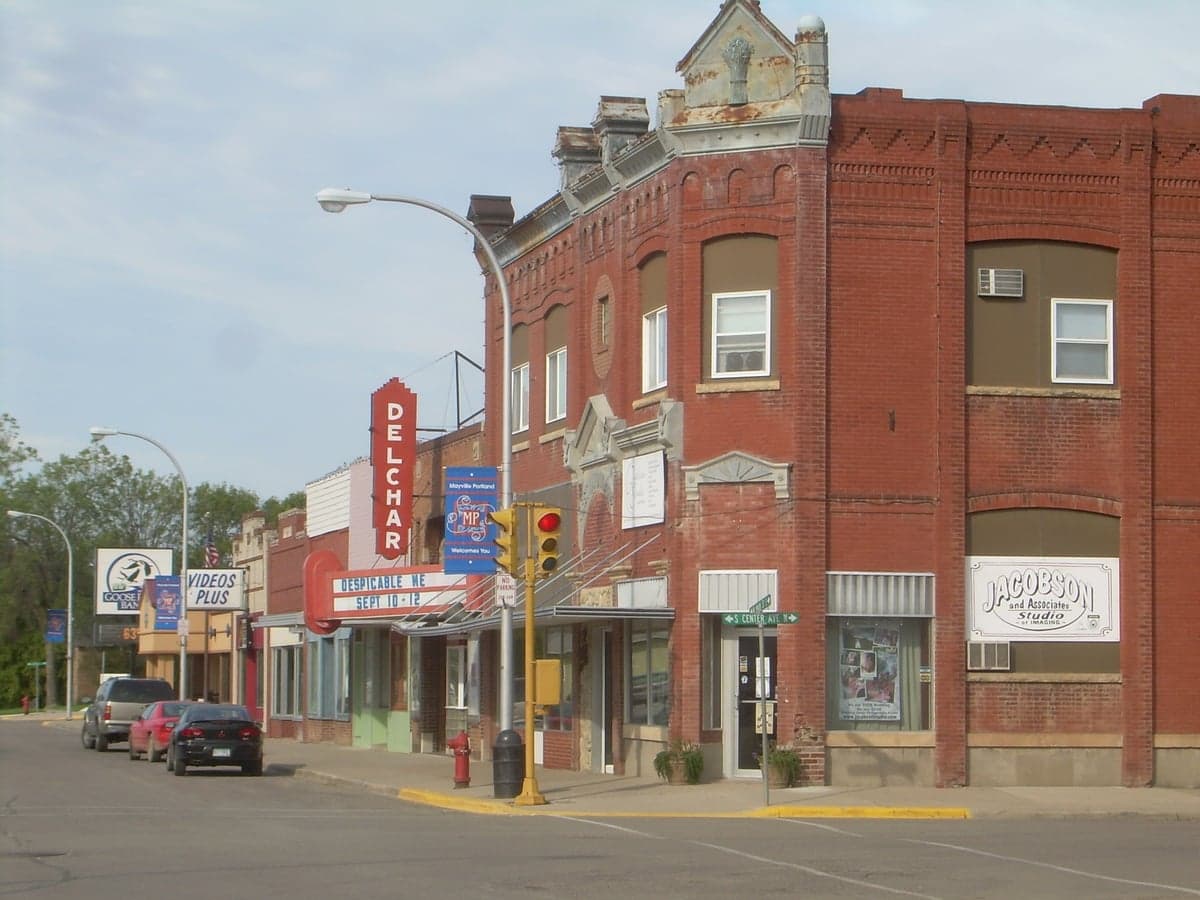
Photo: Wikipedia
Political ClimatePolitical Climate in Mayville, ND
District shown is the primary district for this city’s centroid. Cities may span multiple districts.
Inherited from parent state — no local data available.
Local Political AnalysisPolitical Analysis of Mayville, ND
Mayville, North Dakota, sits in a deeply conservative corner of the state, and that’s not changing anytime soon. The Cook Partisan Voting Index (PVI) of R+18 tells you the baseline: this area votes Republican by a margin nearly 20 points above the national average. In practice, that means you can count on one hand the number of Democratic-leaning precincts in the county, and even those are usually tied to the university crowd. The real story, though, is how the local culture has held steady while places like Fargo—just 45 minutes south—have started to drift leftward on social issues. Mayville remains a place where folks still believe in minding their own business and letting the government stay out of it.
How it compares
Drive 25 miles west to Hillsboro, and you’ll find a similar R+18 vibe—same farming roots, same suspicion of federal mandates. But head south to Fargo, and the contrast is stark. Cass County, where Fargo sits, has been trending purple for years, with a PVI around R+8 and a growing progressive activist scene that’s pushing for things like sanctuary city policies and higher local taxes. Mayville, by contrast, has none of that. The city council and county commission are reliably conservative, and there’s little appetite for the kind of zoning overreach or mask mandates that have plagued bigger towns. Even Grand Forks, 30 miles north, has seen more ideological friction, with debates over diversity initiatives and police funding. Mayville’s political climate is more like a quiet, steady hand—no drama, just common sense.
What this means for residents
For someone moving here, the biggest practical difference is the lack of government meddling in daily life. Property taxes are low, and there’s no city income tax—something you won’t find in Fargo or Grand Forks. The local school board hasn’t been taken over by progressive curriculum fights; they still focus on reading, writing, and arithmetic. Gun rights are respected without question, and you won’t see any “defund the police” nonsense. The downside? If you’re hoping for a vibrant nightlife or a diverse food scene, you’ll be disappointed. But if you value being left alone to raise your family, run your business, and keep what you earn, Mayville delivers. The biggest concern for the future is whether the state’s oil boom money and the influx of out-of-state transplants will eventually dilute this culture. So far, the locals have held the line, but it’s something to keep an eye on.
Culturally, Mayville is still a place where the Lutheran church and the local VFW are the social hubs, and where the Fourth of July parade is the biggest event of the year. There’s a quiet pride in self-reliance here—people don’t look to the government for handouts or permission. The university (Mayville State) does bring in some younger, more liberal faculty, but they tend to keep their politics to themselves. The real policy distinction is the county’s resistance to state-level mandates on things like renewable energy quotas or carbon taxes. Traill County has consistently voted against measures that would impose new regulations on farmers and small businesses. In the long term, the biggest threat isn’t a political shift from within—it’s the possibility that the state legislature in Bismarck, which has its own urban-rural divide, could start imposing one-size-fits-all rules that ignore what works here. For now, though, Mayville remains a solid, conservative haven where personal freedom still means something.

State Political ClimatePolitical Climate in North Dakota
State Political AnalysisPolitical Environment in the State
North Dakota has long been a reliably conservative state, but it’s not the rock-ribbed, monolithic red you might picture. The state leans Republican by about 20 points in presidential elections, with Donald Trump winning it by 33 points in 2024. But the real story is a slow, steady shift: the rural, agrarian populism that once made the state a hotbed for the Nonpartisan League has given way to a more traditional, low-tax, small-government conservatism, especially as the oil boom in the Bakken reshaped the western half of the state. Over the last 20 years, the GOP has tightened its grip on every level of government, but the old-school, live-and-let-live libertarian streak is still very much alive—and it’s the thing most newcomers notice first.
Urban vs. rural divide
The political map of North Dakota is a study in contrasts, but not the kind you see in, say, Texas or Colorado. The state’s two major metros—Fargo and Bismarck—are both conservative, but in different flavors. Fargo, in the Red River Valley, is the economic engine and the most moderate part of the state. Cass County, which includes Fargo, voted for Trump by 18 points in 2024, down from 24 in 2020. That’s a slight drift toward the center, driven by a growing population of younger professionals and out-of-state transplants working in tech, healthcare, and education. Bismarck, the capital, is more reliably red—Burleigh County went +32 for Trump—and its politics are shaped by state government workers and energy industry retirees. The real action is out west. Williston, Watford City, and Dickinson in the oil patch are now some of the most conservative places in the nation, with Trump winning McKenzie County by 80 points. These are boomtowns where the population doubled overnight, and the politics are all about energy independence, property rights, and keeping the federal government out of the way. The rural counties in the east and central parts of the state—places like Walsh County or McLean County—are still deeply red, but they’re shrinking. The divide isn’t urban vs. rural so much as it is growing vs. shrinking. The places adding people are getting more conservative; the places losing people are holding steady or, in a few cases like Grand Forks, showing a slight purple tint from the university population.
Policy environment
North Dakota’s policy environment is a dream for anyone who thinks government should stay out of your wallet and your life. There is no state income tax—that was phased out in a series of cuts starting in 2016, with the final elimination signed by Governor Doug Burgum in 2021. Property taxes are moderate, though local levies vary. The state has a right-to-work law, no statewide mask or vaccine mandates (and a 2023 law banning them outright for government employees), and a regulatory climate that’s friendly to energy extraction, agriculture, and manufacturing. On education, the state has a robust school choice movement: the 2023 session passed a tax credit scholarship program for private school tuition, and there’s a growing push for education savings accounts. Higher education is dominated by the University of North Dakota in Grand Forks and North Dakota State University in Fargo, both of which lean left culturally but are constrained by a conservative legislature. Healthcare is a mixed bag: the state expanded Medicaid under the Affordable Care Act in 2013, a decision that still rankles some conservatives, but it also has some of the lowest per-capita healthcare costs in the nation. Election laws are tight: voter ID is required, same-day registration is not allowed, and the state has a strict photo ID law that was upheld in 2020. There’s no mail-in voting unless you have an excuse, and absentee ballots require a notary or witness. The legislature meets only every two years, which means the pace of change is slow—and that’s by design.
Trajectory & freedom
If you’re asking whether North Dakota is becoming more or less free, the answer is clearly more—at least on the issues that matter most to conservatives. The state has been on a roll since about 2017. In 2021, the legislature passed a constitutional carry law, allowing anyone who can legally own a firearm to carry it concealed without a permit. In 2023, they passed a law banning any state or local enforcement of federal gun laws that don’t exist in state statute—a direct shot at potential federal overreach. On parental rights, the state passed a Parents’ Bill of Rights in 2021, requiring schools to notify parents of any changes to a child’s health or well-being, and in 2023 they banned transgender procedures for minors. Medical autonomy is strong: there’s no state-level vaccine mandate, and a 2023 law prohibits discrimination against the unvaccinated. Property rights are protected by a strong eminent domain statute that requires full compensation and a public hearing. The one area where freedom has taken a hit is on the tax front: while there’s no income tax, the state has a high sales tax (up to 8% in some cities) and a hefty gas tax. But overall, the trajectory is toward more personal liberty, not less. The biggest threat to that trajectory is the federal government—especially on energy and environmental regulations—and the state’s political class is united in pushing back.
Civil unrest & political movements
North Dakota is not a place where you see a lot of street protests or civil unrest. The big exception was the Standing Rock protests in 2016-2017, when thousands of activists from around the country descended on the state to oppose the Dakota Access Pipeline. That was a flashpoint that pitted the state’s energy industry and law enforcement against a coalition of Native American tribes, environmentalists, and left-wing activists. The state government, led by then-Governor Jack Dalrymple, took a hard line, calling in the National Guard and passing laws to criminalize protest activity near critical infrastructure. That episode still resonates—it solidified the state’s reputation as a place that will defend property rights and energy development against outside agitators. Since then, political movements have been quieter. There’s a small but active libertarian presence, especially in the western oil counties, and a growing “constitutional sheriff” movement that pushes back on federal overreach. On the left, the main organizing is around the state’s tribal nations—the Standing Rock Sioux, Turtle Mountain Band of Chippewa, and others—who advocate for voting access, environmental justice, and tribal sovereignty. Immigration politics are not a major flashpoint here; the state has a small foreign-born population (about 4%), and the debate is more about attracting workers than restricting them. There’s no sanctuary city movement to speak of. Election integrity is a live issue: the 2020 election saw no major fraud, but the legislature tightened laws anyway, and there’s a vocal group of activists pushing for hand-counting of ballots and paper trails.
Projection
Looking ahead 5 to 10 years, North Dakota is likely to stay deeply conservative, but the flavor will shift. The biggest demographic trend is the continued growth of the western oil patch and the slow decline of the eastern farm counties. That means the center of political gravity will move further west, toward the more libertarian, energy-driven conservatism of places like Williston and Dickinson. The Fargo metro will continue to grow and moderate slightly, but it’s not going to flip blue—it’s more likely to become a center for center-right professionals who care about low taxes and good schools. The biggest wild card is the state’s aging population: North Dakota has one of the oldest median ages in the country, and as the baby boomers retire, the state will need to attract younger families to keep the economy going. That could mean more pressure to expand Medicaid, fund public schools, or invest in infrastructure—all of which could create tension with the state’s small-government ethos. But for now, the trajectory is clear: more constitutional carry, more school choice, more resistance to federal mandates, and a political culture that values personal freedom above almost everything else. If you’re moving here, expect to find a place where your neighbors will leave you alone, the government stays out of your business, and the biggest political fights are about how to keep the federal government from meddling in energy and land use.
For a new resident—especially one with a conservative leaning—the bottom line is this: North Dakota is one of the few states where the political culture actually matches the rhetoric. You’ll pay no state income tax, you can carry a gun without a permit, your kids won’t be subjected to gender ideology in school, and your vote will count in a system that’s designed to be secure. The trade-offs are real: long winters, a sparse population, and a economy that’s heavily dependent on oil and agriculture. But if you value freedom from government overreach and want to live in a place where your personal choices are respected, North Dakota is about as good as it gets in 2026.
* Values derived from national, state, county, city and local statistics and may differ in a specific area. Last updated: 2026-04-19T05:18:50.000Z
Narrative content on this page is AI-generated and may contain mistakes. Verify any details that matter before acting on them.
ReloMaps may earn a commission from affiliate links at no extra cost to you.

