Photo: Wikipedia
Demographics of Mccook, NE
Affluence Level in Mccook, NE
A below-average socioeconomic profile. Incomes, home values, and educational attainment trail the U.S., with higher poverty and unemployment.
People of Mccook, NE
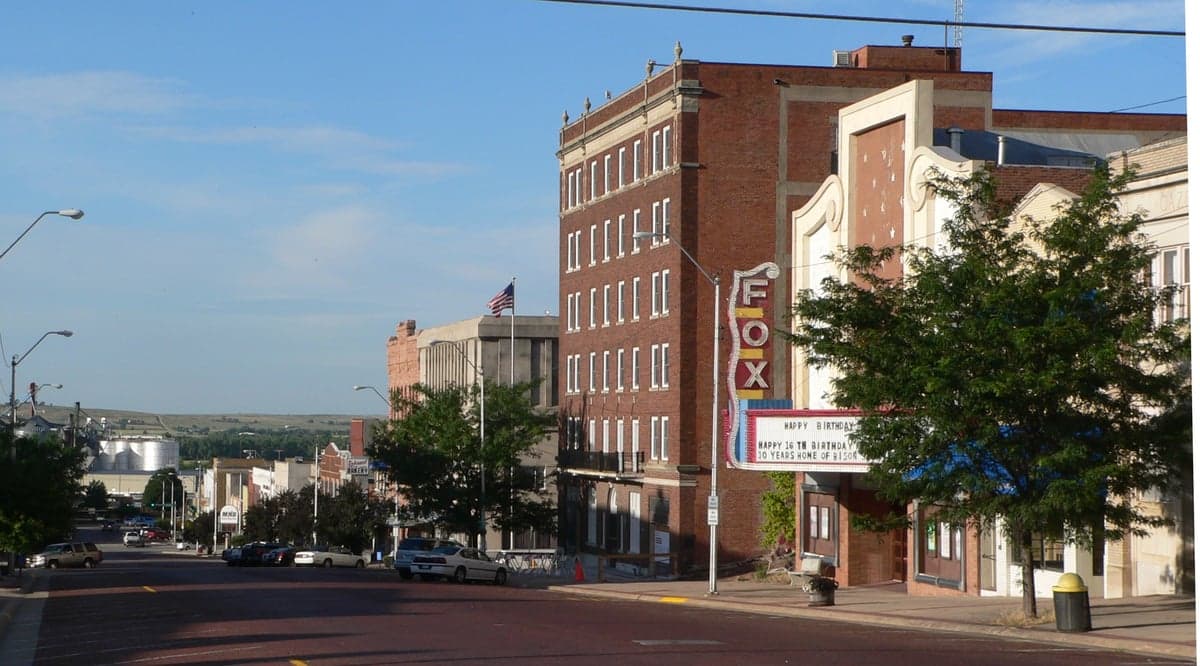
The people of McCook, Nebraska, today number 7,360, forming a predominantly white (89.3%) and politically conservative community rooted in railroad and agricultural history. With a foreign-born population of just 0.8% and a Hispanic share of 6.3%, the city remains one of the least ethnically diverse in southwestern Nebraska. Its identity is shaped by a strong sense of local independence, low crime, and a civic culture centered on the Red Willow County Fairgrounds and the historic Fox Theatre.
How the city was settled and grew
McCook was founded in 1882 as a railroad town on the Burlington and Missouri River Railroad, which drove the first major wave of settlement. The original population was overwhelmingly native-born white Americans from the Midwest and Great Plains, drawn by land grants and the promise of farming and rail work. The East Ward, near the original depot and rail yards, became the working-class heart of the city, housing railroad laborers and their families. By the early 1900s, a small number of German and Scandinavian immigrants arrived, settling in the West Side around West 1st Street, where modest frame homes and small farms dotted the landscape. The city grew steadily through the 1920s, reaching about 4,000 residents by 1930, with the South Side (south of Highway 6) developing as a middle-class district of merchants and professionals. No significant non-white population emerged during this period; the 1930 census recorded fewer than 20 Black residents and virtually no Hispanic or Asian presence.
Modern era (post-1965)
After the 1965 Hart-Cellar Act, McCook saw negligible immigration from Asia, Latin America, or the Indian subcontinent—the foreign-born share today is 0.8%, and East/Southeast Asian and Indian populations are each 0.0%. The Hispanic population, now 6.3%, began growing slowly in the 1990s, driven by agricultural labor in surrounding feedlots and meatpacking plants in nearby towns like Lexington and Grand Island. These families concentrated in the Northwest Neighborhood, a lower-density area near the McCook Municipal Airport and industrial parks, where rental housing and mobile home parks offered affordable entry points. The Black population remains tiny at 0.7%, with no distinct neighborhood concentration. Domestic in-migration has been minimal; the city lost population from a peak of 8,000 in the 1960s to 7,360 today, as younger residents moved to Lincoln or Denver for jobs. The College Heights area, near McCook Community College, has absorbed some new arrivals—mostly retirees and college staff—but remains overwhelmingly white and middle-aged.
The future
McCook’s population is aging and slowly declining, with a median age of 42.3 years and a birth rate below replacement. The Hispanic share is projected to rise modestly to 8–10% by 2040, driven by natural increase and continued agricultural labor demand, but the city is unlikely to see significant diversification from other groups. The East Ward and West Side are both aging in place, with few new housing starts. The South Side has seen some infill development of single-family homes, but overall the city is homogenizing rather than tribalizing into distinct ethnic enclaves. The college-educated share (26.8%) is below the national average, and the economy remains anchored in agriculture, healthcare (Community Hospital), and manufacturing (Becton Dickinson). For the next 10–20 years, McCook will likely remain a stable, low-growth, predominantly white community with a small but growing Hispanic minority.
For someone moving in now, McCook offers a quiet, affordable, and safe environment with strong community institutions, but little ethnic or cultural diversity. The city is becoming more homogeneous in age and background, not less, and newcomers should expect a population that is older, whiter, and more conservative than the national average. The trade-off is a low cost of living, low crime, and a pace of life that appeals to those seeking stability over dynamism.

* Values derived from national, state, county, city and local statistics and may differ in a specific area. Last updated: 2026-04-19T10:08:43.000Z
Narrative content on this page is AI-generated and may contain mistakes. Verify any details that matter before acting on them.
ReloMaps may earn a commission from affiliate links at no extra cost to you.

