Photo: Wikipedia
Demographics of Menomonee Falls, WI
Affluence Level in Menomonee Falls, WI
An upper-middle-class area. Household wealth, education levels, and homeownership run ahead of national benchmarks.
People of Menomonee Falls, WI
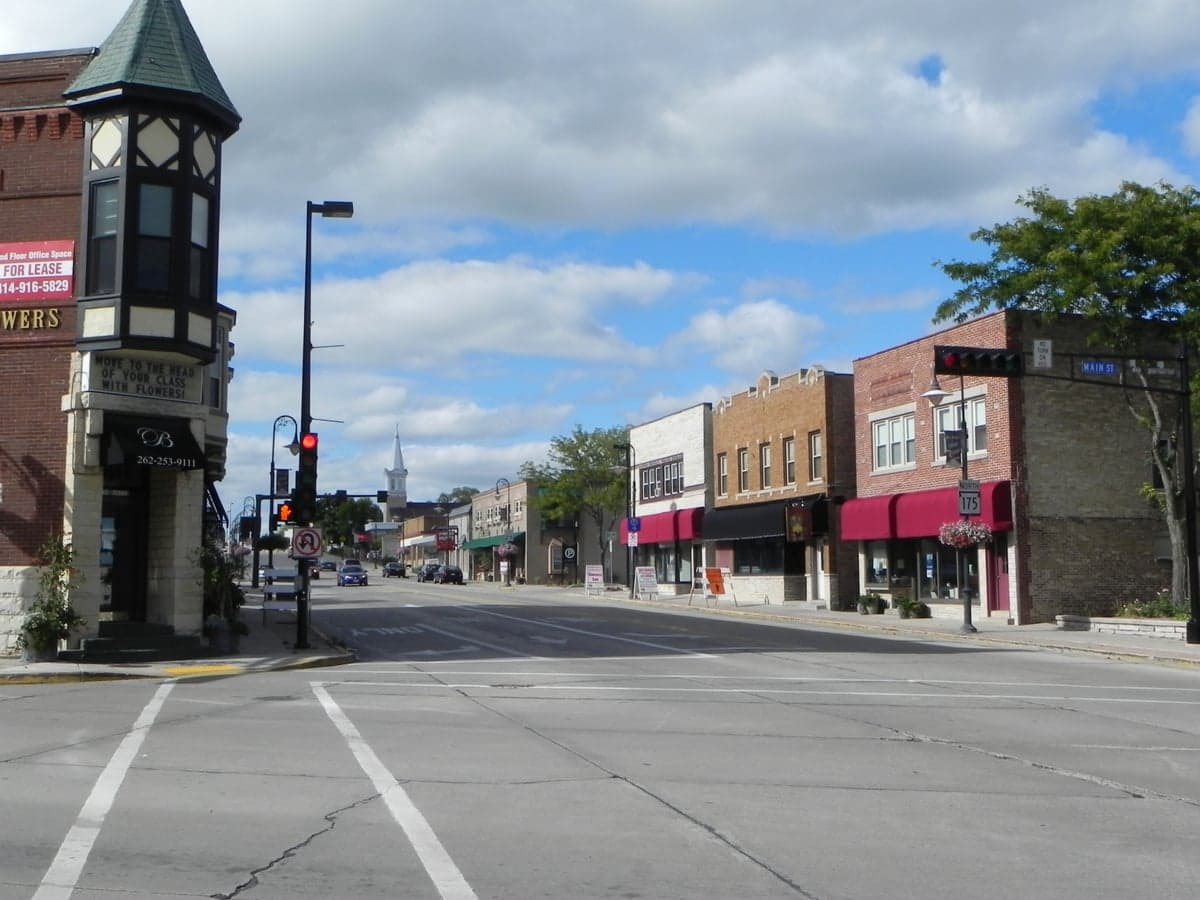
The people of Menomonee Falls, Wisconsin, today number 38,963, forming a predominantly white (82.4%) and highly educated (48.7% college-educated) community with a distinctly suburban character. The population is notably less diverse than the Milwaukee metropolitan area as a whole, with a foreign-born share of just 2.2%, though small but growing clusters of Indian (3.3%) and East/Southeast Asian (1.9%) residents have established roots in specific neighborhoods. The city’s identity is shaped by its blend of historic village charm and post-war suburban expansion, with a strong emphasis on local schools, low crime, and family-oriented living.
How the city was settled and grew
Menomonee Falls began as a mill town in the 1840s, drawing its first permanent settlers—primarily German and Irish immigrants—to work the water-powered mills along the Menomonee River. The original village core, now known as Old Falls Village, was built by these early European settlers, who constructed the limestone buildings and churches that still anchor the historic district. A second wave of German and Polish immigrants arrived in the late 19th century, drawn by the expanding railroad and new manufacturing jobs in the Mill Pond District, where factories producing paper, flour, and wool clustered along the river. By 1900, the population was overwhelmingly German-American, with smaller pockets of Irish and Polish families concentrated in the Village Center neighborhood around Appleton Avenue. The city remained a small, tight-knit mill community through the 1950s, with little ethnic or racial diversity beyond its European-origin base.
Modern era (post-1965)
The post-1965 period transformed Menomonee Falls from a sleepy village into a growing suburban city. The 1960s and 1970s saw a wave of domestic in-migration from Milwaukee and other Midwestern cities, as families sought larger lots and newer homes in developments like North Hills and Woodland Hills. These subdivisions, built on former farmland, attracted mostly white, middle-class families, reinforcing the city’s homogeneous character. The 1990s and 2000s brought the first significant non-European arrivals: a small but steady stream of Indian professionals, many employed in engineering and healthcare at companies like Kohl’s corporate headquarters and Froedtert Health, settled in the Silver Spring neighborhood near the interstate. East/Southeast Asian families, primarily of Chinese and Vietnamese background, followed a similar pattern, clustering in newer developments along Pilgrim Road. The Hispanic population, now 5.3%, grew more gradually, with families settling in the Falls Crossing area and working in construction, landscaping, and service industries. The Black population (3.6%) remains modest, concentrated in scattered single-family homes rather than a distinct enclave. Despite these shifts, the city’s overall racial composition has changed slowly: the white share declined from roughly 95% in 1990 to 82.4% today, a pace that reflects limited in-migration from diverse groups rather than rapid diversification.
The future
Demographic projections suggest Menomonee Falls will continue its gradual diversification over the next 10-20 years, but without dramatic change. The Indian and East/Southeast Asian populations are likely to grow modestly, driven by professional job opportunities and the reputation of the Menomonee Falls School District, but the foreign-born share will remain well below the national average. The Hispanic population may see steady growth through natural increase and continued migration, though it is unlikely to reach double digits by 2040. The city is not tribalizing into distinct ethnic enclaves; instead, new residents are dispersing across existing subdivisions, particularly in the North Hills and Silver Spring areas. The white population will likely continue its slow decline as older residents age and younger families move in from more diverse metro areas, but the city’s character will remain predominantly white and middle-to-upper-middle class. The biggest demographic pressure is not racial or ethnic change but age: the median age is rising, and the city will need to attract younger families to sustain its school enrollment and tax base.
For someone moving in now, Menomonee Falls is a stable, family-oriented suburb with a slow pace of demographic change. The population is becoming slightly more diverse, but the city remains overwhelmingly white, highly educated, and politically conservative. New residents will find a community that values its historic roots while accommodating modest growth, with neighborhoods that are more integrated than segregated. The bottom line: Menomonee Falls is not a melting pot or a tribalized enclave, but a steady, predictable suburb where the biggest story is continuity, not transformation.

* Values derived from national, state, county, city and local statistics and may differ in a specific area. Last updated: 2026-04-21T10:23:48.000Z
Narrative content on this page is AI-generated and may contain mistakes. Verify any details that matter before acting on them.
ReloMaps may earn a commission from affiliate links at no extra cost to you.

