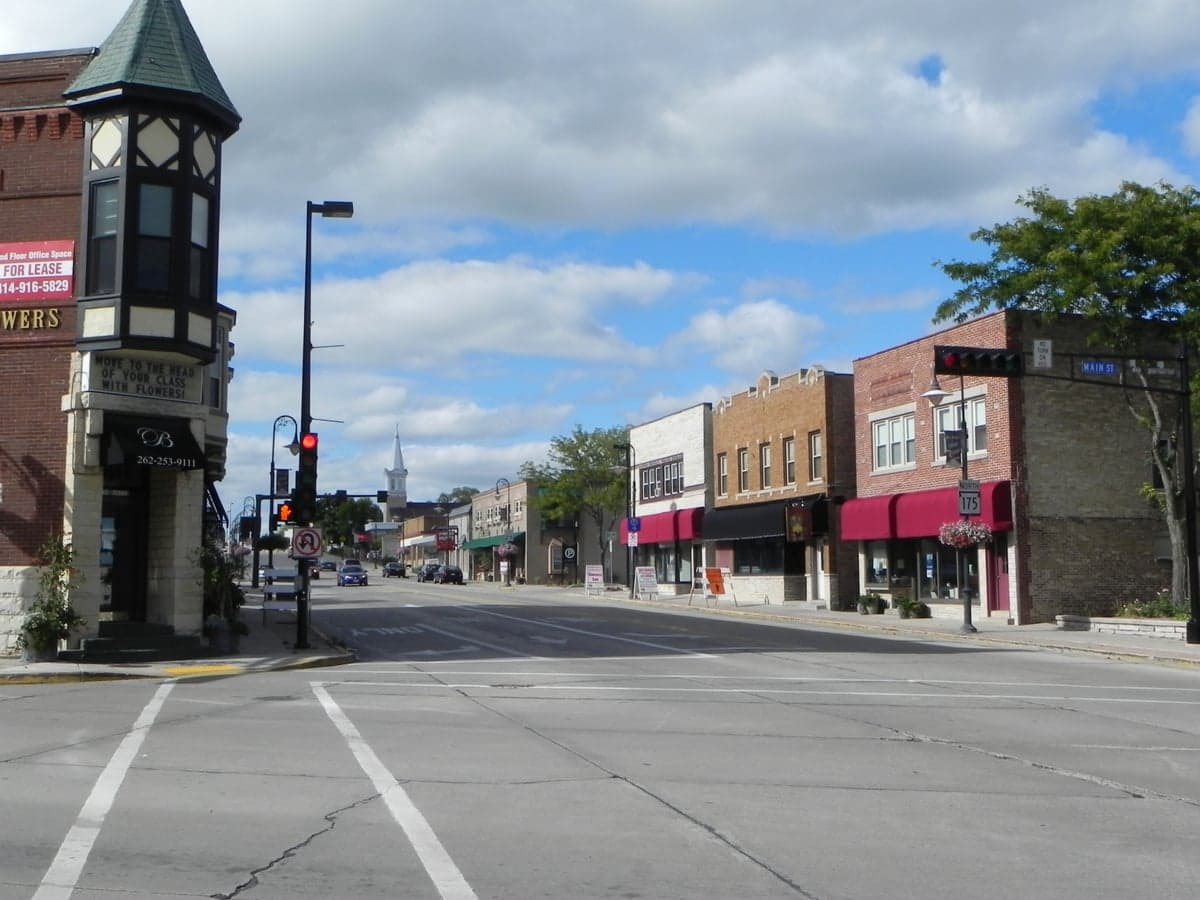
Photo: Wikipedia
Political ClimatePolitical Climate in Menomonee Falls, WI
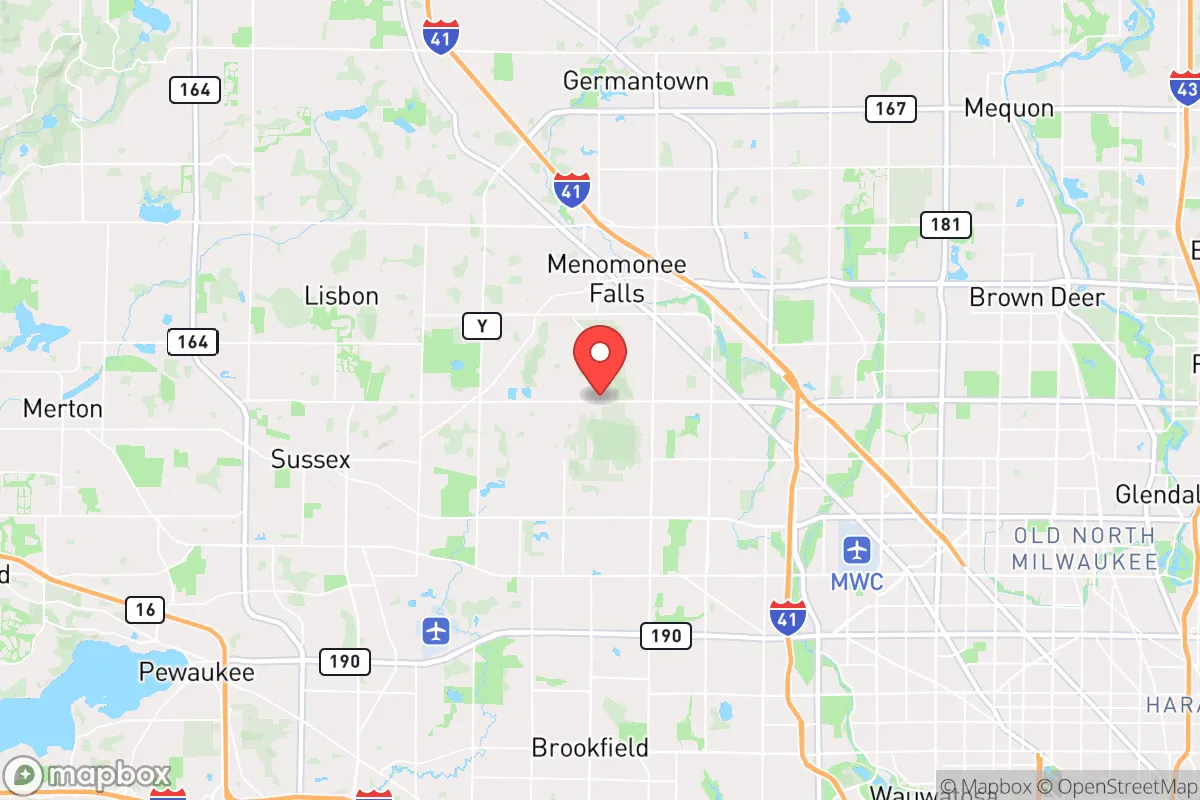
District shown is the primary district for this city’s centroid. Cities may span multiple districts.
Local Political AnalysisPolitical Analysis of Menomonee Falls, WI
Menomonee Falls has long been a reliably conservative community, and that hasn't changed much, even as the broader Milwaukee suburbs have seen some shifts. The area's Cook PVI of R+11 tells you the baseline, but the real story is how that plays out in local elections and daily life. You'll find that the village board and school board have historically leaned right, with a focus on fiscal restraint and keeping taxes low, which is a big part of why people move here from places like Wauwatosa or Shorewood.
How it compares
Drive ten minutes east and you're in Wauwatosa, which has been trending more progressive in recent years, with a city council that's pushed for things like higher density zoning and more public spending on social programs. Head south to Brookfield, and you get a similar conservative vibe to Menomonee Falls, but with a wealthier, more corporate feel. The real contrast is with Milwaukee itself, just 20 minutes away, where the political machine and union influence are a completely different world. In Menomonee Falls, the conversation is still about property rights, keeping the government out of your business, and making sure your tax dollars aren't wasted on things you didn't ask for. That's the kind of stability that keeps people here for generations.
What this means for residents
For a long-time resident like me, the biggest concern is the slow creep of progressive ideology into local government, even in a place like this. You see it in the school board meetings, where there's always a push to bring in more "equity" initiatives or curriculum changes that feel like they're coming from Madison or Washington, not from the parents who actually live here. The village board has held the line pretty well on things like mask mandates and business closures during the pandemic, but you have to stay vigilant. The moment you let your guard down, you get government overreach into your personal freedoms—whether it's telling you what you can do with your property or how to raise your kids. The good news is that the community is still full of people who remember what it was like before all this nonsense, and they show up to vote. The long-term trend is concerning, though, because the state as a whole is getting bluer, and that pressure is always there.
One thing that sets Menomonee Falls apart is its strong sense of local identity and a healthy skepticism of outside control. You don't see the same kind of "we know better" attitude from the village hall that you get in some of the more progressive suburbs. The police department is well-respected, the roads are kept up without a lot of drama, and the zoning laws still protect the single-family neighborhoods that make this a great place to raise a family. The cultural vibe is still very much "live and let live," as long as you're not trying to force your agenda on everyone else. That's the kind of common-sense conservatism that keeps this place from turning into another Tosa or Shorewood, and it's why I'm still here after all these years. Just keep an eye on those school board elections—that's where the real fights are happening now.

State Political ClimatePolitical Climate in Wisconsin
State Political AnalysisPolitical Environment in the State
Wisconsin has long been a classic swing state, but over the past 20 years it’s shifted from a purple battleground to a deeply polarized state where the rural-urban split has become a chasm. The state’s overall partisan lean is essentially a 50/50 coin flip in statewide elections, but the coalition that delivers that result has changed dramatically. In 2000, Al Gore won the state by a razor-thin 0.2%; in 2020, Joe Biden won by 0.6%. But beneath that surface stability, the map has been redrawn: the Milwaukee and Madison metros have become Democratic strongholds, while the rest of the state—especially the northern and western regions—has swung hard to the right. For a conservative considering relocation, the key takeaway is that Wisconsin is a state where your vote matters, but where you live within the state determines whether you feel like you’re in a red or blue bubble.
Urban vs. rural divide
The political geography of Wisconsin is brutally simple. Milwaukee County and Dane County (home to Madison) together deliver roughly 40% of the Democratic vote statewide. Milwaukee itself is a heavily Democratic, union-heavy city with a large minority population, while Madison is a classic college-town progressive hub dominated by the University of Wisconsin. These two counties vote 70-80% Democratic in most elections. Meanwhile, the rest of the state—the Fox Valley (Appleton, Green Bay), the Driftless Region (La Crosse, Eau Claire), and the vast rural north—has trended sharply Republican. The suburbs of Milwaukee, places like Waukesha and Ozaukee counties, are among the most reliably Republican suburban areas in the entire Midwest. The 2020 election saw Brown County (Green Bay) flip from Obama in 2012 to Trump in 2020, and Kenosha County became a national flashpoint. The divide isn’t just about cities versus farms; it’s about a cultural and economic split between the knowledge-economy, government-dependent urban cores and the manufacturing, agriculture, and outdoor-recreation rural areas.
Policy environment
Wisconsin’s policy environment is a mixed bag for conservatives. On the plus side, the state has a flat income tax (currently 4.4% after recent cuts), no estate tax, and a relatively business-friendly regulatory climate compared to neighboring Minnesota or Illinois. The state is a right-to-work state (passed in 2015), which significantly weakened public-sector unions. Property taxes are moderate, though they vary wildly by school district. On the education front, Wisconsin has a robust school choice program—one of the oldest and most expansive in the nation—allowing parents to use vouchers for private schools, including religious ones. This is a major draw for conservative parents. However, the state also has a Democratic governor (Tony Evers) who has vetoed numerous conservative bills, including a 2023 bill to ban abortion after 14 weeks. The legislature is firmly Republican-controlled, so the policy environment is a constant tug-of-war. Election laws are relatively secure: Wisconsin requires photo ID to vote, has no same-day registration (except for in-person absentee), and has a voter roll maintenance program. But the state’s liberal Supreme Court (currently 4-3 liberal majority after the 2023 election of Janet Protasiewicz) has been a wildcard, striking down Republican-drawn legislative maps and ruling on abortion access.
Trajectory & freedom
On the freedom front, Wisconsin is a state in flux. The good news: constitutional carry became law in 2011, and the state has a strong castle doctrine and stand your ground law. Gun rights are well-protected. Parental rights in education have been a battleground: the legislature passed a bill in 2023 requiring schools to notify parents if a child requests a name or pronoun change, but Governor Evers vetoed it. Medical freedom took a hit during COVID, with Evers issuing a statewide mask mandate and business closures, though the legislature successfully sued to limit his emergency powers. Property rights are generally strong, but the state’s DNR has a reputation for aggressive environmental regulation, particularly around wetlands and shoreline development. The biggest freedom concern for conservatives is the state Supreme Court’s shift. In 2024, the court threw out the Republican-drawn legislative maps, ordering new ones that are expected to give Democrats a chance at winning the Assembly for the first time in over a decade. This could lead to a wave of progressive legislation on abortion, voting, and taxes. The trajectory is concerning: Wisconsin is becoming less free for conservatives as the courts and the governor’s office are both in liberal hands.
Civil unrest & political movements
Wisconsin has been a flashpoint for political violence and unrest. The Kenosha riots of 2020, following the shooting of Jacob Blake, saw two nights of arson and looting, and the subsequent Kyle Rittenhouse trial became a national referendum on self-defense and the Second Amendment. The state has a long history of labor activism, particularly the 2011 protests at the state capitol against Act 10 (the union-restriction law), which drew over 100,000 people. On the right, the Wisconsin Republican Party is well-organized and has a strong grassroots network, particularly in Waukesha and the Fox Valley. Immigration politics are relatively quiet compared to border states, but there is a growing tension in rural areas over the influx of H-2A farm workers and the impact on wages. Election integrity remains a hot-button issue: the 2020 election saw a massive increase in absentee voting, and the state’s bipartisan election commission has been criticized by both sides. The Waukesha Christmas parade attack in 2021, where a man drove his SUV through a parade, killing six, added to the sense that the state’s political and social fabric is fraying. A new resident would notice that political signs and flags are ubiquitous, and conversations about politics are common in bars and coffee shops.
Projection
Over the next 5-10 years, Wisconsin is likely to become more competitive at the state level, but not necessarily more conservative. The in-migration pattern is a double-edged sword: people are moving from Illinois and Minnesota to the Kenosha-Racine corridor and the Madison suburbs, bringing their progressive voting habits with them. Meanwhile, rural areas are depopulating, which hurts Republican turnout. The new legislative maps will almost certainly produce a Democratic majority in the Assembly by 2026 or 2028, which means the state could see a wave of progressive legislation: a repeal of right-to-work, a state-level paid family leave mandate, and a codification of abortion rights. The state Supreme Court will remain liberal for at least a decade, meaning conservative laws passed by the legislature will be struck down. The wildcard is the 2026 gubernatorial election: if a Republican wins, they could veto the worst of the progressive agenda. But the demographic and judicial trends are not in conservatives’ favor. Someone moving in now should expect that the state’s policy environment will become more like Minnesota’s over the next decade—higher taxes, more regulation, and less individual freedom.
Bottom line for a new resident: If you’re a conservative, Wisconsin is still a good place to live, but you need to choose your location carefully. The Waukesha and Ozaukee suburbs of Milwaukee are safe havens, as are the Fox Valley cities like Appleton and Green Bay. Avoid Dane County and Milwaukee County if you want to be surrounded by like-minded people. The state’s school choice program is a major plus for parents, and the gun laws are solid. But be prepared for a political environment that is becoming more hostile to conservative values at the state level, and get involved in local politics to push back. Wisconsin is still worth the move—but it’s a state you’ll have to fight for.
* Values derived from national, state, county, city and local statistics and may differ in a specific area. Last updated: 2026-04-21T10:23:48.000Z
Narrative content on this page is AI-generated and may contain mistakes. Verify any details that matter before acting on them.
ReloMaps may earn a commission from affiliate links at no extra cost to you.

