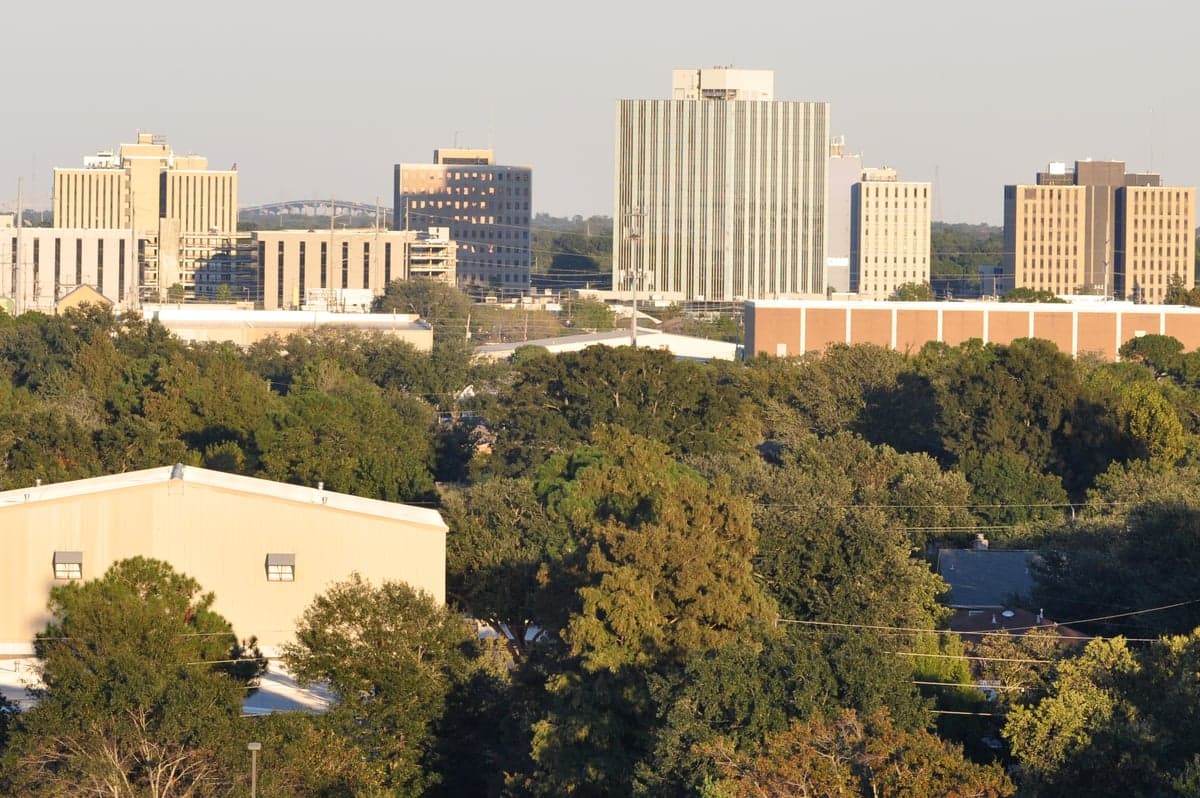
Photo: Wikipedia
Strategic Assessment of Metairie, LA
Meaningful friction. Expect exposure to either population pressure, blast zones, or natural disaster risk. Consider buying a retreat property.
What does the Strategic Assessment tell us?
Our Strategic Assessment grades tactical survivability of an area. Major population centers, military targets, fallout zones, natural disasters, and border exposure all drive risk — lower exposure means a more defensible position in a crisis.
This is heavily inspired by Joel Skousen's Strategic Relocation book. Highly recommended you checkout the book ($)What does this tell us?
Our Strategic Assessment grades tactical survivability of an area. Major population centers, military targets, fallout zones, natural disasters, and border exposure all drive risk — lower exposure means a more defensible position in a crisis.
This is heavily inspired by Joel Skousen's Strategic Relocation book. Highly recommended you checkout the book ($)Strategic Pillars

Key Distances
Regional Safe Places
Below is our recommended "safe zones" in Louisiana and the surrounding area based on our strategic heuristics. For most people, it's unrealistic to live in a “safe zone” full-time due to work, family or other personal reasons. They tend to be more rural. However, many of these areas are perfect for second homes and retreat properties that double as a vacation home or even a short-term rental.

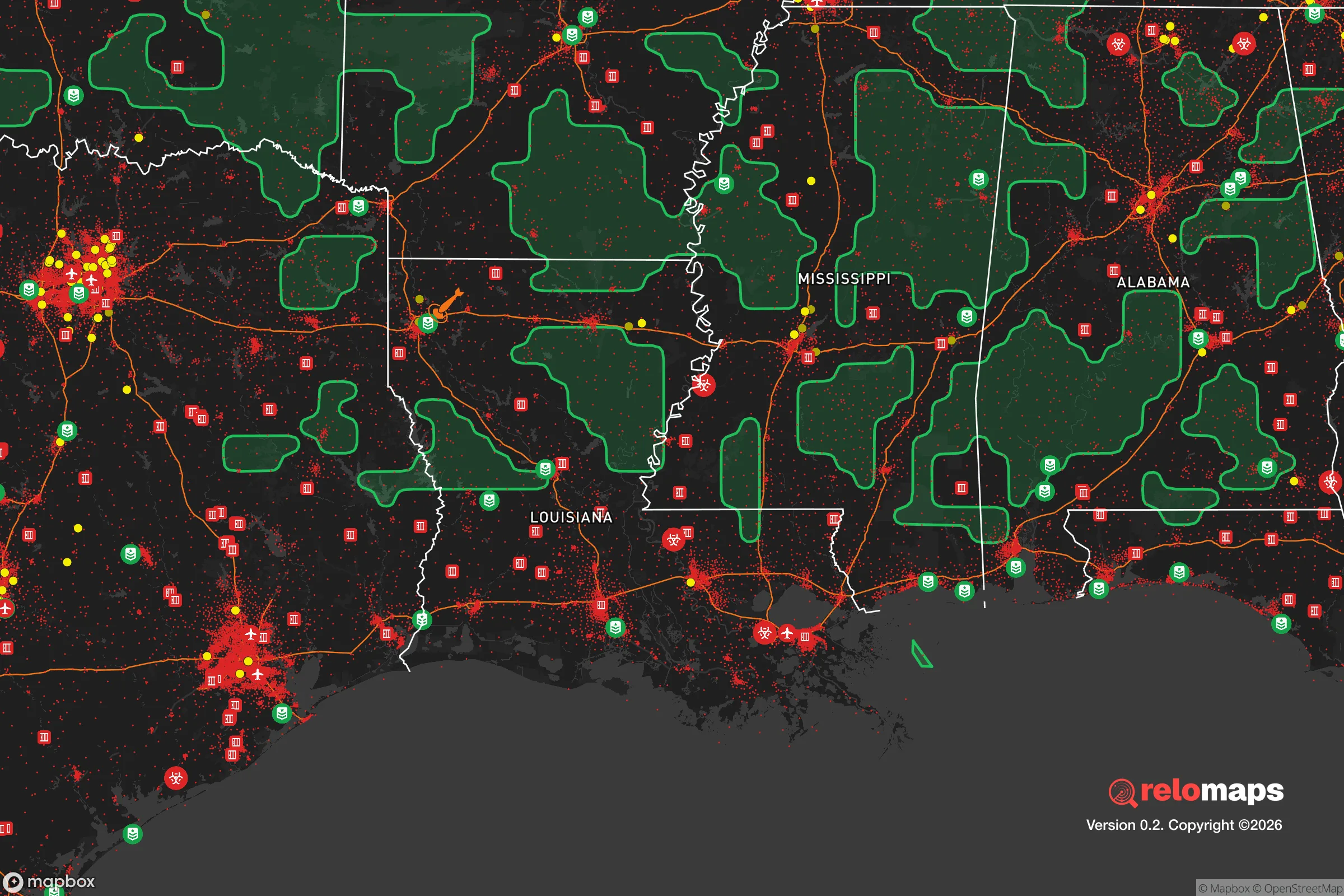


Important Note: For informational purposes only. This does not mean nothing bad ever happens in the green zones. Please use common sense. This is based on public data and modeled with AI. We tried to take a conservative approach but mistakes happen. We update this regularly as new information becomes available.
Solar Generator Recommendations
Backup power matters more here than in safer locations. We've picked three solar generators across budgets and capacity tiers — start with the budget unit if you only need a few essentials, or step up if you want to run a fridge and HVAC for days at a time.

Jackery Portable Power Station Explorer 300
Budget OptionPower on the Go: Weighing only 11 lbs, it's convenient to set up and store with book-sized foldable solar panels

BLUETTI Portable Power Station AC180
Designed for both indoor and outdoor scenarios, AC180 is highly capable as it has a robost capacity and continuous output power.

EF ECOFLOW DELTA Pro Ultra Power Station
Upgraded PickEcoFlow DELTA Pro Ultra is a whole-home energy system designed to grow with your family. Integrated with the Smart Home Panel 2, it scales to meet your evolving energy needs — keeping your home powered, intelligent, and secure through every stage of life.
We earn a commission, at no additional cost to you.
Strategic Assessment Analysis
Metairie, Louisiana, sits in a precarious strategic position that demands a hard-nosed assessment from anyone serious about preparedness. On paper, its location along the Mississippi River and proximity to New Orleans offer economic advantages, but for a survivalist mindset, those same factors create a web of vulnerabilities that are difficult to overlook. The area’s resilience is fundamentally tied to its ability to withstand natural disasters and civil disruption, yet its geography and infrastructure present a mixed bag that requires careful, unsentimental evaluation.
Geographic position and natural advantages for long-term survival
Metairie’s location in Jefferson Parish, just west of New Orleans, places it on a narrow strip of elevated land along the Mississippi River’s natural levee. This elevation, while modest, gives it a slight edge over surrounding parishes that sit at or below sea level. The area benefits from the Mississippi River as a reliable water source, though it requires significant treatment before consumption. The nearby swamps and bayous provide a natural buffer against urban sprawl, offering limited cover and resources for those willing to navigate them. However, the region’s flat, low-lying terrain makes it difficult to establish defensible positions. The lack of significant hills or natural barriers means that any large-scale movement of people or vehicles would be unimpeded, which is a double-edged sword for a relocator seeking security. The subtropical climate supports year-round growing seasons, which is a genuine advantage for food production, but the high humidity and frequent storms create constant maintenance challenges for any off-grid setup.
Risks, exposures, and proximity to fallout-relevant landmarks
The most glaring vulnerability for Metairie is its proximity to New Orleans, a major population center that would become a focal point for civil unrest, resource competition, and potential mass casualty events. In any scenario involving societal breakdown—whether from economic collapse, pandemic, or political turmoil—New Orleans’ dense population and strained infrastructure would create a cascading wave of refugees heading west along the I-10 corridor. Metairie sits directly in that path. The area is also ringed by critical infrastructure that could become targets: the Mississippi River bridges, the Huey P. Long Bridge, and the Louis Armstrong New Orleans International Airport are all within a few miles. A coordinated attack or major accident at any of these points could choke off escape routes and contaminate the surrounding area. Additionally, the region’s petrochemical corridor along the Mississippi River, with refineries and chemical plants stretching from Baton Rouge to the Gulf, presents a constant risk of industrial accidents or targeted strikes. A release of toxic chemicals or a fire at one of these facilities could render large swaths of Metairie uninhabitable for weeks. The area’s flood risk is well-documented, but less discussed is the threat of storm surge from hurricanes, which can push water miles inland and overwhelm the levee system that protects Metairie. A direct hit from a Category 3 or higher storm would likely flood the entire parish, making any prepper supplies stored at ground level worthless.
Practical resilience for a relocator: food, water, energy, and defensibility
For a single individual or family looking to establish a resilient base, Metairie presents significant hurdles. The water supply is entirely dependent on the Jefferson Parish water system, which draws from the Mississippi River. In a grid-down scenario, that system would fail within hours, and the river water itself is heavily polluted with agricultural runoff, industrial waste, and sediment. Boiling or filtering alone would not make it safe for long-term consumption without advanced treatment systems. Rainwater collection is viable given the region’s high annual rainfall—around 62 inches per year—but requires proper storage and filtration to avoid contamination from airborne pollutants and roof runoff. Food production is possible in the long growing season, but the soil in Metairie is primarily clay and silt, often contaminated with lead and other urban pollutants from decades of industrial activity. Raised beds with imported soil would be necessary for safe gardening. Energy independence is achievable with solar panels, but the frequent cloud cover and hurricane-force winds require robust mounting systems and battery storage. Natural gas is widely available in the area, but a pipeline disruption would cut off that supply. Defensibility is the weakest link. Metairie is a dense suburban grid with few choke points. The streets are wide and straight, making it easy for groups to move through the area. Most homes are built on slabs with no basements, and the proximity of neighbors means that any defensive perimeter would be easily breached. A rural property with acreage and natural barriers would be far more secure, but such options are scarce within a reasonable commute to the area’s economic opportunities.
In the final analysis, Metairie offers a strategic trade-off that only a specific type of relocator should consider. Its economic base and access to the Mississippi River provide a lifeline for those who need to maintain a professional career while building a preparedness lifestyle. But the risks—from natural disasters, industrial hazards, and the gravitational pull of New Orleans’ instability—are substantial and cannot be mitigated by stockpiling alone. For a survivalist with a conservative worldview who values self-reliance and community cohesion, Metairie’s suburban density and vulnerability to external shocks make it a less-than-ideal long-term base. The area is better suited as a temporary staging point for those who plan to eventually relocate to higher ground or more defensible terrain in the northern part of the state. If you are committed to staying, invest heavily in flood-proofing, water purification, and a reliable evacuation plan that accounts for the I-10 corridor’s inevitable congestion. Otherwise, look further north or west, where the ground is higher, the population thinner, and the fallout risks lower.

* Values derived from national, state, county, city and local statistics and may differ in a specific area. Last updated: 2026-04-23T04:58:29.000Z
Narrative content on this page is AI-generated and may contain mistakes. Verify any details that matter before acting on them.
ReloMaps may earn a commission from affiliate links at no extra cost to you.

