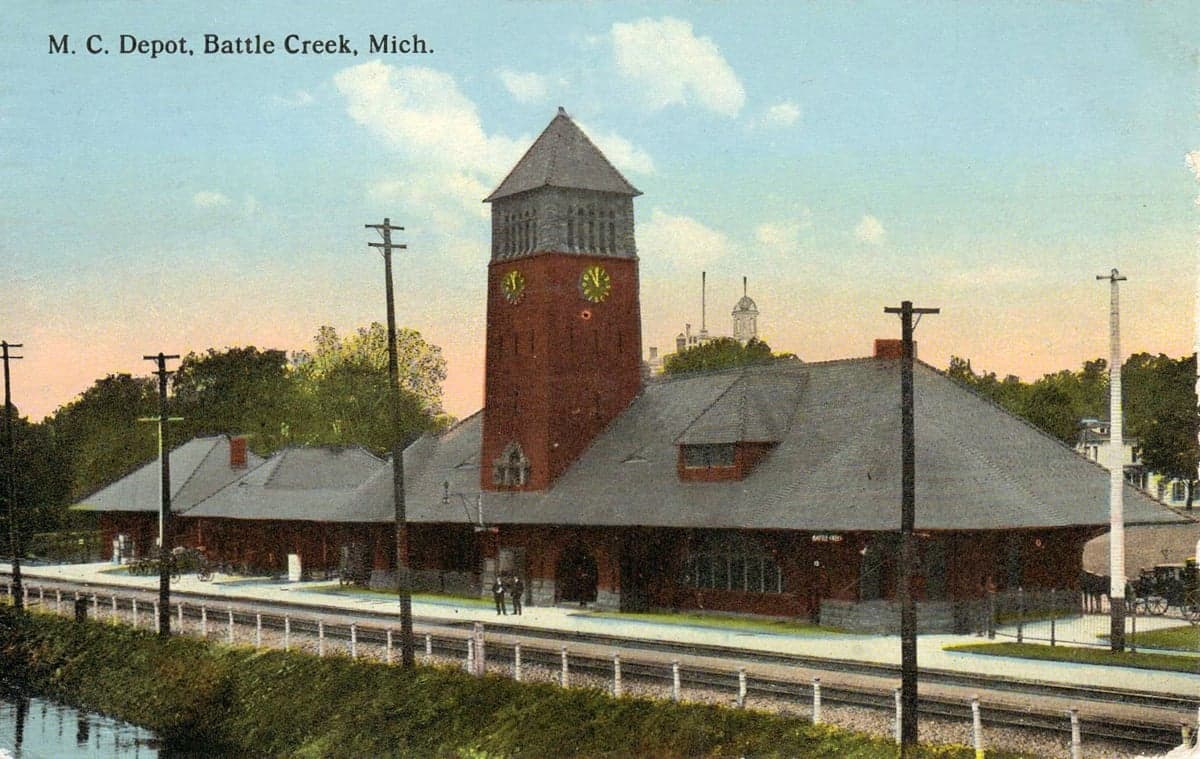
Photo: Wikipedia
Demographics of Calhoun County
Affluence Level in Calhoun County
A below-average socioeconomic profile. Incomes, home values, and educational attainment trail the U.S., with higher poverty and unemployment.
People of Calhoun County
Calhoun County, Michigan, is home to 133,846 residents, a population that is 75.7% white, 9.9% Black, 5.7% Hispanic, and 2.2% East/Southeast Asian, with a mere 2.2% foreign-born. Its character is defined by a quietly conservative, family-oriented Midwestern ethos, rooted in a manufacturing and agricultural heritage that still anchors places like Battle Creek and Marshall. Distinctive markers include a lower college attainment rate (22.2%) than the state average, a stable Black community concentrated in Battle Creek and Albion, and small but slowly diversifying enclaves. The county feels resolutely native-born—a place where generational roots run deep and civic identity prizes self-reliance and community continuity.
Settlement & growth (pre-1960)
Before European settlement, the region was home to the Potawatomi people, who used the Kalamazoo River and its tributaries for travel and trade. French fur traders established brief posts in the early 1700s, but significant American settlement began only after the Treaty of Chicago (1821) forced Native cessions. The first major wave arrived in the 1830s from New England and Upstate New York— Yankees who prized education and civic order. They founded Marshall (1830), which became the county seat, and Battle Creek (1831), originally a small milling village. These settlers were drawn by cheap land in the Michigan Territory and a climate suitable for wheat.
By the 1840s and 1850s, German and Irish immigrants joined the flow, often arriving via the Erie Canal and then steamer across Lake Michigan. Germans farmed the fertile loam around Pennfield, Springfield, and Homer, establishing tight-knit Lutheran and Catholic parishes. The Irish concentrated in railroad construction camps and later settled in Battle Creek and Marshall, working in the growing network of gristmills and sawmills. A smaller wave of Dutch immigrants arrived in the 1860s, forming farming communities near Burlington and Athens.
The late 19th century brought the era that defined the county: the rise of the cereal industry in Battle Creek. John Harvey Kellogg and C.W. Post built factories that pulled in Polish, Italian, and Eastern European workers. Between 1880 and 1920, these groups clustered in Battle Creek’s Post Addition and Lakeview neighborhoods, alongside native-born migrants from rural Michigan. The same period saw a small but notable Mexican community emerge near Albion, working in sugar beet fields and railroad maintenance.
The Great Migration (1910–1960) brought African Americans from the Deep South, especially Mississippi and Alabama, to fill factory jobs in Battle Creek’s paper mills and Kellogg’s plants, as well as in the Albion Malleable Iron Company. By 1960, Black residents made up about 8% of the county’s population, concentrated in Battle Creek’s Washington Heights and Emmett Township, and in northern Albion. This wave reshaped the county’s racial geography and laid the foundation for the Black community that remains significant today.
Modern era (post-1965)
The 1965 Hart-Cellar Act had only a modest effect on Calhoun County due to its modest job growth and limited draw for new immigrants. The foreign-born share never rose above 3%. The most notable post-1965 immigrant wave came from East and Southeast Asia: Vietnamese refugees arrived in the late 1970s and 1980s, many sponsored by churches and working in Battle Creek’s manufacturing plants. A small Filipino community also formed through healthcare recruitment for the Battle Creek VA Medical Center. Today, these East and Southeast Asian residents number about 2.2% of the county, with a visible presence in Battle Creek’s Lakeview and Urbandale areas.
Hispanic population growth has been slower and more agricultural. Migrant workers from Mexico and Central America, drawn to the county’s fruit and vegetable farms near Fulton and Tekonsha, have settled year-round since the 1990s, raising the Hispanic share to 5.7%. They are dispersed across the county but have notable clusters in Marshall and southern Battle Creek, where Spanish-language services have grown. The Indian subcontinent population remains tiny (0.4%), largely professionals in healthcare and higher education at Albion College or the Battle Creek VAMC.
Domestically, the post-1965 era has been one of manufacturing decline and suburban dispersal. Battle Creek lost population from its 1970 peak of about 38,000, while Pennfield Charter Township and Emmett Charter Township grew as bedroom communities. Albion has seen a significant demographic shift: the closing of the Albion Malleable Iron plant in the 1980s and the decline of Albion College’s enrollment have left the town poorer and more racially isolated—its population is now over 40% Black, with a high share of vacant housing. Meanwhile, Marshall has maintained a more stable, white-collar population due to its historic downtown and a role as a county government center.
The future
The population is aging and slowly shrinking—Calhoun County’s 2020 count of 133,846 was down 2.3% from 2010. The white share is projected to decline gradually (to around 72–73% by 2030) as older cohorts pass away and younger, more diverse groups age into the data. Hispanic and East/Southeast Asian shares are growing slowly but are being absorbed into the county’s existing social fabric rather than forming insular enclaves; intermarriage rates are rising, especially among second-generation Vietnamese and Mexican-origin residents. The Black population is geographically stabilizing in Battle Creek and Albion, but out-migration of younger Black families to larger metro areas like Grand Rapids and Lansing is slowly reducing its share.
The county is homogenizing in some respects—older white residents are aging in place in rural townships like Sheridan and Convis—while simultaneously seeing modest diversification in suburban Battle Creek neighborhoods. The biggest wildcard is domestic in-migration: Michigan’s broader population stagnation means few newcomers arrive, and those who do are often retirees seeking lower property taxes or remote workers attracted to the Kalamazoo River’s recreational appeal. The cultural identity of the county is likely to remain socially conservative, with a civic emphasis on schools, churches, and local sports, even as its ethnic composition edge slightly away from the 90%-white past.
For someone moving in now, Calhoun County offers a stable, slow-changing

* Values derived from national, state, county, city and local statistics and may differ in a specific area. Last updated: 2026-05-22T13:12:24.000Z
Narrative content on this page is AI-generated and may contain mistakes. Verify any details that matter before acting on them.
ReloMaps may earn a commission from affiliate links at no extra cost to you.

