Photo: Wikipedia
Demographics of Monroe County
Affluence Level in Monroe County
A middle-class area roughly in line with national averages across income, home values, education, and employment.
People of Monroe County
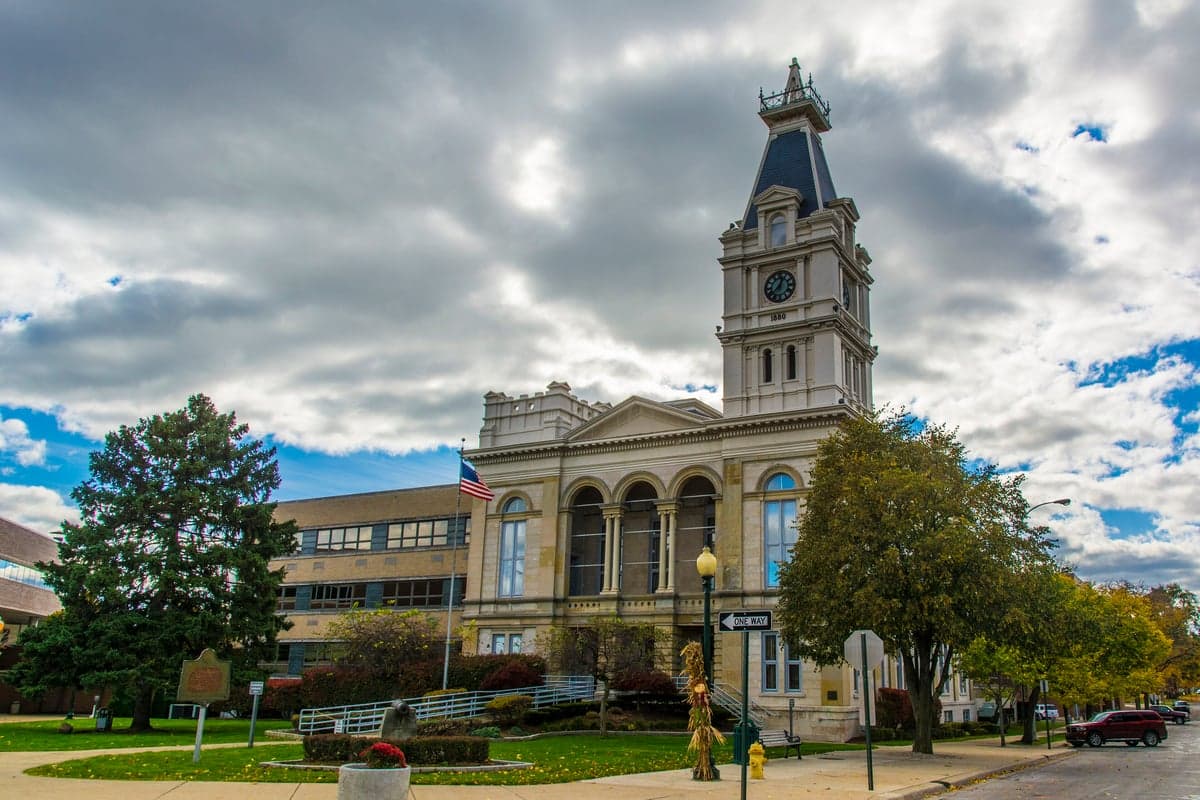
Monroe County, Michigan, is a predominantly white, working-to-middle-class community of 155,001 residents that blends its deep agricultural and industrial roots with a growing suburban commuter identity. The county’s population is notably less diverse than the national average, with 89.2% identifying as white, a foreign-born population of just 1.1%, and a college attainment rate of 23.4% that trails state and national figures. Its distinctive character is shaped by a strong Catholic and Protestant heritage from 19th-century European settlement, a lingering French-Canadian influence in the river towns, and a modern-day reliance on the automotive and manufacturing sectors of nearby Toledo and Detroit.
Settlement & growth (pre-1960)
Long before European arrival, the region was home to the Wyandot (Huron) and Potawatomi peoples, who used the River Raisin corridor for fishing and trade. French explorers and missionaries established a presence in the late 17th century, and the first permanent European settlement was French-Canadian, centered at what is now the city of Monroe along the River Raisin. After the War of 1812 and the bloody Battle of the River Raisin, American settlers began arriving in earnest, drawn by the fertile lake-plain soil and the promise of land grants.
The major settlement wave came from German immigrants starting in the 1830s and 1840s, who established farming communities in Dundee, Maybee, and Carleton. These families were primarily Lutheran and Catholic, and they built the region’s agricultural backbone—dairy, corn, and soybeans—that remains significant today. A smaller but influential wave of Irish immigrants arrived in the 1840s and 1850s, many settling in Monroe city and working on the railroad or in early manufacturing. French-Canadians continued to cross the border from Ontario into the 1870s, reinforcing the Catholic character of communities like Erie and La Salle.
By the early 20th century, the county’s economy diversified with the rise of the automotive industry. The Ford Motor Company’s plant in Monroe and later the Monroe Auto Equipment Company (now Tenneco) drew Polish and Italian immigrants and migrants from Appalachia between 1910 and 1930. These groups concentrated in Monroe city’s east side and in the village of Milan. The county’s population grew steadily through the post-war baby boom, reaching 101,000 by 1960, but remained overwhelmingly white and native-born, with the black population hovering below 2%.
Modern era (post-1965)
The 1965 Hart-Cellar Act had minimal impact on Monroe County. Unlike major metropolitan areas, the county did not attract significant post-1965 immigration from Asia, Latin America, or the Middle East. The foreign-born share today is just 1.1%, and the Asian (East and Southeast Asian) population is 0.3%, with Indian-subcontinent residents at 0.1%. The Hispanic population, at 4.2%, is the largest minority group and has grown modestly since the 1990s, primarily through domestic migration from Texas and the Southwest rather than direct immigration. These Hispanic residents are dispersed across the county, with small clusters in Monroe and Dundee, working in agriculture, food processing, and construction.
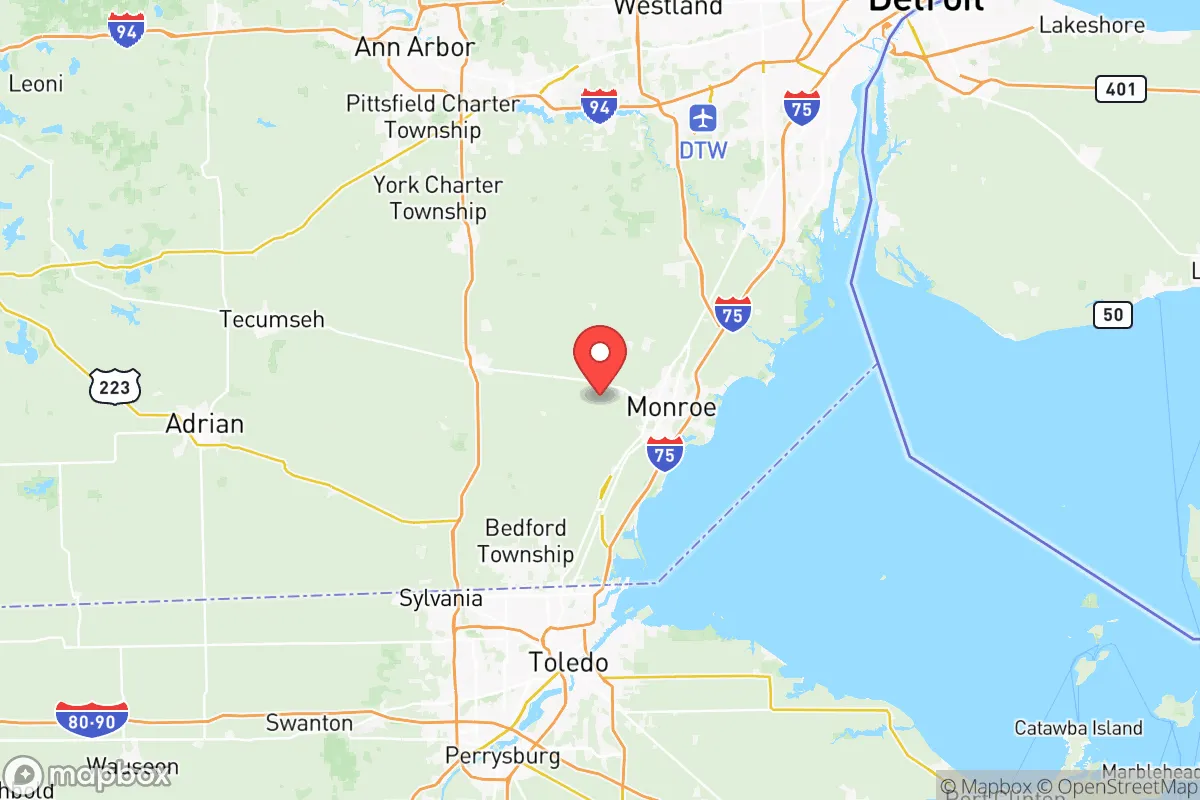
The most significant demographic shift since 1965 has been domestic: the suburbanization of Monroe County as a bedroom community for workers in Toledo, Ohio (15 miles south) and Detroit (40 miles north). The construction of I-75 in the 1960s opened the county to commuters, and new subdivisions sprouted in Bedford Township and Frenchtown Township. These areas attracted white middle-class families leaving the cities, reinforcing the county’s racial homogeneity. The black population remains low at 2.2%, concentrated in Monroe city, and has not grown substantially despite the broader Great Migration’s earlier impact on Detroit.
The county’s economy has shifted from agriculture and heavy manufacturing toward logistics, healthcare, and education. Major employers include the Monroe Public Schools, ProMedica Monroe Regional Hospital, and the Fermi 2 nuclear power plant in Lagrange Township. The loss of some manufacturing jobs in the 2000s and 2010s has led to a slight population decline from a peak of 152,000 in 2010, though the county has stabilized around 155,000.
The future
Monroe County is projected to remain one of Michigan’s least diverse counties over the next 10–20 years. The white population share is expected to decline slowly—from 89.2% to perhaps 85–86% by 2040—driven primarily by an aging white population and modest growth among Hispanic and multiracial residents. The Hispanic share may reach 6–7% as families in agriculture and food processing expand, but the county lacks the job diversity or urban amenities to attract significant new immigrant groups. The East/Southeast Asian and Indian populations will likely remain below 1% each.
Domestic migration patterns will continue to shape the county. Younger adults are leaving for college and jobs in Ann Arbor, Detroit, and Toledo, while retirees and remote workers are moving into lakefront properties along Lake Erie in communities like Luna Pier and Estral Beach. The county’s cultural identity will remain rooted in its European-American, Catholic-Protestant heritage, with a growing but still small Hispanic presence adding some diversity to festivals and cuisine. The college attainment rate, at 23.4%, is unlikely to rise sharply unless the county attracts more knowledge-economy employers.
For someone moving in now, Monroe County offers a stable, affordable, and safe environment with strong community ties, but it is not a place of rapid demographic change or cultural dynamism. The population is aging, slowly diversifying, and increasingly oriented toward commuting rather than local employment. New residents will find a county that values its history, its agricultural land, and its proximity to larger cities, but one that remains largely insulated from the immigration-driven diversity reshaping much of the United States.

* Values derived from national, state, county, city and local statistics and may differ in a specific area. Last updated: 2026-10-09T23:27:43.000Z
Narrative content on this page is AI-generated and may contain mistakes. Verify any details that matter before acting on them.
ReloMaps may earn a commission from affiliate links at no extra cost to you.

