Photo: Wikipedia
Demographics of Oakland County
Affluence Level in Oakland County
A middle-class area roughly in line with national averages across income, home values, education, and employment.
People of Oakland County
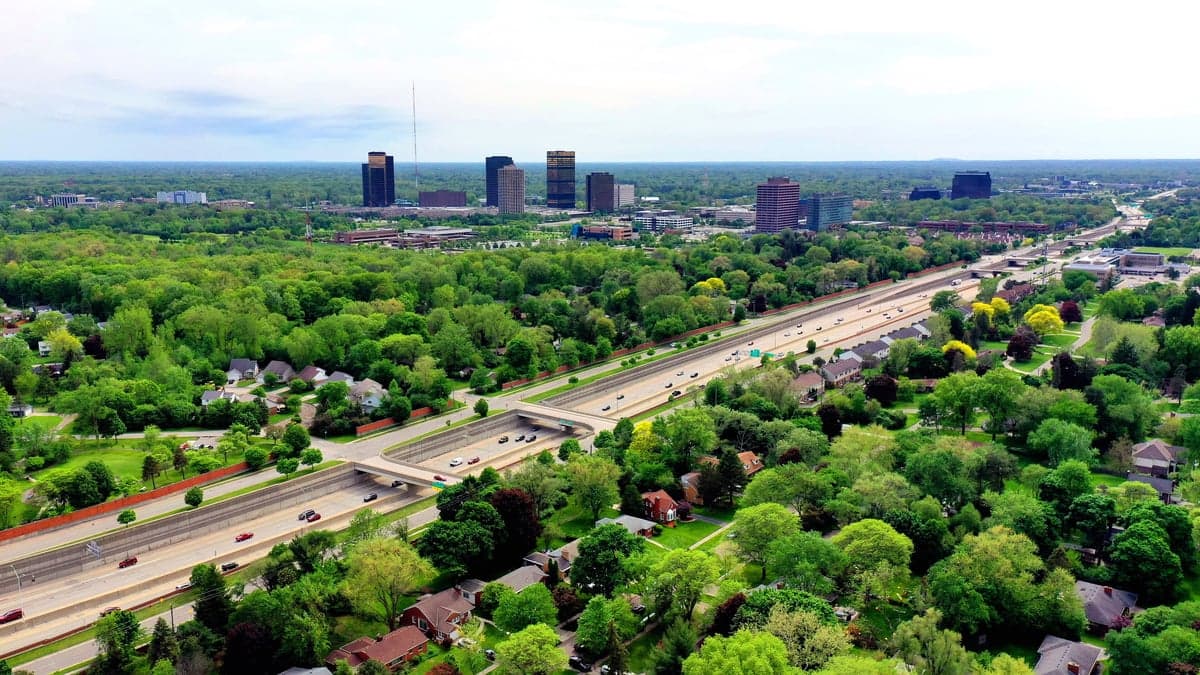
Today, Oakland County, Michigan is home to over 1.27 million residents, making it the second-most populous county in the state and a distinctively affluent, educated, and politically moderate-to-conservative suburban powerhouse. With a population that is 69.2% white, 12.9% Black, 4.9% Hispanic, 4.4% Indian (subcontinent), and 3.7% East/Southeast Asian, the county is characterized by its high concentration of college-educated professionals (50.2%) and a relatively low foreign-born share of 6.0%. Its identity is shaped by a legacy of industrial prosperity, white-collar suburban expansion, and a growing diversity that is reshaping communities from Rochester Hills to Farmington Hills.
Settlement & growth (pre-1960)
Before American settlement, the area now known as Oakland County was inhabited by the Anishinaabe peoples, particularly the Ojibwe (Chippewa) and Odawa tribes, who used the region's abundant lakes and forests for fishing, hunting, and seasonal camps. French fur traders and missionaries passed through the area in the 17th and 18th centuries, but no permanent European settlement occurred until after the 1807 Treaty of Detroit, which ceded Native lands to the United States. The county was officially organized in 1820, named for its abundant oak forests, and the first American settlers were primarily Yankees from New York and New England, drawn by cheap land and the promise of agricultural opportunity. These early pioneers founded the county seat of Pontiac in 1818, along with Rochester (now Rochester Hills) and Birmingham, establishing a pattern of small, self-sufficient farming communities.
The real population boom began with the rise of the automobile industry in the early 20th century. Detroit's auto plants drew waves of European immigrants and domestic migrants to Oakland County's growing industrial suburbs. Pontiac became a major manufacturing hub, home to General Motors' Pontiac division, attracting thousands of Polish, Italian, and German immigrants between 1900 and 1930. These groups settled in ethnic enclaves within Pontiac and spread to nearby Ferndale and Royal Oak, where they worked in auto plants and foundry jobs. The Great Migration of Black Americans from the South began in earnest after World War I, with African Americans moving to Pontiac and Oak Park for industrial work, though segregation and redlining confined many to specific neighborhoods until the 1960s. By 1950, Oakland County's population had surged to 396,000, driven by the post-war suburban boom as white families left Detroit for new subdivisions in Southfield, Troy, and Bloomfield Hills.
Modern era (post-1965)
The 1965 Hart-Cellar Act fundamentally reshaped Oakland County's demographics, though the effects were slower to arrive here than in coastal metros. The county's foreign-born population remains modest at 6.0%, but the composition has shifted dramatically. The most significant post-1965 change has been the growth of the Indian (subcontinent) community, which now constitutes 4.4% of the county's population—a share that rivals or exceeds many larger U.S. metros. This wave began in the 1970s and accelerated through the 1990s, driven by the expansion of the automotive and engineering sectors. Indian professionals, many with advanced degrees in engineering and medicine, settled heavily in Troy and Farmington Hills, where they established temples, grocery stores, and cultural organizations. Troy in particular has become a regional hub for the Indian community, with its high-performing schools and proximity to corporate headquarters in the Oakland County Tech Corridor.
East and Southeast Asian communities (3.7% of the population) also grew during this period, though more slowly. Chinese, Korean, and Vietnamese immigrants arrived in the 1980s and 1990s, often as professionals or small business owners, and concentrated in Novi and Rochester Hills. The Hispanic population (4.9%) is smaller but growing, with Mexican and Central American communities forming in Pontiac and Wixom, drawn by construction, landscaping, and service jobs. Meanwhile, the Black population (12.9%) has shifted geographically: as Detroit's Black middle class expanded, many families moved to Southfield and Oak Park in the 1970s and 1980s, making Southfield one of the most affluent majority-Black suburbs in the United States. White flight from Detroit accelerated this trend, and today Oakland County's Black population is largely suburban and economically diverse.
Domestic migration has also reshaped the county. The decline of Detroit's auto industry in the 1980s and 2000s led to population stagnation in older industrial cities like Pontiac, while the northern and western suburbs—Clarkston, Oxford, and Lake Orion—grew rapidly as white, middle-class families sought larger lots, lower taxes, and conservative-leaning school districts. The county's overall population has remained stable since 2000, hovering around 1.2 million, but the internal distribution has shifted toward the exurbs.
The future
Oakland County is likely to continue its trajectory of gradual diversification, but the pace will be slower than in coastal metros. The Indian (subcontinent) community is the fastest-growing ethnic group, driven by both immigration and high birth rates, and will likely expand from its current 4.4% share to 6-7% by 2040, with Troy and Farmington Hills becoming even more distinctly Indian enclaves. East and Southeast Asian communities will grow modestly, while the Hispanic population may double from its current 4.9% as service-sector jobs attract new arrivals to Pontiac and Wixom. The white population, while still a majority at 69.2%, will continue to shrink as a share, particularly in the inner-ring suburbs, while the exurbs like Oxford and Clarkston will remain overwhelmingly white and politically conservative.
The county is not homogenizing but rather tribalizing into distinct enclaves by ethnicity and income. Bloomfield Hills and Birmingham will remain bastions of wealthy, white professionals; Southfield will solidify its identity as a Black-majority, middle-class suburb; and Troy will become increasingly Indian-majority. This balkanization may reduce cross-cultural friction but also limit integration. In-migration from other states is modest, as Michigan's population growth is slow, so the county's cultural identity will evolve primarily through internal demographic shifts and immigrant assimilation, rather than a flood of newcomers.
For a conservative-leaning individual or family moving to Oakland County today, the bottom line is this: you are entering a region that is affluent, well-educated, and politically divided between liberal-leaning inner suburbs and conservative exurbs. The county offers excellent schools, low crime in most areas, and a stable economy anchored by healthcare, engineering, and professional services. The growing diversity—particularly the Indian community in Troy and Farmington Hills—adds cultural richness without the rapid, destabilizing change seen in some Sun Belt metros. If you choose a community like Rochester Hills or Oxford, you will find a predominantly white, conservative environment with strong schools and family-oriented values. If you prefer a more diverse, suburban setting, Troy or Novi offer a blend of ethnic enclaves and high-end amenities. The county is not becoming a melting pot, but a mosaic—and for many, that is precisely the appeal.

* Values derived from national, state, county, city and local statistics and may differ in a specific area. Last updated: 2026-05-11T22:51:11.000Z
Narrative content on this page is AI-generated and may contain mistakes. Verify any details that matter before acting on them.
ReloMaps may earn a commission from affiliate links at no extra cost to you.

