Photo: Wikipedia
Demographics of Middletown, OH
Affluence Level in Middletown, OH
A below-average socioeconomic profile. Incomes, home values, and educational attainment trail the U.S., with higher poverty and unemployment.
People of Middletown, OH
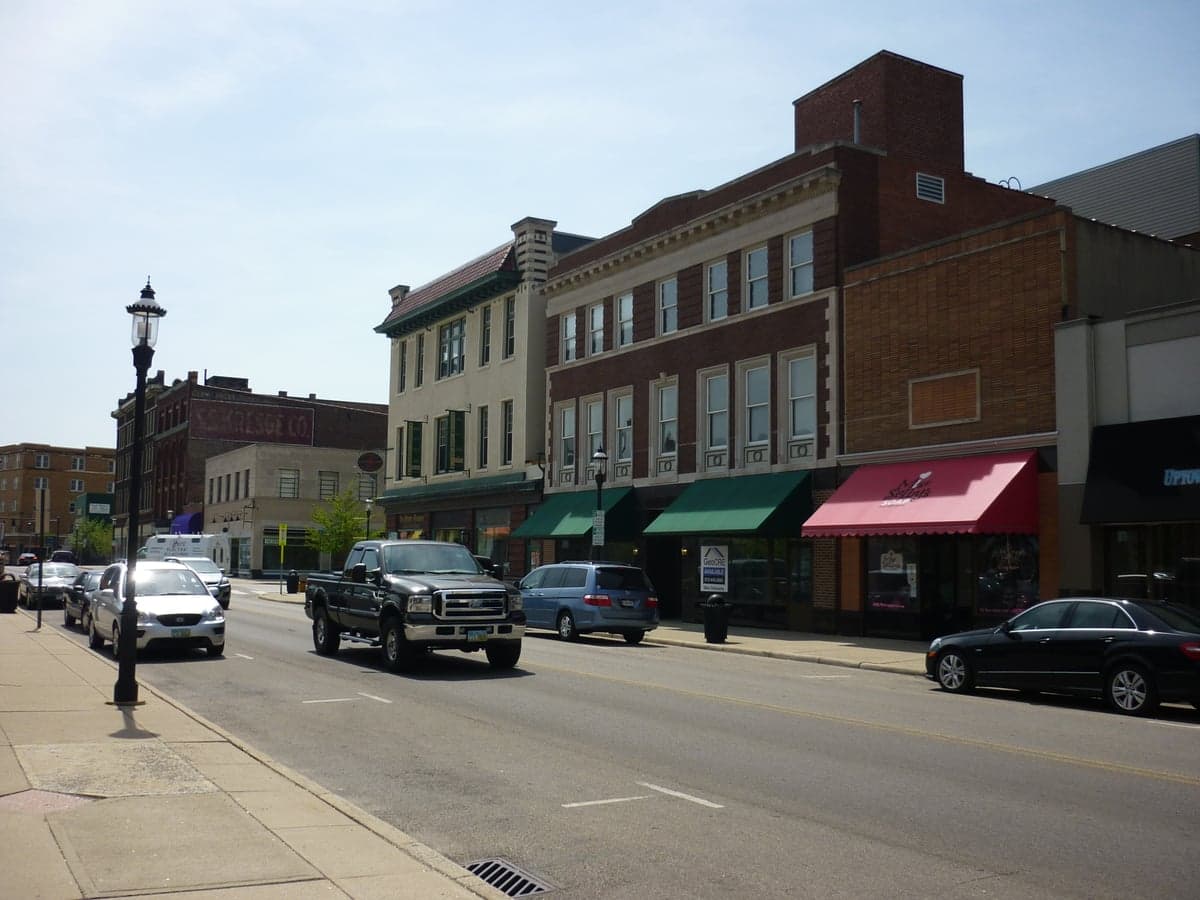
Middletown, Ohio, is a city of 50,607 residents that has evolved from a manufacturing boomtown into a community grappling with economic transition and demographic stability. Its population is predominantly White (73.3%) with a significant Black minority (13.1%) and a growing Hispanic community (5.7%), while the foreign-born share remains low at 2.3%. The city’s identity is shaped by a working-class heritage, a modest college attainment rate of 16.1%, and a population that is older and more rooted than Ohio’s fast-growing suburban corridors. For a conservative-leaning newcomer, Middletown offers a place where family ties and local institutions still anchor daily life, but where economic opportunity and population growth have slowed.
How the city was settled and grew
Middletown’s population history begins with its founding in 1802 along the Miami River, drawing early settlers—mostly of English, German, and Scotch-Irish descent—who farmed the fertile bottomlands. The real population surge came with the industrial revolution: by the late 19th century, the city became a steel and paper manufacturing hub, anchored by the American Rolling Mill Company (ARMCO), which attracted waves of European immigrants. German and Irish laborers settled in the Central Business District and the near-west side neighborhoods like West End, building dense worker housing near the mills. By the 1920s, Appalachian migrants from Kentucky and West Virginia arrived for factory jobs, concentrating in the South End and Manchester neighborhoods, where their descendants remain a culturally distinct presence. The city’s Black population grew during the Great Migration, with African Americans moving from the South for ARMCO and other industrial work, settling primarily in the East End and Amsterdam neighborhoods. By 1950, Middletown’s population peaked at over 50,000, a diverse but segregated industrial workforce.
Modern era (post-1965)
After the 1965 Hart-Cellar Act, Middletown saw only modest foreign-born growth, reflecting its inland, non-gateway status. The city’s demographic shifts since the 1970s have been driven more by domestic migration and suburbanization than by new immigration. White flight to outlying townships like Liberty and Monroe accelerated after the 1970s, leaving the city’s core neighborhoods—particularly the East End and Central Business District—with higher concentrations of Black and lower-income residents. The Hispanic population, now 5.7%, began growing in the 1990s, with Mexican and Central American families settling in the South End and along the Verity Parkway corridor, often working in light manufacturing and service jobs. The Asian population (East/Southeast Asian) remains tiny at 0.8%, concentrated among a few families in the northwest Sunset Ridge area, while the Indian-subcontinent population is negligible at 0.2%. The foreign-born share (2.3%) is well below Ohio’s average, and the city has not experienced the refugee resettlement or tech-driven immigration seen in Columbus or Cincinnati. Middletown’s population has declined from its 1970 peak of 52,000 to 50,607 today, reflecting deindustrialization and outmigration of younger adults.
The future
Middletown’s population trajectory points toward continued slow decline or stagnation, with modest diversification driven by Hispanic growth. The White population is aging and shrinking, while the Black share has stabilized around 13%. The Hispanic share is likely to rise to 8-10% over the next decade, as families in the South End and along Verity Parkway grow and attract new arrivals from Mexico and Central America. However, the city lacks the job growth or housing stock to draw significant new immigrant groups—East/Southeast Asian and Indian communities are unlikely to expand without a major employer shift. The city is not tribalizing into distinct ethnic enclaves so much as consolidating into a lower-income, older, and more Hispanic core, while the surrounding townships absorb younger, whiter families. For a conservative-leaning mover, this means Middletown offers a stable, affordable base with a familiar cultural character, but little of the upward mobility or ethnic dynamism found in larger metros.
Middletown is becoming a quieter, more homogeneous small city—a place where the working-class roots remain visible, but where population decline and economic stagnation are the dominant trends. For someone moving in now, the city offers low housing costs and a strong sense of local history, but limited job growth and a population that is slowly aging and diversifying only through Hispanic growth. It is not a destination for those seeking rapid change or new immigrant communities, but rather a stable, traditional Midwestern town where the past still shapes the present.

* Values derived from national, state, county, city and local statistics and may differ in a specific area. Last updated: 2026-04-21T20:22:49.000Z
Narrative content on this page is AI-generated and may contain mistakes. Verify any details that matter before acting on them.
ReloMaps may earn a commission from affiliate links at no extra cost to you.

