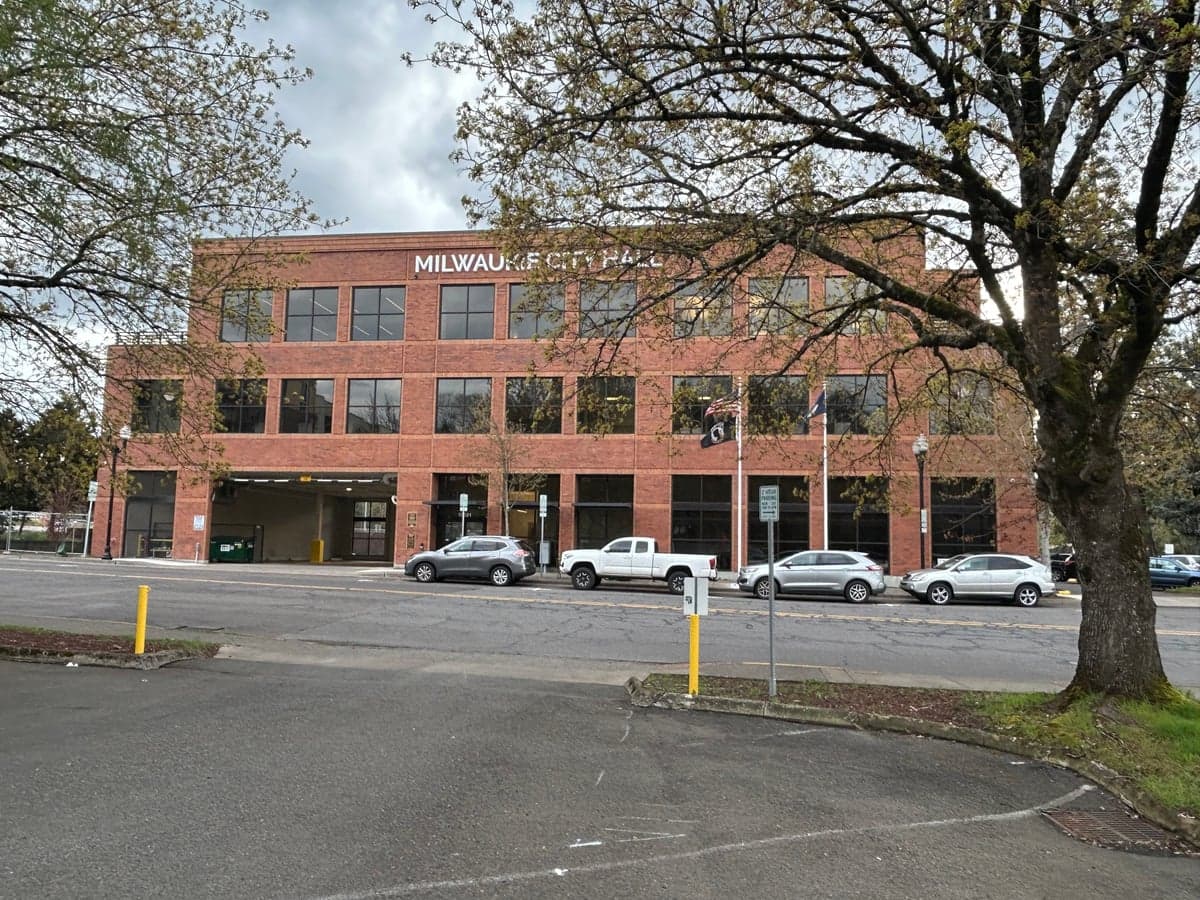
Photo: Wikipedia
Demographics of Milwaukie, OR
Affluence Level in Milwaukie, OR
A middle-class area roughly in line with national averages across income, home values, education, and employment.
People of Milwaukie, OR
The people of Milwaukie, Oregon today form a predominantly white, college-educated community of just over 21,000 residents, with a notably low foreign-born population of 2.0%—roughly one-third the national average. The city’s character is shaped by its historic role as a working-class river town that has gradually gentrified into a bedroom suburb of Portland, retaining a distinct small-town identity within the metro area. Milwaukie’s population is older and more settled than the regional average, with a median age of 41.6 years, and its neighborhoods reflect a mix of pre-war bungalows, mid-century ranches, and newer infill development.
How the city was settled and grew
Milwaukie’s founding population arrived in the 1840s and 1850s, drawn by the Donation Land Claim Act of 1850, which granted 320 acres to white settlers. The city’s name—a misspelling of the Algonquian word for “good land”—was chosen by Lot Whitcomb, a mill operator who built the first commercial sawmill on the Willamette River in 1847. Whitcomb’s mill and the surrounding Historic Milwaukie District (centered on Main Street and McLoughlin Boulevard) attracted a wave of Yankee and Midwestern migrants, many from New England and Ohio, who established the city as a lumber and shipbuilding hub. By the 1880s, the Oregon Railway & Navigation Company extended a line through Milwaukie, spurring growth in the Ardenwald-Johnson Creek neighborhood, where German and Scandinavian immigrants settled as farmers and railroad workers. The early 20th century brought a second wave of domestic migrants—Midwesterners and Southerners—who found work in the city’s canneries and fruit-packing plants, particularly in the Linwood area, which developed as a working-class enclave of small cottages and bungalows. Milwaukie remained a distinct, self-contained community through the 1950s, with a population that was overwhelmingly white and native-born.
Modern era (post-1965)
The post-1965 era saw Milwaukie transform from an independent industrial town into a bedroom suburb of Portland, driven by the expansion of the Interstate 205 corridor and the construction of the Clackamas Town Center shopping district in the 1980s. Domestic in-migration from other parts of Oregon and California accelerated in the 1990s and 2000s, as families sought affordable housing within commuting distance of Portland. The Lake Road and Oatfield neighborhoods absorbed much of this growth, with new subdivisions of split-level and contemporary homes replacing older orchards and farmland. The city’s Hispanic population grew from roughly 3% in 1990 to 10.5% today, concentrated in the Lewelling area near Highway 224, where Mexican and Central American families found work in landscaping, construction, and food processing. East and Southeast Asian communities—primarily Vietnamese and Chinese—make up 2.7% of the population, with a small cluster of families in the Ardenwald neighborhood, drawn by the area’s proximity to Portland’s Asian grocery stores and cultural institutions. The Black population remains minimal at 1.8%, and Indian-subcontinent residents account for just 0.1%. Milwaukie’s foreign-born share of 2.0% is among the lowest in the Portland metro area, reflecting limited immigration-driven diversity.
The future
Milwaukie’s population is projected to grow slowly, reaching roughly 23,000 by 2035, driven primarily by infill development and the completion of the Portland-Milwaukie light rail line (the Orange Line) in 2015. The city is likely to become slightly more diverse, with the Hispanic share expected to rise to 12-13% and the East/Southeast Asian share to 3-4%, as younger families move into new townhome developments near the Downtown Milwaukie transit station. However, the city’s low foreign-born rate and high housing costs (median home value $485,000) will continue to limit significant immigration-driven change. The white, college-educated population is likely to remain dominant, particularly in the Historic Milwaukie District and Ardenwald, where older homeowners are gradually replaced by younger professionals. Milwaukie is not tribalizing into distinct ethnic enclaves; rather, it is homogenizing around a middle-class, family-oriented identity, with most new residents coming from within Oregon and Washington.
For someone moving in now, Milwaukie offers a stable, low-diversity community with strong schools and a walkable downtown, but limited ethnic variety and a population that skews older and more settled than the regional average. The city is becoming a quieter, more expensive version of its former self—a place where newcomers are likely to be domestic migrants seeking a small-town feel within the Portland orbit, rather than immigrants or refugees. The bottom line: Milwaukie is a safe, predictable choice for families who prioritize stability and local amenities over cultural diversity or rapid growth.

* Values derived from national, state, county, city and local statistics and may differ in a specific area. Last updated: 2026-04-22T21:33:05.000Z
Narrative content on this page is AI-generated and may contain mistakes. Verify any details that matter before acting on them.
ReloMaps may earn a commission from affiliate links at no extra cost to you.

