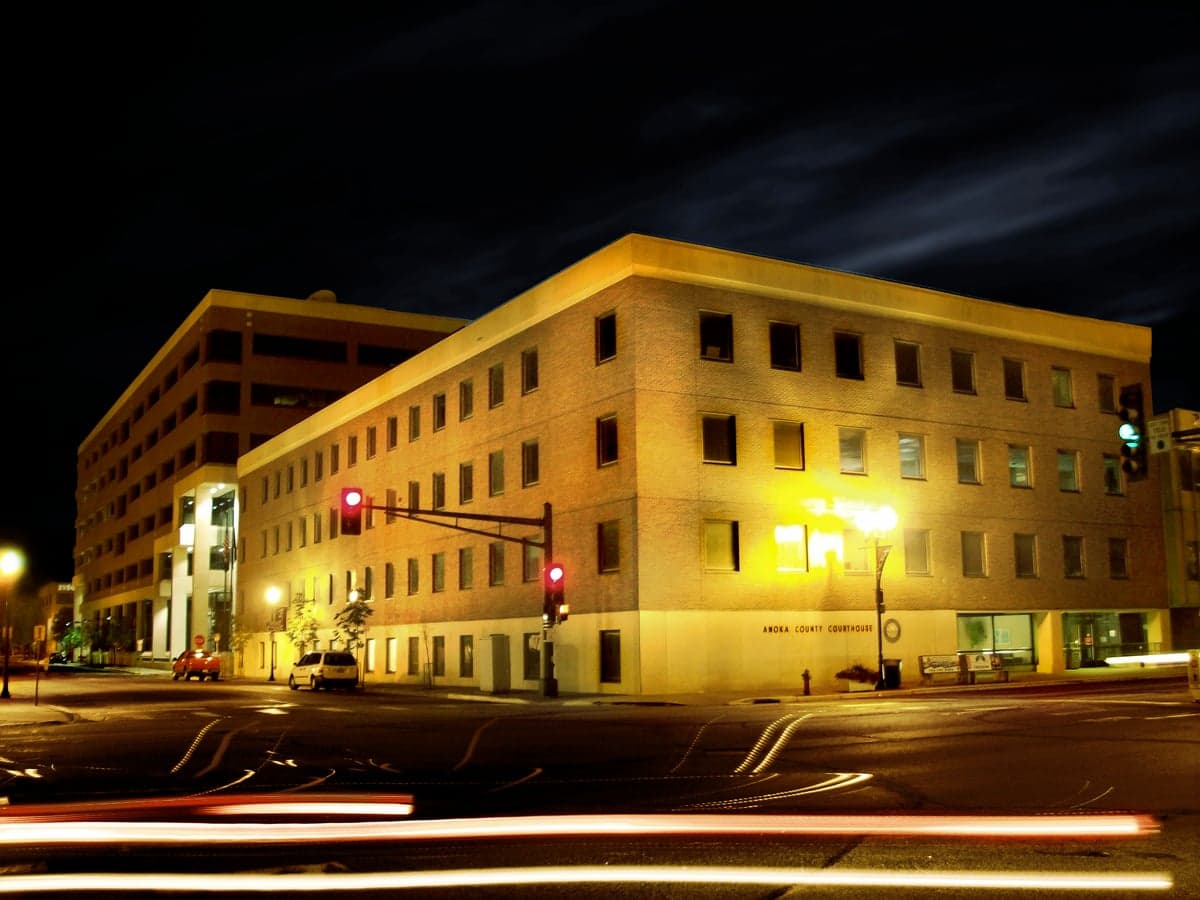
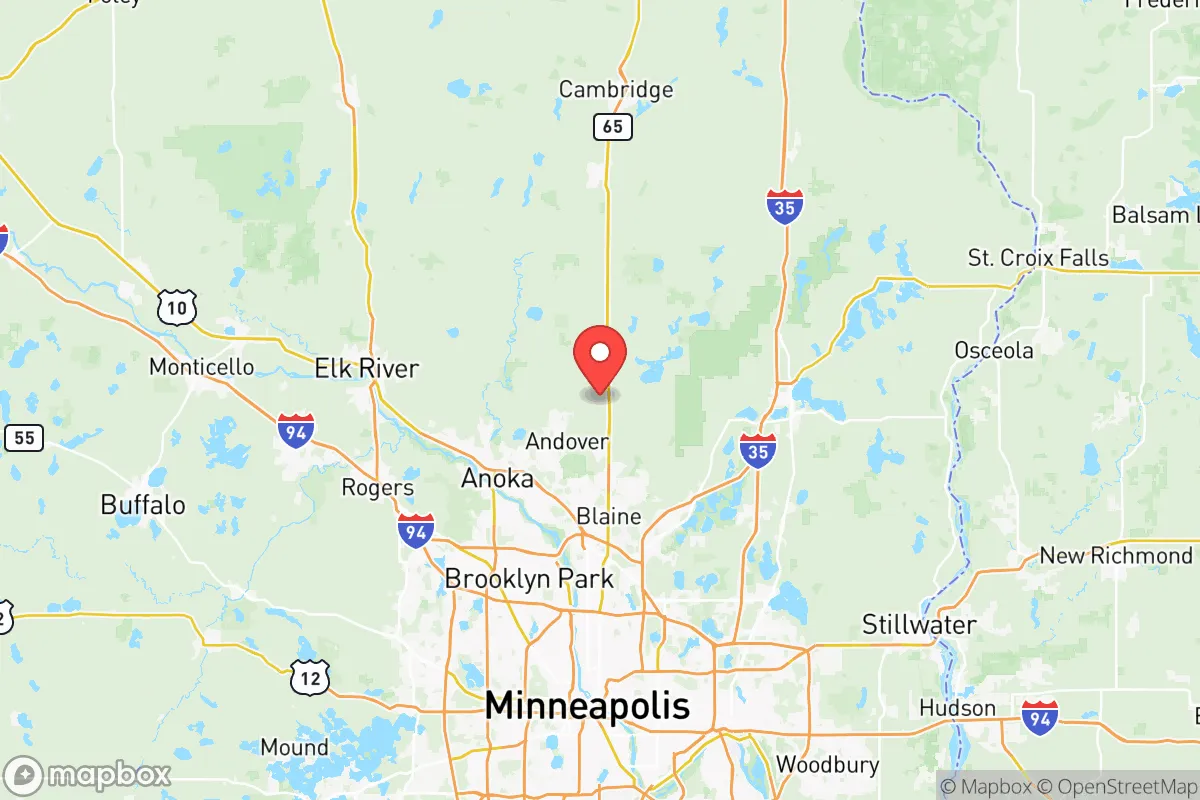
Photo: Wikipedia
Demographics of Anoka County
Affluence Level in Anoka County
A middle-class area roughly in line with national averages across income, home values, education, and employment.
People of Anoka County
Anoka County’s 367,095 residents form a predominantly white, middle-ring suburban population with a distinctly Midwestern character—rooted in Scandinavian and German settlement, shaped by post-war industrial growth, and now slowly diversifying. The county’s identity is defined by its position as the “Gateway to the North,” blending blue-collar river towns with expanding exurban subdivisions. With a foreign-born share of just 3.1%—well below the national average—Anoka County remains one of Minnesota’s most ethnically homogeneous metro counties, though its Black (8.3%) and East/Southeast Asian (4.7%) populations have grown notably since 2000.
Settlement & growth (pre-1960)
Before European settlement, the area now called Anoka County was home to the Dakota (Sioux) people, particularly the Mdewakanton band, who lived along the Rum River and Mississippi River corridors. The Ojibwe (Chippewa) also contested the region during the 18th-century fur trade era, but by the time of the 1837 Treaty with the Chippewa, the U.S. government had acquired most of the land. French-Canadian voyageurs and fur traders were the first Europeans to pass through, but they left no permanent settlements.
American settlement began in earnest after 1849, when the Minnesota Territory was organized. The first wave was overwhelmingly Yankee—English-speaking settlers from New England and upstate New York—who arrived via the Mississippi River and established the county’s earliest towns. Anoka (founded 1844 as a trading post) became the county seat in 1857, drawing millers and merchants who harnessed the Rum River’s waterpower. St. Francis and Bethel, settled in the 1850s, attracted subsistence farmers and loggers who cleared the dense pine forests.
The second major wave, from 1860 to 1890, was overwhelmingly German and Scandinavian. German immigrants—many from Pomerania and West Prussia—settled in Columbia Heights and Fridley, where they worked in sawmills and later in the burgeoning railroad industry. Swedish and Norwegian families clustered in Ham Lake and East Bethel, drawn by the 1862 Homestead Act’s promise of 160 acres. By 1900, Anoka County’s population was 90% northern European, with a small but visible Irish Catholic community in Anoka proper, employed in the city’s flour mills and the Anoka State Hospital (opened 1900).
The third wave, from 1900 to 1960, was driven by industrialization and suburbanization. The 1910s and 1920s saw a modest influx of Polish and Italian laborers who built the Northern Pacific Railway’s Anoka shops and worked in the gravel pits of Coon Rapids. However, the county’s population remained overwhelmingly white and native-born through the Great Depression. The real transformation came after World War II. The 1950s and 1960s brought a massive domestic migration of white families from Minneapolis and St. Paul, fleeing urban density for new subdivisions in Blaine, Spring Lake Park, and Lino Lakes. The construction of Interstate 35W and U.S. Highway 10 made these towns commuter suburbs, and Anoka County’s population more than doubled between 1950 and 1970, from 35,579 to 98,717.
Modern era (post-1965)
The 1965 Hart-Cellar Act had a limited immediate effect on Anoka County, as the region lacked the industrial or agricultural pull factors that drew immigrants to Chicago or California. However, the 1970s and 1980s saw the first significant non-white settlement: Hmong refugees from Laos, resettled by Catholic and Lutheran charities, began arriving in 1976. They concentrated in Anoka and Coon Rapids, where affordable housing and entry-level manufacturing jobs at companies like Medtronic and Honeywell provided a foothold. By 2000, the Hmong community numbered roughly 2,000, making them the county’s largest Asian subgroup.
The 1990s and 2000s brought two new domestic migration streams. First, African American families from Chicago and Detroit moved to Blaine and Fridley, drawn by the Twin Cities’ strong labor market and lower crime rates. Second, white retirees and young families from the Dakotas and Wisconsin moved into exurban developments in Ramsey and Oak Grove, seeking larger lots and lower taxes. The county’s Black population grew from 1.2% in 1990 to 8.3% today, while the East/Southeast Asian population (now predominantly Hmong and Vietnamese) reached 4.7%.
Hispanic settlement has been more modest. The 5.6% Hispanic population is largely Mexican-American, with families concentrated in Anoka and Columbia Heights, working in construction, landscaping, and food processing. The Indian-subcontinent population (0.6%) is tiny but growing, with professionals in healthcare and tech settling in Blaine near the Northstar Commuter Rail line. Notably, the county’s foreign-born share (3.1%) is less than half the Minnesota state average (8.5%), reflecting the region’s continued reliance on domestic migration rather than international immigration.
The future
Anoka County is slowly diversifying, but the pace is glacial compared to the Twin Cities’ core. The white population share has declined from 90% in 1990 to 76% today, driven almost entirely by the growth of Black and East/Southeast Asian communities. The Hispanic share is growing at a steady but unspectacular rate of about 0.3 percentage points per year. The Indian-subcontinent population, while small, is likely to accelerate as tech employment expands along the I-35W corridor.
Domestic migration patterns are shifting. The county is losing some white families to exurban counties like Sherburne and Isanti, where land is cheaper, while gaining Black and Asian families from Minneapolis and Brooklyn Park who seek better schools and lower crime. This is creating a subtle tribalization: Blaine and Coon Rapids are becoming more diverse and middle-class, while Ham Lake and East Bethel remain overwhelmingly white and conservative. The county’s college-educated share (31.7%) is below the state average (37.5%), suggesting that the region is not yet attracting the knowledge-worker influx seen in Hennepin or Ramsey counties.
Over the next 10-20 years, Anoka County will likely become a “majority-minority” county only in the most technical sense—the white share will drop below 50% around 2060, but the county will remain culturally Midwestern and politically moderate. The Hmong and Mexican-American communities are assimilating rapidly, with high rates of English proficiency and homeownership. The biggest wildcard is whether the county can attract enough young professionals to replace retiring Baby Boomers, or whether it will follow the trajectory of Rust Belt suburbs and see population stagnation.
For someone moving in now, Anoka County offers a stable, family-oriented environment with good schools and relatively low crime, but limited ethnic diversity and a cultural identity that remains firmly rooted in its Scandinavian and German past. The county is becoming more diverse, but slowly, and the change is happening in specific towns—not uniformly across the region. It is a place where newcomers will find a welcoming but homogeneous community, and where the biggest demographic story is not immigration but the quiet aging of the white population.

* Values derived from national, state, county, city and local statistics and may differ in a specific area. Last updated: 2026-05-12T04:07:41.000Z
Narrative content on this page is AI-generated and may contain mistakes. Verify any details that matter before acting on them.
ReloMaps may earn a commission from affiliate links at no extra cost to you.

