
Photo: Wikipedia
Political ClimatePolitical Climate in Pearl River County
Showing district-level results — no local-only data available.
Local Political AnalysisPolitical Analysis of Pearl River County
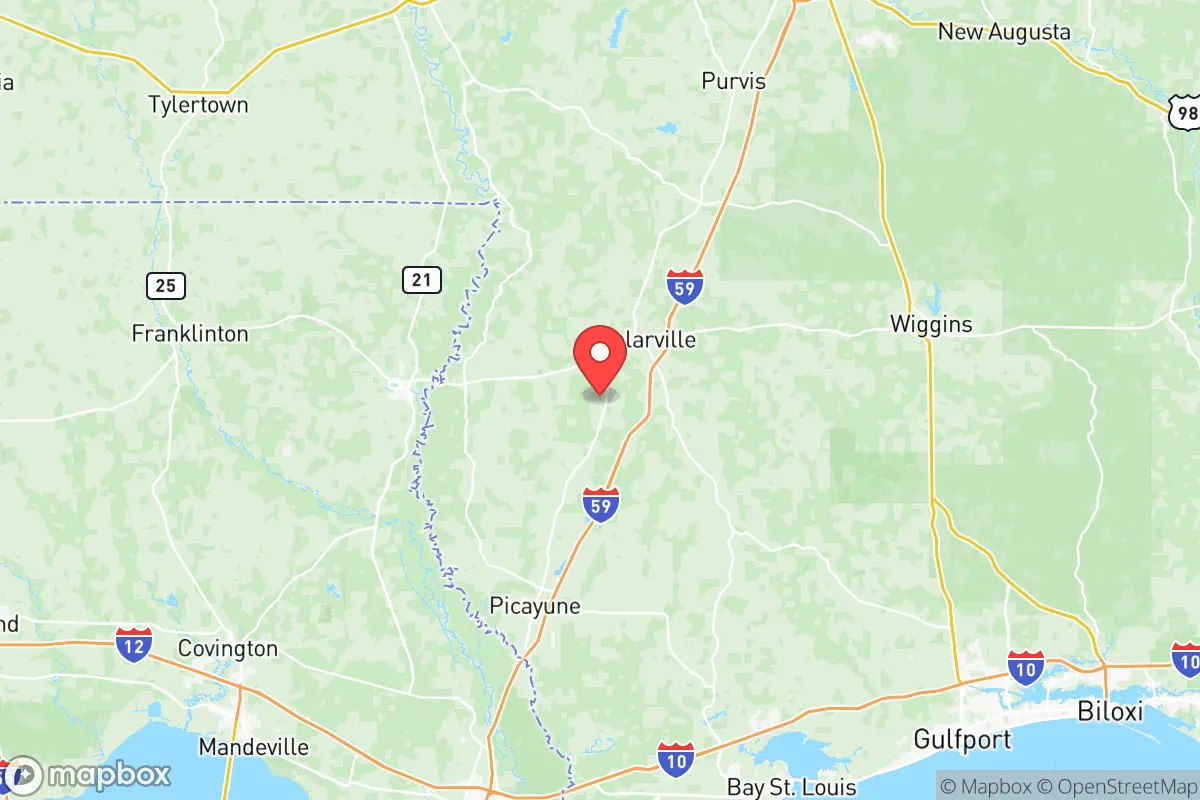
Pearl River County is about as solidly conservative as they come in Mississippi, with a Cook PVI of R+21 that puts it a full ten points to the right of the state's already R+11 rating. That's not just a number on a map—it means in presidential elections, Republicans here routinely win by margins that would make statewide races in other parts of the country look like nail-biters. The county has been trending even redder over the last decade, driven by an influx of folks from New Orleans and the Gulf Coast who are looking for lower taxes, less government intrusion, and a community that still believes in personal responsibility over bureaucratic handouts.
How it compares
Mississippi as a whole is reliably Republican, but Pearl River County is in a different league. The state's R+11 PVI reflects a mix of deep-red rural areas and a few blue-leaning pockets like Jackson and the Delta. In Pearl River County, you don't have those counterweights. The county seat, Poplarville, is a conservative stronghold where the local culture revolves around Pearl River Community College, hunting season, and church potlucks. Picayune, the largest town, leans red but has a few precincts near the St. Tammany Parish line that show more purple tendencies—those are folks who work in Louisiana but chose Mississippi for the lower cost of living and fewer regulations. The unincorporated areas around Carriere and McNeill are as red as they come, with turnout driven by Second Amendment concerns and opposition to federal overreach. There are no swing precincts in the traditional sense; the closest thing is the small number of voters in the city limits of Picayune who might split tickets on local races, but even there, the overall tilt is solidly conservative.
What this means for residents
For someone living here, the political climate means you can expect local government to stay out of your business. The county supervisors and school board are overwhelmingly Republican, and there's a strong cultural resistance to anything that smells like progressive social engineering—critical race theory in schools, mask mandates, or zoning laws that tell you what you can do on your own land. Property taxes are among the lowest in the state, and there's no county income tax. The downside? If you're hoping for expanded public transit or big government-funded projects, you'll be disappointed. The county prioritizes low taxes and limited services, which suits most residents just fine. The biggest concern I hear from neighbors is about the direction of the state as a whole—Mississippi's R+11 is still solid, but there's worry that Jackson and the coast could pull the state toward more centralized control, especially on education and healthcare mandates.
Culturally, Pearl River County stands apart from the rest of Mississippi in a few key ways. The influence of Louisiana is everywhere—you'll hear more Cajun accents in Picayune than you will in most of the state, and the food scene reflects that. But politically, that Louisiana connection actually reinforces the conservative bent, because many of the transplants came here specifically to escape the higher taxes and crime of New Orleans. The county's motto might as well be "leave us alone." There's a deep skepticism of federal programs, even ones that bring money, because residents remember how strings get attached. The local paper, the Picayune Item, covers school board meetings and zoning disputes with a libertarian-leaning skepticism that you don't see in more progressive parts of the state. If you're looking for a place where your personal freedoms are respected and the government keeps its nose out of your life, this is it—but don't expect it to stay that way without vigilance, because the pressure from state and federal level to conform to progressive norms is constant.

State Political ClimatePolitical Climate in Mississippi
State Political AnalysisPolitical Environment in the State
Mississippi is one of the most reliably conservative states in the nation, with a Cook Partisan Voting Index of R+11, meaning it votes about 11 points more Republican than the national average. The state hasn’t voted for a Democratic presidential candidate since 1976, and the GOP holds supermajorities in both chambers of the legislature. Over the last 10-20 years, the shift has been subtle but real: the old “Blue Dog” Democrat tradition in rural areas has nearly vanished, replaced by a solid, culturally conservative Republican coalition that dominates from the Delta to the Gulf Coast.
Urban vs. rural divide
The political map breaks down along predictable lines, but with a few surprises. The state’s largest metro, Jackson, is a Democratic stronghold driven by a majority-Black population and a strong union presence in government and education. Hinds County, which contains most of Jackson, routinely votes 70-80% Democratic. But drive 20 minutes out to Madison or Ridgeland, and you’re in deep-red suburbs where the GOP gets 70% of the vote. The Gulf Coast metros—Biloxi, Gulfport, and Pascagoula—lean Republican but have a libertarian streak, especially on gun rights and taxes. The northeastern corner around Tupelo and Oxford is interesting: Tupelo is reliably conservative, while Oxford (home to Ole Miss) has a small but vocal progressive enclave among faculty and students. The Delta region—places like Greenville and Clarksdale—is overwhelmingly Democratic, but turnout is low and the population is shrinking. The real engine of the state’s conservative lean is the sprawling rural and exurban territory between these islands of blue, where voters are white, evangelical, and deeply skeptical of federal overreach.
Policy environment
Mississippi’s policy environment is among the most conservative in the country, and it’s been getting more so. The state has no income tax on Social Security benefits, and in 2022 it began phasing out its individual income tax entirely, with a goal of elimination by 2026. Sales tax is around 7%, but groceries are exempt. Property taxes are very low by national standards, thanks to a homestead exemption that caps assessments. On education, the state passed the Mississippi Charter Schools Act in 2013, and there are now over 30 charter schools, mostly in Jackson. School choice is expanding, with Education Savings Accounts (ESAs) passed in 2024 for special-needs students and low-income families. Healthcare is a mixed bag: Mississippi did not expand Medicaid under the ACA, and the state has one of the highest uninsured rates in the country. Abortion is effectively banned after a trigger law took effect in 2022, with no exceptions for rape or incest. Election laws are strict: voter ID is required, absentee voting is limited to specific excuses, and same-day registration is not allowed. The state also passed a law in 2021 banning private funding of election administration, a direct response to the “Zuckerbucks” controversy.
Trajectory & freedom
On the freedom front, Mississippi has been moving decisively in the direction of personal liberty, at least as conservatives define it. The Mississippi Freedom Act (2023) prohibits government mandates for vaccines, masks, or business closures during public health emergencies—a direct rebuke to COVID-era overreach. Gun rights are among the strongest in the nation: permitless carry (constitutional carry) became law in 2016, and the state preempts local gun ordinances entirely. In 2024, the legislature passed a law prohibiting any state or local enforcement of federal gun regulations that don’t exist in state statute, a kind of Second Amendment sanctuary measure. Parental rights got a boost with the Parents’ Bill of Rights (2023), which requires schools to notify parents of any medical or mental health services offered to their child and to get consent before any gender-related counseling. Property rights are solid: Mississippi is a “right-to-farm” state, limiting nuisance lawsuits against agricultural operations. The only area where freedom has arguably contracted is in medical autonomy: the near-total abortion ban and restrictions on gender-affirming care for minors (passed in 2023) represent the state asserting its view of moral order over individual medical decisions.
Civil unrest & political movements
Mississippi has not seen the kind of large-scale civil unrest that has hit other states. The 2020 George Floyd protests in Jackson were relatively small and mostly peaceful, with a few nights of property damage downtown. The state’s most visible political movements are on the right: the Mississippi Republican Party is dominated by the conservative “American Family Association” wing, which is active on school board races and library board appointments. There have been organized efforts to remove “obscene” books from public libraries, particularly in DeSoto County (the Memphis suburbs) and Rankin County (east of Jackson). Immigration politics are muted because the state has a very small foreign-born population (about 2.5%), but there is a strong undercurrent of concern about illegal immigration, especially in the poultry-processing towns of Morton and Forest. Election integrity controversies flared in 2020 when then-Governor Tate Reeves (R) refused to expand mail-in voting, and the state’s GOP-run legislature passed the aforementioned ban on private election funding. There is no serious secessionist movement, but “nullification” rhetoric appears occasionally in legislative debates over federal gun laws and environmental regulations.
Projection
Over the next 5-10 years, Mississippi is likely to become even more conservative, not less. The in-migration pattern is small but significant: retirees from the Midwest and Northeast are moving to the Gulf Coast for the low taxes and warm weather, and they tend to be Republican. The state’s population is aging and slowly declining overall, but the areas that are growing—Madison County, DeSoto County, and the Coast—are all deep red. The Delta will continue to lose population and political clout. The Democratic Party in Mississippi is increasingly confined to Jackson and a few rural Black-majority counties, and its statewide candidates rarely break 40%. The biggest wildcard is the state’s education system: if the charter school and ESA expansions produce measurable gains in literacy and graduation rates, it could cement the conservative model for a generation. If not, there may be pressure for more funding and less reform. Either way, the political trajectory is clear: Mississippi is doubling down on low taxes, gun rights, parental control, and limited government, and there’s no sign of a reversal.
Bottom line for a new resident: If you’re moving to Mississippi, you’re coming to a state that is firmly, unapologetically conservative—and getting more so. You’ll find low taxes, strong gun rights, and a government that mostly stays out of your business, as long as you align with its cultural values. The trade-offs are real: public services are lean, healthcare access is limited in rural areas, and the political culture can feel insular. But for someone who values personal liberty, local control, and a slower pace of life, Mississippi offers a refuge that is increasingly rare in the United States.
* Values derived from national, state, county, city and local statistics and may differ in a specific area. Last updated: 2026-05-11T22:32:41.000Z
Narrative content on this page is AI-generated and may contain mistakes. Verify any details that matter before acting on them.
ReloMaps may earn a commission from affiliate links at no extra cost to you.

