Photo: Wikipedia
Demographics of Monument, CO
Affluence Level in Monument, CO
An upper-middle-class area. Household wealth, education levels, and homeownership run ahead of national benchmarks.
People of Monument, CO
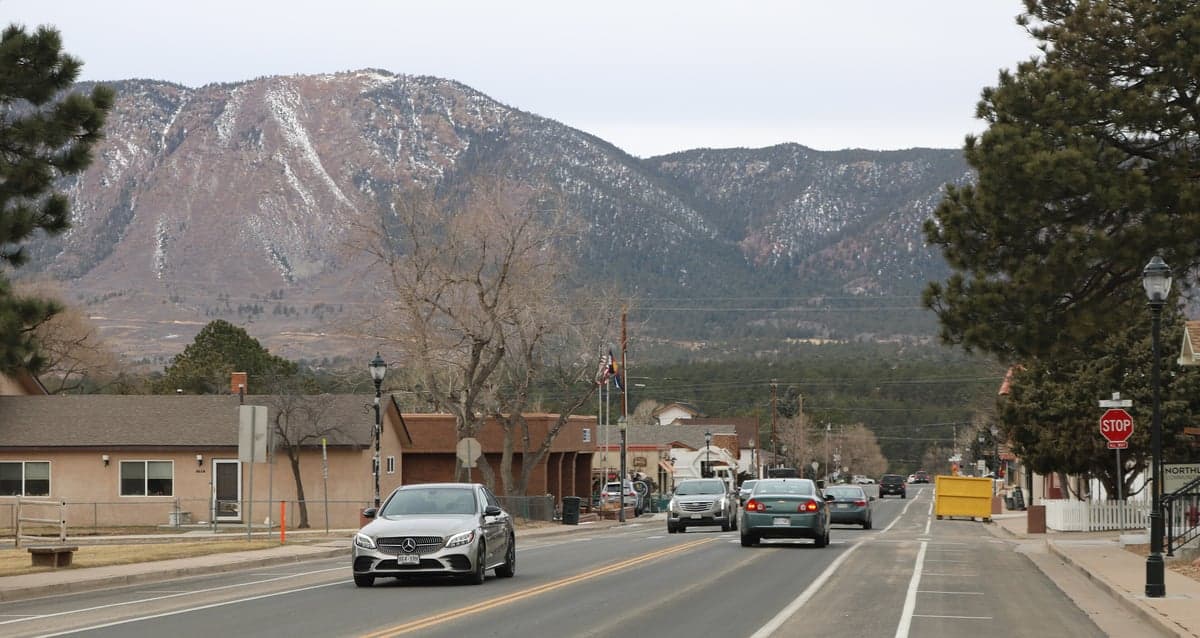
The people of Monument, Colorado, in 2026 form a predominantly white, highly educated, and family-oriented community of 11,035, characterized by a strong conservative-leaning culture and a notably low foreign-born population of just 1.9%. With 57.5% of adults holding a college degree, the town’s identity is shaped by professionals, military-affiliated families, and remote workers who value its small-town atmosphere and proximity to Colorado Springs. Distinctive markers include a heavy emphasis on outdoor recreation, a robust network of evangelical churches, and a palpable sense of civic pride centered on the historic Monument Village core and the newer, master-planned subdivisions to the south.
How the city was settled and grew
Monument’s settlement history began in the 1860s, driven by the expansion of the Denver and Rio Grande Railroad, which established a depot here in 1872. The original population consisted of Anglo-American homesteaders and railroad workers, drawn by the promise of land grants and the economic opportunity of serving as a stop for timber and agricultural goods. The town was officially incorporated in 1879, and its early growth was modest, centered around the Monument Village historic district, where the original wood-frame homes and commercial buildings still stand. A second wave arrived in the early 20th century, fueled by the discovery of clay deposits that supported a brick-making industry, with workers settling in the Brick Yard area near the old kilns. By 1950, Monument remained a small, overwhelmingly white farming and railroad community of fewer than 500 residents, with no significant immigrant or minority populations.
Modern era (post-1965)
The post-1965 era transformed Monument from a rural hamlet into a suburban bedroom community, driven primarily by domestic in-migration from Colorado Springs and other parts of the Front Range. The 1980s and 1990s saw explosive growth as families sought larger lots, lower crime rates, and highly rated schools, particularly the Lewis-Palmer School District. This wave settled overwhelmingly in master-planned subdivisions like Woodmoor, a sprawling, golf-course-oriented community of custom homes that became the epicenter of upper-middle-class, conservative-leaning families. A second major development, Monument Ridge, attracted military and defense contractor families associated with nearby Fort Carson and Peterson Air Force Base. The racial composition remained overwhelmingly white throughout this period, with the Hispanic population—now 8.9%—growing slowly, primarily through domestic migration from other Colorado towns rather than international immigration. The East/Southeast Asian community (1.0%) and Indian-subcontinent community (1.1%) are small but visible in the professional and tech sectors, concentrated in newer subdivisions like Jackson Creek and Forest Lakes. The Black population remains negligible at 0.2%, reflecting the town’s historical lack of diversity and its distance from major urban job centers that attract more diverse workforces.
The future
Monument’s population trajectory points toward continued slow growth and demographic homogenization rather than diversification. The foreign-born share of 1.9% is far below the national average and shows no signs of significant increase, as the town lacks the rental housing stock, public transit, and entry-level job base that typically attract immigrant communities. The Hispanic population is projected to grow modestly, likely reaching 12-14% by 2036, driven by second-generation families moving from Colorado Springs for better schools. The East/Southeast Asian and Indian communities are expected to remain small but stable, sustained by the tech and medical sectors in the broader region. The dominant trend is the aging of the existing white population, with many original Woodmoor and Monument Ridge homeowners now retiring, while younger families—often from within Colorado—replace them. The town is not tribalizing into distinct ethnic enclaves; rather, it is becoming more economically stratified, with newer, higher-density developments like Promontory attracting younger, less affluent families, while established neighborhoods maintain their character.
For someone moving in now, Monument is becoming a stable, culturally conservative, and increasingly expensive enclave for families who prioritize safety, schools, and outdoor access over urban diversity or nightlife. The population is not diversifying rapidly, and the town’s identity as a white, college-educated, and politically conservative community is likely to persist for at least another generation. New residents should expect a welcoming but insular social environment, where community ties are built through schools, churches, and neighborhood associations rather than through a broad, multicultural civic life.

* Values derived from national, state, county, city and local statistics and may differ in a specific area. Last updated: 2026-04-29T00:40:10.000Z
Narrative content on this page is AI-generated and may contain mistakes. Verify any details that matter before acting on them.
ReloMaps may earn a commission from affiliate links at no extra cost to you.

