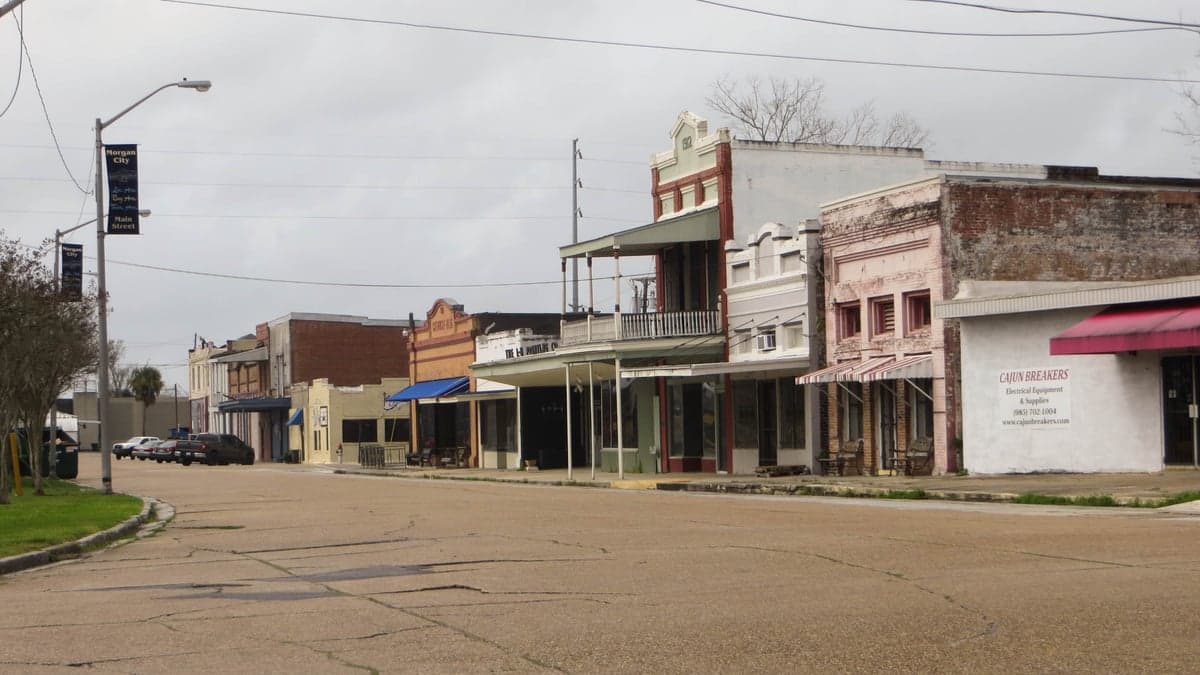
Photo: Wikipedia
Strategic Assessment of Morgan City, LA
Meaningful friction. Expect exposure to either population pressure, blast zones, or natural disaster risk. Consider buying a retreat property.
What does the Strategic Assessment tell us?
Our Strategic Assessment grades tactical survivability of an area. Major population centers, military targets, fallout zones, natural disasters, and border exposure all drive risk — lower exposure means a more defensible position in a crisis.
This is heavily inspired by Joel Skousen's Strategic Relocation book. Highly recommended you checkout the book ($)What does this tell us?
Our Strategic Assessment grades tactical survivability of an area. Major population centers, military targets, fallout zones, natural disasters, and border exposure all drive risk — lower exposure means a more defensible position in a crisis.
This is heavily inspired by Joel Skousen's Strategic Relocation book. Highly recommended you checkout the book ($)Strategic Pillars

Key Distances
Regional Safe Places
Below is our recommended "safe zones" in Louisiana and the surrounding area based on our strategic heuristics. For most people, it's unrealistic to live in a “safe zone” full-time due to work, family or other personal reasons. They tend to be more rural. However, many of these areas are perfect for second homes and retreat properties that double as a vacation home or even a short-term rental.

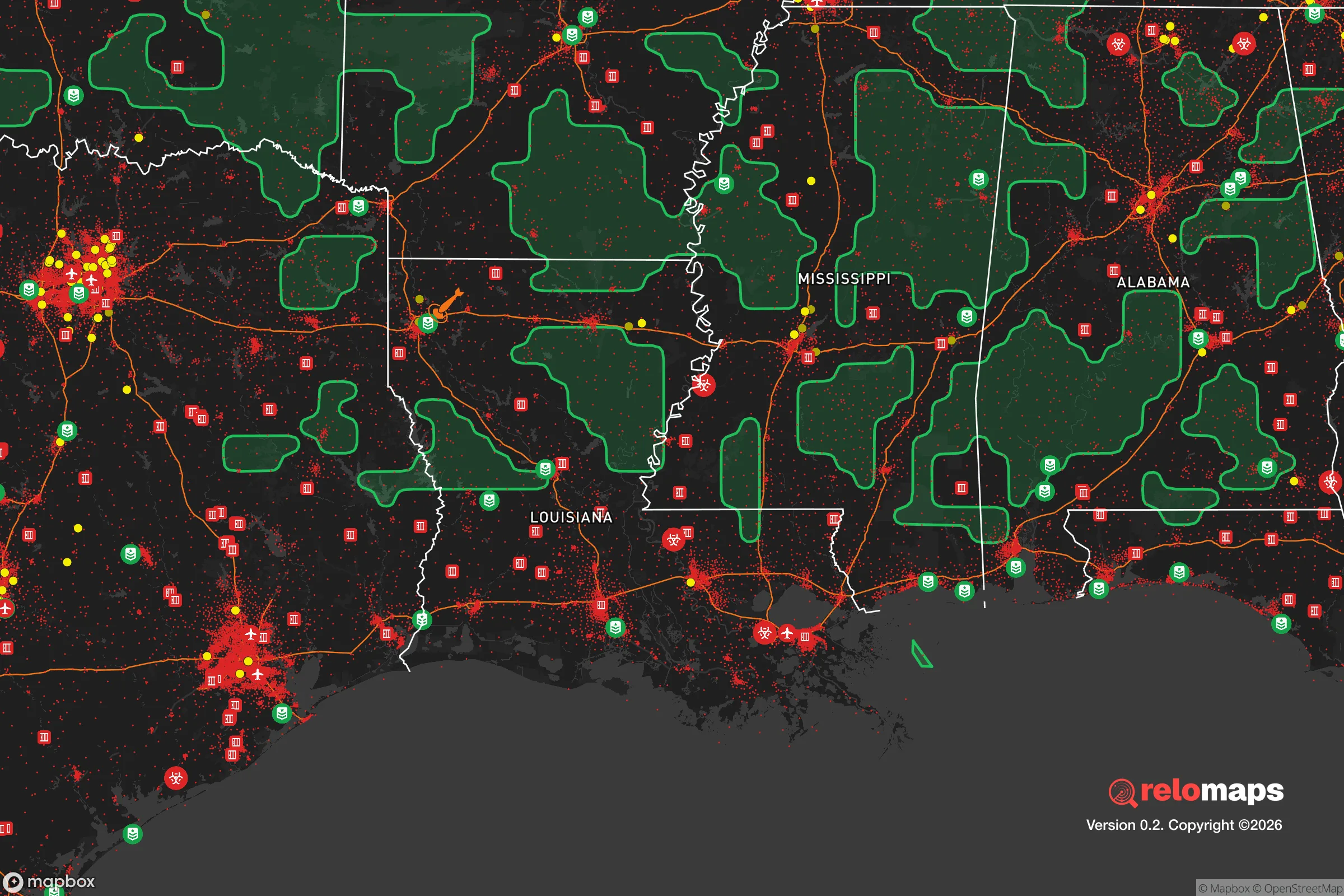


Important Note: For informational purposes only. This does not mean nothing bad ever happens in the green zones. Please use common sense. This is based on public data and modeled with AI. We tried to take a conservative approach but mistakes happen. We update this regularly as new information becomes available.
Solar Generator Recommendations
Backup power matters more here than in safer locations. We've picked three solar generators across budgets and capacity tiers — start with the budget unit if you only need a few essentials, or step up if you want to run a fridge and HVAC for days at a time.

Jackery Portable Power Station Explorer 300
Budget OptionPower on the Go: Weighing only 11 lbs, it's convenient to set up and store with book-sized foldable solar panels

BLUETTI Portable Power Station AC180
Designed for both indoor and outdoor scenarios, AC180 is highly capable as it has a robost capacity and continuous output power.

EF ECOFLOW DELTA Pro Ultra Power Station
Upgraded PickEcoFlow DELTA Pro Ultra is a whole-home energy system designed to grow with your family. Integrated with the Smart Home Panel 2, it scales to meet your evolving energy needs — keeping your home powered, intelligent, and secure through every stage of life.
We earn a commission, at no additional cost to you.
Strategic Assessment Analysis
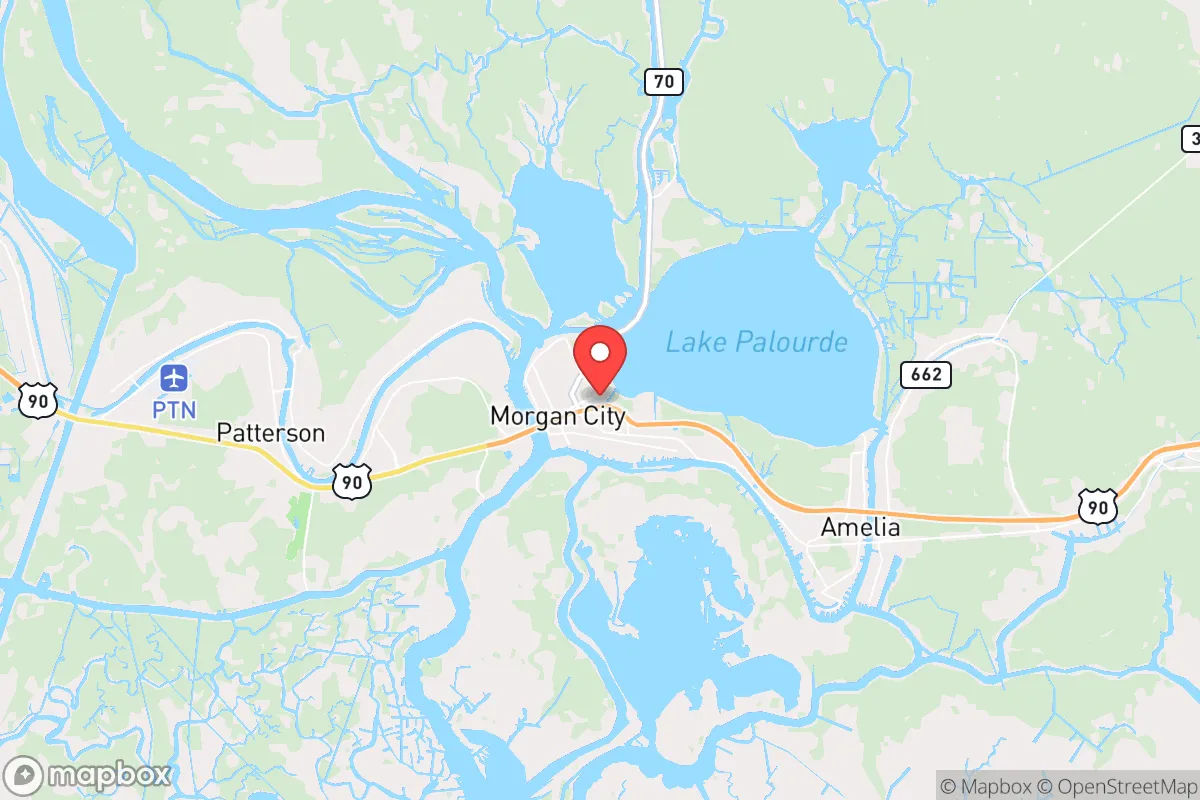
Morgan City, Louisiana, sits in a strategic sweet spot that most relocation analysts overlook, offering genuine resilience advantages for those thinking ahead about civic unrest, supply chain disruptions, and natural disaster fallout. Positioned roughly 90 miles southwest of New Orleans and 60 miles southeast of Baton Rouge, this small city of about 10,000 people occupies a narrow strip of high ground along the Atchafalaya River, giving it a unique blend of isolation and accessibility that matters when the grid gets shaky. For a conservative-leaning individual or family looking to plant roots somewhere that isn't a target, Morgan City's working-class character, industrial backbone, and geographic reality make it worth a hard look—but only if you understand the trade-offs.
Geographic position and natural advantages for long-term stability
Morgan City's location is defined by water, and that's both its greatest asset and its most obvious liability. The city sits at the confluence of the Atchafalaya River and the Gulf Intracoastal Waterway, which means it has direct barge and boat access to the entire Mississippi River system and the Gulf of Mexico. For a prepper mindset, that translates into a serious logistical advantage: if highways get clogged or compromised, the waterways remain a viable alternative for moving supplies, equipment, or people. The surrounding Atchafalaya Basin is the largest swamp in the United States, a sprawling 1.4-million-acre wetland that acts as a natural buffer against large-scale development and population density. That basin is a massive, trackless wilderness that would be extremely difficult for any organized force to patrol or control, offering a backcountry escape route that few other Gulf Coast towns can match. The city itself sits on a natural levee ridge, which gives it slightly higher elevation than the surrounding marsh—enough to matter during routine flooding, though not enough to ignore hurricane storm surge entirely. For someone thinking about long-term stability, the basin also provides a virtually unlimited supply of fresh water, fish, and game, which is a hard-to-overstate advantage if supply chains ever go dark.
Risks, exposures, and proximity to fallout-relevant landmarks
Let's be blunt: Morgan City is not immune to the big risks, and pretending otherwise would be irresponsible. The most obvious exposure is hurricane storm surge. The city is roughly 25 miles inland from the Gulf of Mexico, but the Atchafalaya River acts as a conduit for surge to push north. Hurricane Andrew in 1992 and Hurricane Rita in 2005 both caused significant flooding here, and a direct hit from a Category 3 or higher storm would likely inundate large portions of the city. That means any serious prepper setup needs to account for evacuation or vertical evacuation plans—second-story storage, boats, and a bug-out location north of Interstate 10 are non-negotiable. The second major risk is industrial. Morgan City is a hub for oil and gas support services, with numerous fabrication yards, pipeline terminals, and chemical storage facilities along the river. A major industrial accident—fire, explosion, toxic release—could render parts of the city uninhabitable for days or weeks. On the plus side, the city is far enough from New Orleans and Baton Rouge that a major urban collapse or civil unrest in those cities would likely not spill over directly. The nearest military installation of strategic significance is Naval Air Station Joint Reserve Base New Orleans, about 80 miles east, which is close enough to matter if the federal government ever decides to lock down the region but far enough that Morgan City wouldn't be a primary target. There are no nuclear power plants, major military bases, or high-value infrastructure within 50 miles that would make this a first-strike location in a conflict scenario.
Practical resilience for a relocator: food, water, energy, and defensibility
For someone serious about self-sufficiency, Morgan City offers a mix of genuine assets and real gaps. Water is abundant—the Atchafalaya Basin is essentially a freshwater reservoir, and rainwater collection is straightforward given the region's 60-plus inches of annual rainfall. The city's municipal water supply comes from the river, but a well-maintained cistern or a simple rain barrel system would provide a reliable backup. Food is where this area shines. The basin is one of the most productive fisheries in North America—crawfish, catfish, bass, and blue crab are available year-round, and hunting for deer, duck, and wild hog is excellent in the surrounding public lands like the Atchafalaya National Wildlife Refuge and the Sherburne Wildlife Management Area. For gardening, the growing season is long—February through November—but the soil is mostly heavy clay and silt, so raised beds or container gardening are the practical path. Energy is a mixed bag. The local grid is served by Cleco and Entergy, both of which have a history of storm-related outages that can last days or weeks. Solar is viable, but the frequent cloud cover from Gulf moisture means you'll need a larger panel array and battery bank than you would in the Southwest. Propane is widely available due to the industrial base, and a backup generator is essentially mandatory. Defensibility is decent but not fortress-level. The city is compact, with only a few main roads in and out—Highway 90 east-west and Highway 182 north-south—which means chokepoints are easy to monitor. The surrounding swamp makes foot travel off-road extremely difficult for anyone unfamiliar with the terrain, giving locals a natural advantage. However, the city itself is not walled or gated, and the working-class neighborhoods are mostly open and accessible. A rural property on the outskirts, with a boat dock and a good view of the river approaches, would be the ideal setup for someone wanting both community access and security.
The overall strategic picture for Morgan City is that it's a solid B-tier relocation option for the conservative prepper who values practical self-sufficiency over comfort and convenience. It's not a bug-out paradise—the hurricane risk is real, the industrial hazards are present, and the local economy is tied to volatile oil and gas markets. But for someone who wants to be within a day's drive of major medical and supply hubs while maintaining a low profile in a community that still remembers how to hunt, fish, and fix things with their own hands, it's a legitimate contender. The key is to go in with eyes open: buy on high ground, invest in a boat and a generator, build relationships with the local shrimpers and trappers, and have a plan to get north of I-10 when the big one comes. If you can handle that, Morgan City offers a level of real-world resilience that most suburban subdivisions can't touch.

* Values derived from national, state, county, city and local statistics and may differ in a specific area. Last updated: 2026-05-01T04:03:57.000Z
Narrative content on this page is AI-generated and may contain mistakes. Verify any details that matter before acting on them.
ReloMaps may earn a commission from affiliate links at no extra cost to you.

