Photo: Wikipedia
Demographics of Morgan City, LA
Affluence Level in Morgan City, LA
A below-average socioeconomic profile. Incomes, home values, and educational attainment trail the U.S., with higher poverty and unemployment.
People of Morgan City, LA
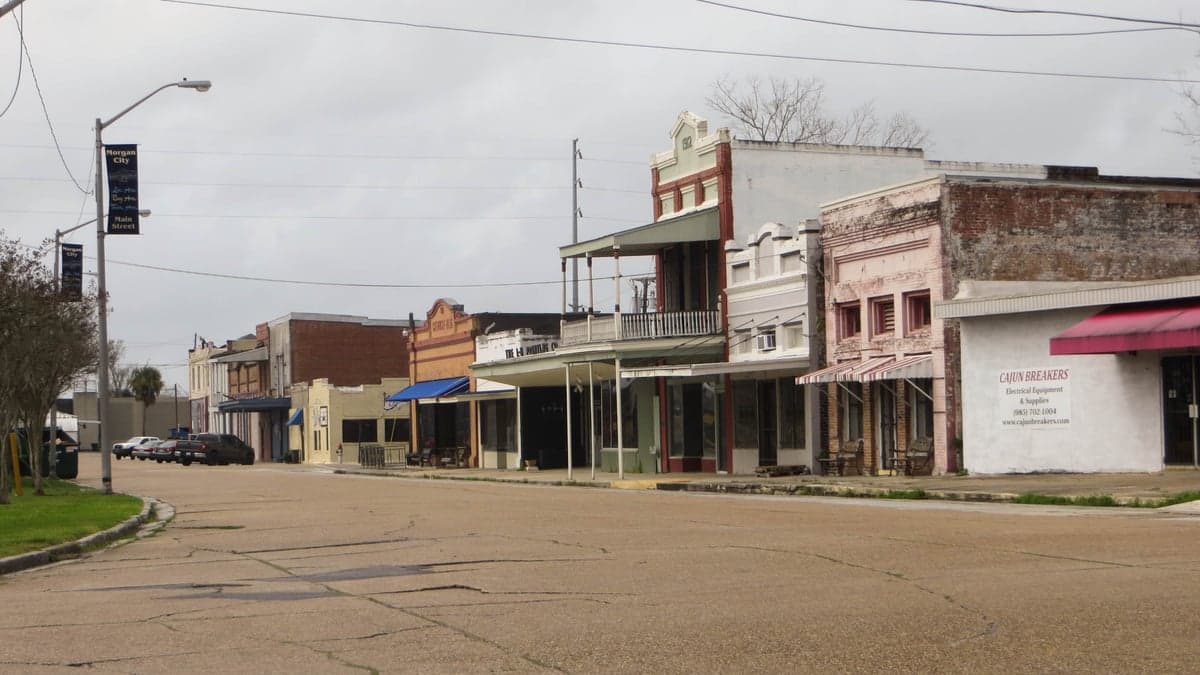
Morgan City, Louisiana, is a small, historically blue-collar community of 11,208 residents, shaped by a century of oil-and-gas and maritime industry booms. The city is predominantly White (60.5%) with significant Black (17.4%) and Hispanic (15.3%) populations, and a notably low college attainment rate (15.9%) reflecting its working-class character. Its people are defined by a strong Cajun and Creole cultural foundation, overlaid by successive waves of domestic and international workers drawn to the Atchafalaya River corridor. Today, the city feels like a stable, older industrial hub where family roots run deep, but where population has been slowly declining since the 1980s oil bust.
How the city was settled and grew
Morgan City’s human history begins with the Atchafalaya Basin’s Indigenous peoples, primarily the Chitimacha and Houma, who used the bayous for trade and settlement. French and Acadian settlers arrived in the late 1700s, establishing small farms and fishing camps along the river. The city’s modern identity was forged in the 1850s when the New Orleans, Opelousas and Great Western Railroad reached the area, and the town was officially incorporated in 1860. The original French and Acadian families settled what is now Old Town (the historic core along Front Street), building the first churches, schools, and commercial buildings. A second wave came during the 1910s–1930s, when the discovery of oil and gas in South Louisiana drew workers from rural Acadiana and Texas. These domestic migrants, mostly White and Cajun, filled neighborhoods like Garden City and Lake End, building modest homes near the shipyards and oilfield supply docks. The city’s Black population grew during the same period, as African American families moved from surrounding plantations into the “Back of Town” area (roughly bounded by Federal Avenue and the railroad tracks), establishing a separate but vibrant community with its own churches, businesses, and a segregated school system that lasted into the 1960s.
Modern era (post-1965)
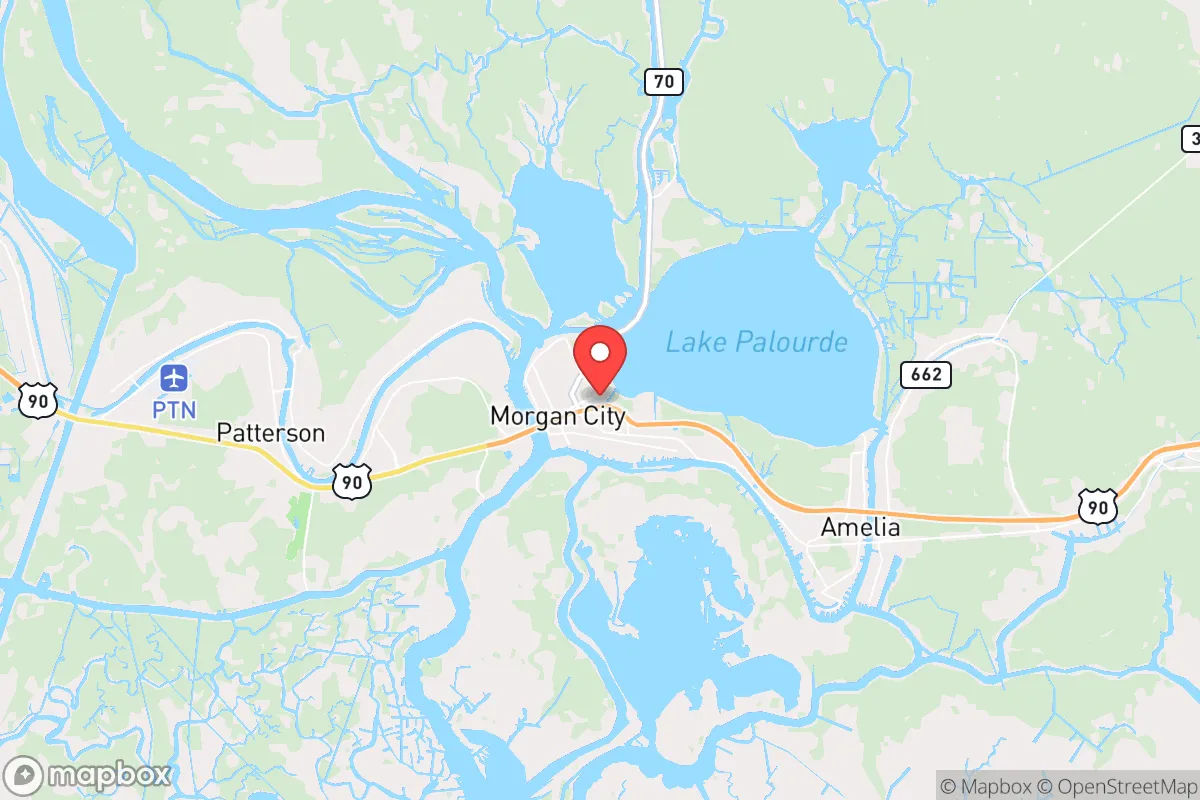
The 1965 Hart-Cellar Act had a modest but real effect on Morgan City. The city’s foreign-born population today is just 4.3%, but that share is almost entirely post-1965. The most visible change was the arrival of Southeast Asian refugees—primarily Vietnamese and Laotian—in the late 1970s and 1980s, recruited to work in the shrimp and fishing industries. These families settled in the Bayou Vista area (an unincorporated suburb just east of the city limits) and along the La. 182 corridor, where they established small seafood processing businesses and Catholic churches. The East/Southeast Asian population now stands at 1.6%. Meanwhile, the Hispanic population (15.3%) grew steadily from the 1990s onward, driven by Mexican and Central American workers in construction, oilfield services, and seafood processing. These newer arrivals concentrated in the Amelia area (west of the city) and in rental housing near the industrial canal. The White population, which was over 75% in 1980, has declined to 60.5% as younger families left for larger cities and the oil industry downsized. The Black population has remained stable at around 17%, concentrated in the historic Back of Town and newer subdivisions like South Morgan City. The city’s overall population peaked at roughly 16,000 in 1980 and has since fallen to 11,208, reflecting the loss of oilfield jobs and limited economic diversification.
The future
Morgan City’s population is likely to continue a slow decline, with the White and Black populations aging and the Hispanic and Southeast Asian communities plateauing. The city is not tribalizing into distinct enclaves—most neighborhoods are mixed by income and ethnicity—but the Hispanic population is growing faster than others, concentrated in the western and southern edges. The foreign-born share (4.3%) is low by national standards and is not expected to surge, as the local economy offers few entry-level jobs outside of seasonal seafood work. The college-educated share (15.9%) is among the lowest in Louisiana, which limits the city’s ability to attract tech or professional-service employers. Over the next 10–20 years, Morgan City will likely become slightly more Hispanic and slightly older, with the White population continuing to shrink. The city’s character will remain working-class and family-oriented, but without a major new industry or infrastructure investment, the population will stabilize at around 10,000–11,000.
For someone moving in now, Morgan City offers a low-cost, tight-knit community with deep Cajun and Creole roots, but limited economic mobility and a slowly shrinking population. The city is becoming more Hispanic and more diverse in its working-class base, but it remains a place where family history and local industry—not new arrivals—define the social fabric. Newcomers will find a welcoming but insular environment, where most social life revolves around churches, hunting camps, and high school football.

* Values derived from national, state, county, city and local statistics and may differ in a specific area. Last updated: 2026-05-01T04:03:57.000Z
Narrative content on this page is AI-generated and may contain mistakes. Verify any details that matter before acting on them.
ReloMaps may earn a commission from affiliate links at no extra cost to you.

