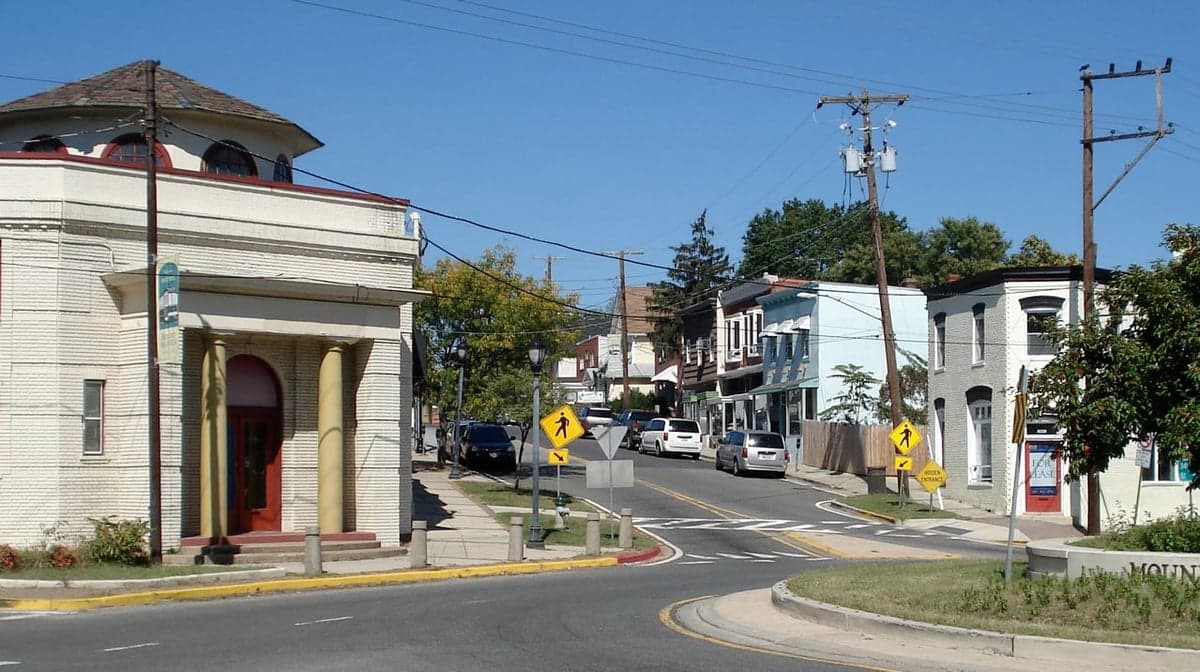
Photo: Wikipedia
Personal Sovereignty in Mount Rainier, MD
Viable for self-reliance. Generally workable, though some barriers may limit total independence.
What does Personal Sovereignty tell us?
Personal Sovereignty measures your capacity for self-reliance and independence with minimal government friction. Higher scores mean fewer barriers between you and the way you want to live... but it assumes you have the space you need and good neighbors.
What does this tell us?
Personal Sovereignty measures your capacity for self-reliance and independence with minimal government friction. Higher scores mean fewer barriers between you and the way you want to live... but it assumes you have the space you need and good neighbors.
State Policy
Energy independence: Importer (8% of energy produced in-state)
Personal Liberty
Homesteading

Personal Liberty Analysis
Mount Rainier, Maryland, presents a complex picture for those prioritizing personal sovereignty. While the city itself is a small, walkable enclave with a strong community identity, it sits firmly within Prince George's County and the broader state of Maryland—a jurisdiction known for its dense regulatory environment and progressive governance. For a survivalist or prepper mindset, the immediate takeaway is that Mount Rainier offers limited room for the kind of autonomous, off-grid lifestyle that maximizes individual freedom, but it does provide a unique base for those who value community resilience and are willing to navigate a high-tax, high-regulation landscape. The trade-off here is stark: you gain proximity to the political and economic power of the D.C. metro area, but you cede significant control over your property, your healthcare choices, and your self-defense rights.
Tax burden and regulatory posture in Prince George's County
Maryland is consistently ranked among the least tax-friendly states in the nation, and Mount Rainier residents feel this acutely. The state's income tax is progressive, with rates climbing to 5.75%, and Prince George's County adds its own local income tax of 3.2%, bringing the combined top marginal rate to nearly 9%. Property taxes are also substantial, with the county's effective rate hovering around 1.1% of assessed value, and the state adds another layer of taxation on estates and inheritances. For a prepper focused on financial independence, this tax burden directly reduces the capital available for land, supplies, and self-reliance investments. The regulatory posture is equally restrictive. Maryland has some of the strictest environmental and land-use regulations in the Mid-Atlantic, including the Maryland Department of the Environment's (MDE) stringent stormwater management and critical area laws that can complicate even minor property modifications. Building permits, septic system approvals, and any kind of structural change require extensive county review, making it difficult to quickly adapt a property for self-sufficiency without bureaucratic delays. The state's overall regulatory climate is best described as "permission-based," which runs counter to a sovereignty-first philosophy.
Self-defense and gun law specifics in Maryland
For those who view the Second Amendment as a cornerstone of personal sovereignty, Maryland is a challenging environment. The state has a "may-issue" concealed carry permit system, but after the Supreme Court's Bruen decision, the state shifted to a "shall-issue" framework with objective criteria. However, the process remains onerous: applicants must complete a 16-hour training course, pass a live-fire qualification, and undergo a thorough background check that includes fingerprinting. The state also maintains a handgun roster that bans many popular models, and the "assault weapons" ban prohibits the sale of many semi-automatic rifles, including AR-15s, which are standard for home defense and prepper arsenals. Magazine capacity is capped at 10 rounds for long guns and 10 rounds for handguns. Prince George's County itself has no additional local gun laws beyond state statutes, but the county's police department is known for strict enforcement. For a prepper, this means building a defensive capability is legally constrained, and the state's "red flag" law allows for temporary firearm seizure based on a petition, which many conservatives view as a due process violation. Self-defense in Mount Rainier is legally possible but heavily regulated, requiring significant paperwork, cost, and compliance.
Self-reliance and homesteading viability: lot sizes, zoning, and off-grid feasibility
Mount Rainier is an older, densely developed inner-ring suburb with typical lot sizes ranging from 4,000 to 7,000 square feet. Zoning is predominantly R-55 (Residential, 5,500 square foot minimum lot size), which allows for single-family homes but severely restricts agricultural or homesteading activities. Keeping chickens is permitted in Prince George's County with a permit and specific coop setbacks, but larger livestock like goats or pigs are prohibited. Off-grid living is essentially impossible within city limits because the municipality requires connection to public water and sewer systems. Solar panels are allowed but must comply with county building codes and homeowner association rules if applicable, and net metering is available but subject to state utility regulations. Rainwater collection is legal but limited to non-potable uses, and any significant water storage system requires permits. For a prepper seeking true self-reliance—growing food, harvesting water, generating power—Mount Rainier's small lots and strict zoning make it a poor fit. The best strategy here is to view the property as a "base camp" for urban resilience, not a homestead. You can maintain a robust vegetable garden, store supplies, and build community networks, but you will remain dependent on municipal infrastructure and the grid.
Personal liberties: parental rights, medical autonomy, speech, and property
Maryland's legal landscape on personal liberties is mixed, with some protections and notable overreaches. On parental rights, the state has a strong presumption of shared custody in divorce proceedings, but it also mandates comprehensive sex education in public schools, which includes LGBTQ+ topics, and parents cannot opt their children out of the entire curriculum—only specific lessons. This is a flashpoint for conservatives who believe in parental authority over education. Medical autonomy is heavily restricted: Maryland has some of the strictest vaccine mandates in the country, including requirements for school attendance that allow only narrow medical exemptions, not religious or philosophical ones. The state also has a robust public health infrastructure that can impose quarantine and isolation orders. On speech, Maryland has a "false light" privacy tort that can be used to sue for speech that portrays someone in a misleading way, which some view as a chilling effect on free expression. Property rights are constrained by the state's strong eminent domain powers and the aforementioned regulatory hurdles. For a prepper, the biggest concern is the state's ability to mandate medical interventions and restrict property use without compensation. Personal sovereignty in Mount Rainier is significantly curtailed by state-level mandates on education, health, and land use.
In the broader context of the Mid-Atlantic, Mount Rainier offers a low level of personal sovereignty compared to more rural, less regulated areas like western Maryland or parts of Virginia. The combination of high taxes, restrictive gun laws, dense zoning, and state-level mandates on health and education creates an environment where individual autonomy is constantly negotiated with government authority. For a prepper or survivalist, this is not a place to "bug out" to, but it could serve as a strategic urban node for those who value community, political engagement, and the ability to influence local governance. The trade-off is clear: you trade maximum freedom for proximity to power and resources. If your priority is absolute self-reliance, look elsewhere. If you are willing to work within the system while building a resilient network, Mount Rainier can be a viable, if constrained, base of operations.

* Values derived from national, state, county, city and local statistics and may differ in a specific area. Last updated: 2026-04-22T02:58:03.000Z
Narrative content on this page is AI-generated and may contain mistakes. Verify any details that matter before acting on them.
ReloMaps may earn a commission from affiliate links at no extra cost to you.

