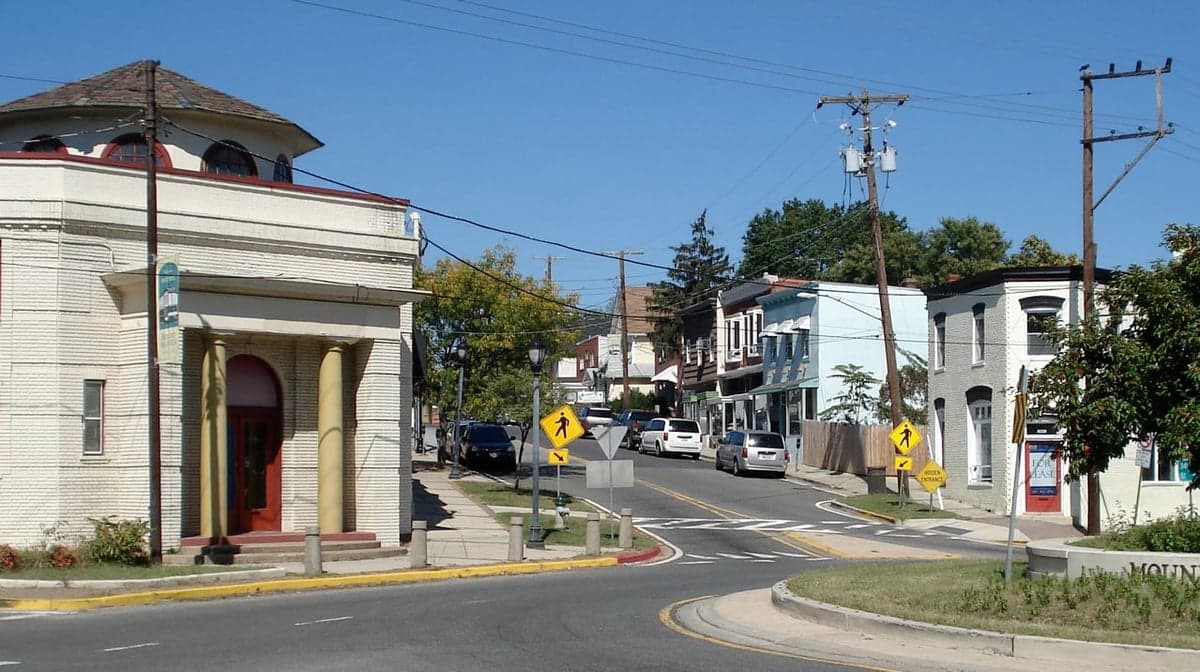
Photo: Wikipedia
Political ClimatePolitical Climate in Mount Rainier, MD
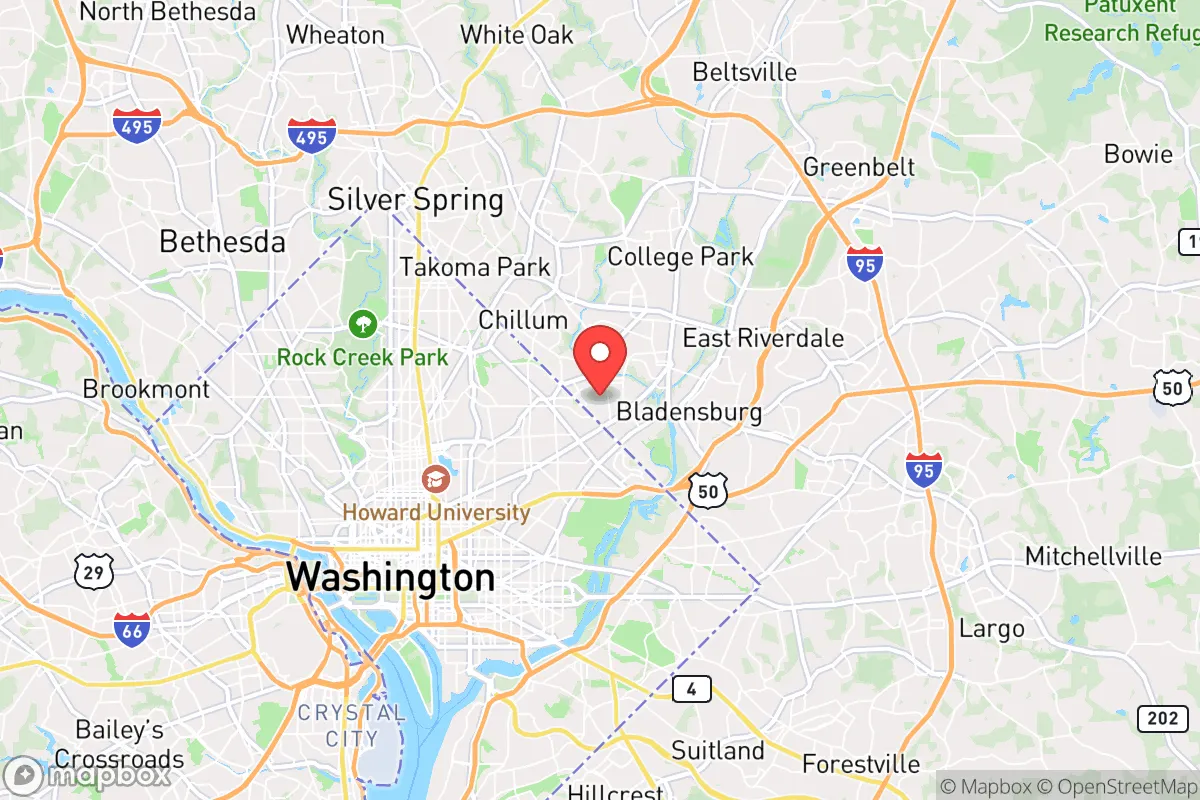
District shown is the primary district for this city’s centroid. Cities may span multiple districts.
Local Political AnalysisPolitical Analysis of Mount Rainier, MD
Mount Rainier, Maryland, is about as deep blue as it gets in the D.C. suburbs, with a Cook PVI of D+39, meaning it votes nearly 40 points more Democratic than the national average. That’s not just a lean; it’s a full-on ideological lockstep that’s been tightening for years. If you’re looking for a place where local government respects personal freedoms and keeps its nose out of your business, this isn’t it—and it’s only getting worse. The trajectory here is toward more regulation, more progressive social engineering, and less tolerance for anyone who questions the direction.
How it compares
To understand how far left Mount Rainier has drifted, look at the towns just a few miles away. Head north to Hyattsville or College Park, and you’ll find similar progressive strongholds—though even Hyattsville feels a bit more moderate by comparison. But drive 15 minutes east to Brentwood or North Brentwood, and you’re still in deep-blue territory. The real contrast is with places like Bowie or Upper Marlboro to the southeast, where you’ll find more moderate Democrats and even a few Republicans who can speak openly without getting side-eyed. Mount Rainier, though, is the epicenter of the area’s most aggressive progressive activism. It’s not just voting blue; it’s pushing policies that feel like government overreach—like strict rent control measures and zoning rules that tell property owners what they can and can’t do with their land. Neighboring towns like Edmonston have similar vibes, but Mount Rainier takes the cake for being the most ideologically uniform and least tolerant of dissent.
What this means for residents
For the average person living here, the political climate means you’re constantly dealing with new rules and regulations that chip away at your personal freedoms. The city council and county government are all-in on progressive priorities—think expanded public health mandates, aggressive environmental regulations that can affect your home renovations, and a police department that’s been defunded in spirit if not in name. If you own a small business, you’re navigating a maze of local licensing and fee hikes that seem designed to favor big chains over mom-and-pops. And if you’re a gun owner or just someone who values privacy, forget it—the county’s red flag laws and surveillance-friendly policies make you feel like you’re always being watched. The schools are solid, but the curriculum leans heavily into social justice themes that might not sit well with parents who want a more traditional education. Longtime residents will tell you it wasn’t always this way; Mount Rainier used to be a quiet, working-class suburb where people minded their own business. Now, it feels like every block has a neighborhood association pushing the latest progressive cause.
One cultural distinction that stands out is the city’s embrace of “sanctuary” policies and its willingness to challenge state and federal authority on immigration enforcement. While that might sound noble to some, it creates a sense of lawlessness that worries folks who just want safe streets and clear rules. The local arts scene is vibrant, but it’s also heavily politicized—most events and murals carry an activist message. If you’re looking for a place where you can live quietly without being lectured, Mount Rainier is probably not your spot. The long-term outlook? Expect more of the same, with the city doubling down on progressive policies as the D.C. metro area continues to pull left. For those who value personal liberty and limited government, it’s a tough place to call home.

State Political ClimatePolitical Climate in Maryland
State Political AnalysisPolitical Environment in the State
Maryland has long been one of the most reliably Democratic states in the nation, but don’t let the blue veneer fool you—this is a state of stark political contrasts. Over the past 20 years, the state has shifted from a moderate, blue-collar Democratic stronghold to a deeply progressive one, driven almost entirely by the suburban explosion around Washington, D.C. and Baltimore. While the state hasn’t voted Republican in a presidential race since 1988, the real story is the widening chasm between the hyper-liberal urban core and a fiercely independent, increasingly conservative rural and exurban fringe.
Urban vs. rural divide
The political map of Maryland is essentially two countries. The western panhandle, from Hagerstown to Cumberland, and the entire Eastern Shore—places like Salisbury and Easton—vote reliably Republican, often by 20-30 point margins. Meanwhile, the D.C. suburbs—Montgomery County, Prince George’s County, and increasingly Howard County—are among the most liberal jurisdictions in America, routinely delivering 75-80% of the vote to Democrats. Baltimore City is its own beast, a deep-blue urban core with declining population but outsized political influence. The real battlegrounds are the exurban counties like Frederick County and Carroll County. Frederick, once a conservative stronghold, has flipped purple and is trending blue as D.C. commuters push north. Carroll County, anchored by Westminster, remains a rare redoubt of conservative voting in the central part of the state, but even there, the margins are shrinking as development creeps in.
Policy environment
Maryland’s policy environment is a textbook case of progressive governance with a heavy hand. The state has a progressive income tax structure with rates topping out at 5.75%, but when you add county-level “piggyback” taxes, effective rates can exceed 8% in places like Montgomery County. Property taxes are high, and the state’s estate tax kicks in at just $5 million, making it one of the worst states for wealth preservation. On the regulatory front, Maryland has some of the strictest environmental and land-use laws in the country, which has made housing construction expensive and slow. Education policy is dominated by the teachers’ unions, and the state’s Blueprint for Maryland’s Future law is a massive, multi-billion-dollar funding overhaul that prioritizes equity metrics over school choice. On election law, Maryland has no-excuse mail-in voting, same-day registration, and automatic voter registration—policies that critics argue erode ballot integrity. The state also has some of the strictest gun laws in the nation, including a ban on “assault weapons” and a handgun permit system that, until a 2022 Supreme Court ruling, required applicants to demonstrate a “good and substantial reason” to carry.
Trajectory & freedom
Maryland is moving decidedly in the direction of less personal freedom, and the pace has accelerated since 2020. The Firearm Safety Act of 2013 was already among the nation’s toughest, but in 2023, the legislature passed a bill banning firearms from most public spaces, including parks and libraries, and requiring liability insurance for gun owners. On parental rights, the state passed the “Trans Health Equity Act” in 2023, which prohibits insurance companies from denying coverage for gender transition procedures for minors, effectively overriding parental consent in medical decisions. The state also passed a law in 2024 that allows non-citizens to vote in local elections in certain municipalities, including Takoma Park and Hyattsville, a policy that has sparked significant backlash. On the tax front, the state’s “digital advertising tax” was upheld by the courts in 2024, a first-in-the-nation levy that critics say will drive businesses out. The overall trajectory is clear: more regulation, higher taxes, and a shrinking sphere of individual autonomy, especially for gun owners, parents, and small business owners.
Civil unrest & political movements
Maryland has a long history of political activism, but the flashpoints have intensified. The 2015 Baltimore riots following the death of Freddie Gray were a national crisis, and the city has never fully recovered its population or economic base. The “Defund the Police” movement had real teeth in Baltimore, where the city council cut the police budget by $22 million in 2020, though crime rates have since forced a partial reversal. On the right, the “We the People” movement and local Second Amendment sanctuary resolutions have been active in rural counties like Garrett County and Allegany County, where sheriffs have publicly refused to enforce certain state gun laws. Immigration politics are a live wire: Maryland is a sanctuary state, and the “Maryland Trust Act” prohibits state and local law enforcement from cooperating with federal immigration authorities. This has created friction in communities like Frederick, where a growing Hispanic population has shifted the political calculus. Election integrity remains a hot-button issue, with Republican activists pointing to the state’s universal mail-in voting system as a source of ongoing concern, though no major fraud has been proven.
Projection
Looking ahead 5-10 years, the trend lines are not favorable for conservatives. The D.C. suburbs continue to grow, both in population and political influence, while rural counties are losing residents. The 2020 census cost Maryland one congressional seat, and the lost district was in the western part of the state. The state’s Democratic supermajority in Annapolis is likely to persist, meaning the policy trajectory—higher taxes, stricter gun laws, expanded government healthcare, and progressive education mandates—will continue. However, there are countercurrents. The exurban counties like Harford County and Carroll County are seeing an influx of families fleeing the D.C. suburbs, and if that migration accelerates, it could create new battleground districts. The state’s high cost of living and regulatory burden are also pushing some businesses and high-income earners to neighboring Pennsylvania, Delaware, or Virginia, which could eventually moderate the tax appetite in Annapolis. But for now, anyone moving to Maryland should expect a state that is becoming more progressive, more regulated, and less friendly to traditional conservative values.
For a new resident, the bottom line is this: Maryland is a beautiful state with excellent schools, great job opportunities, and stunning natural landscapes, but it comes with a heavy price tag—both financially and in terms of personal freedom. If you’re moving here, choose your county carefully. The rural western counties and the Eastern Shore still offer a more conservative lifestyle, but you’ll be fighting an uphill battle against Annapolis. If you value low taxes, gun rights, and local control, Maryland is likely not your long-term home. It’s a state where you can live well if you’re willing to pay the price, but don’t expect the political winds to shift in your favor anytime soon.
* Values derived from national, state, county, city and local statistics and may differ in a specific area. Last updated: 2026-04-22T02:58:03.000Z
Narrative content on this page is AI-generated and may contain mistakes. Verify any details that matter before acting on them.
ReloMaps may earn a commission from affiliate links at no extra cost to you.

