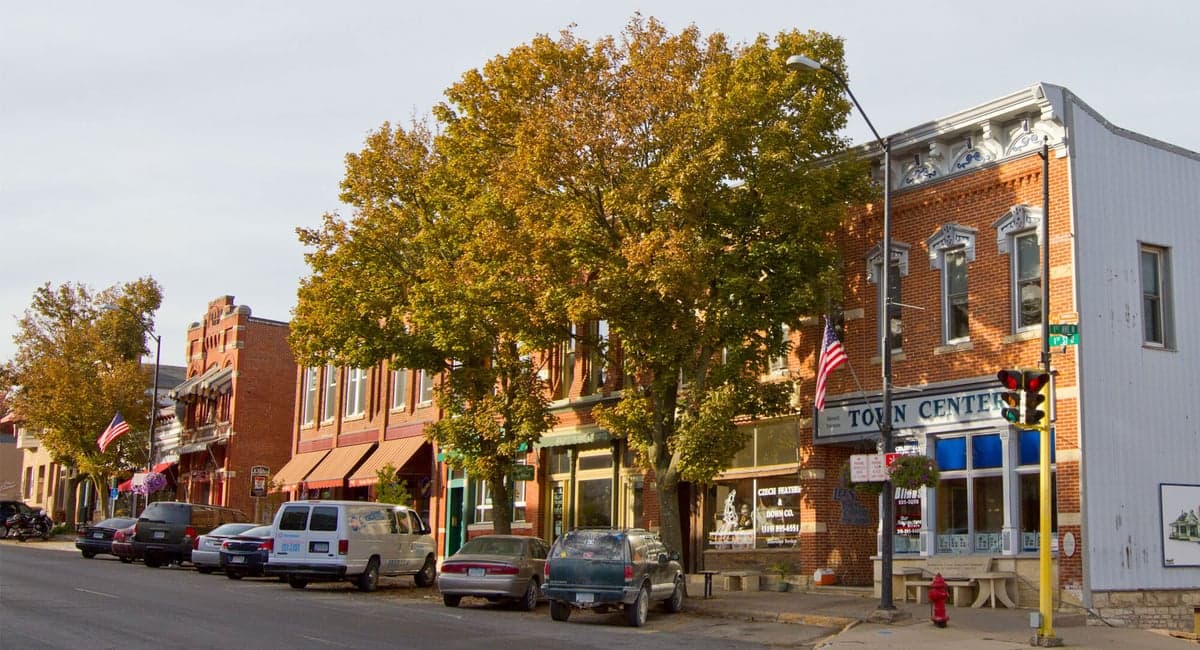
Photo: Wikipedia
Demographics of Mount Vernon, IA
Affluence Level in Mount Vernon, IA
A middle-class area roughly in line with national averages across income, home values, education, and employment.
People of Mount Vernon, IA
Mount Vernon, Iowa, is a tight-knit college town of 4,551 residents where nearly half of adults hold a bachelor’s degree or higher, a figure that reflects the deep influence of Cornell College on the community’s character. The population is overwhelmingly white (92.2%) and native-born (98.9% U.S.-born), with a small but visible Hispanic community (3.4%) and modest East/Southeast Asian (1.2%) and Black (1.8%) representation. The city balances a historic small-town identity with the intellectual and cultural currents brought by a liberal arts college, creating a place that feels both rooted and quietly progressive. For a conservative-leaning audience, Mount Vernon offers a stable, family-oriented environment with strong schools and a walkable downtown, though its demographic homogeneity is notable even by Iowa standards.
How the city was settled and grew
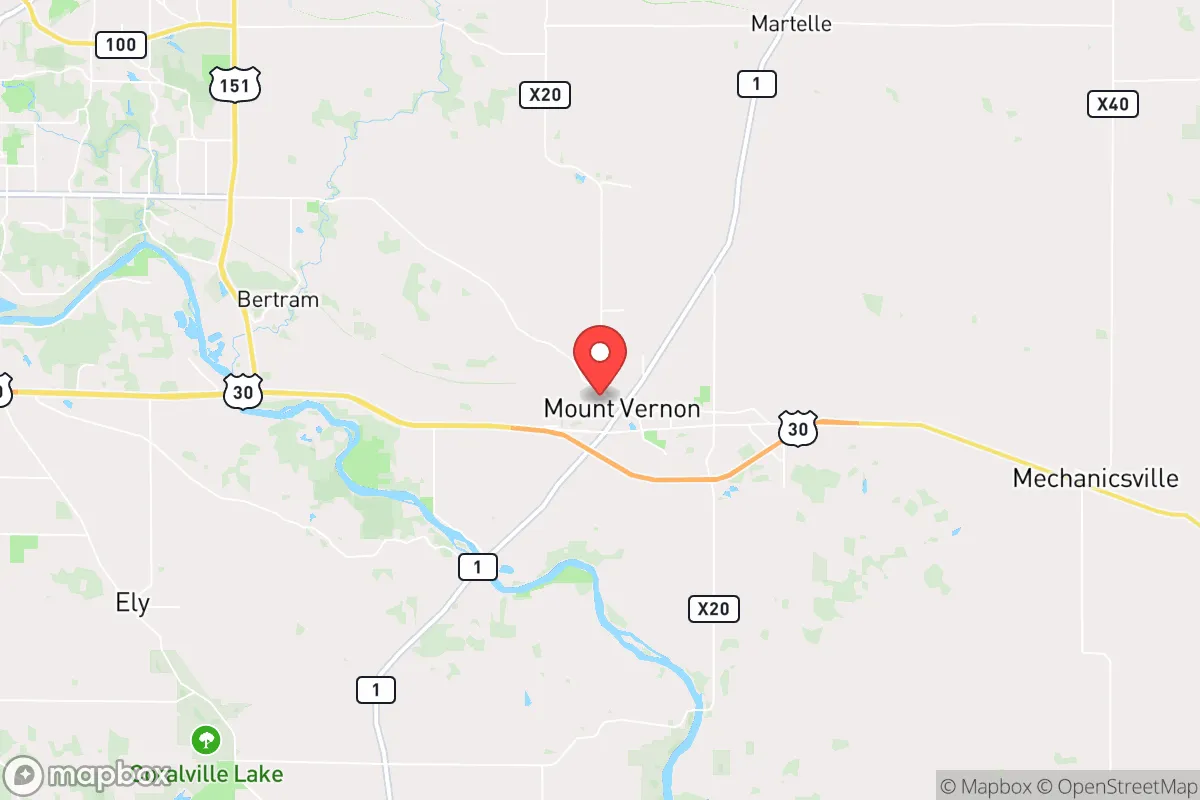
Mount Vernon’s original population arrived in the 1830s and 1840s, drawn by the fertile farmland of the Iowa Territory and the promise of a new community along the Military Road linking Dubuque to Iowa City. The town was platted in 1847, and its early settlers were overwhelmingly Yankee and German Protestant farmers and tradesmen from New England, New York, and Pennsylvania. The arrival of the Burlington, Cedar Rapids & Northern Railway in the 1850s cemented Mount Vernon as a regional shipping point for grain and livestock. The founding of Cornell College in 1853 by Methodist minister William Wesley Brown brought a second wave: educated professionals, clergy, and faculty who built homes in the College Hill neighborhood surrounding the campus. By the 1880s, a small but distinct German Catholic community had settled along the eastern edge of town, near what is now East Mount Vernon, establishing St. John’s Catholic Church as their anchor. The early 20th century saw little new immigration; Mount Vernon remained a predominantly native-born, Protestant community through the 1950s, with the West Side developing as a middle-class residential area for merchants and railroad workers.
Modern era (post-1965)
The post-1965 period brought modest demographic change, largely through domestic in-migration rather than foreign immigration. The expansion of Cornell College’s enrollment in the 1970s and 1980s attracted faculty and staff from outside the Midwest, many of whom settled in the North Campus area and the newer Woodland Estates subdivision west of Highway 1. These newcomers were predominantly white and college-educated, reinforcing the city’s existing character rather than diversifying it. The Hispanic population, now 3.4%, began growing in the 1990s as agricultural and construction workers moved into the region; most Hispanic residents today live in the South Mount Vernon area near the industrial park, though the community remains small and dispersed. The Black and East/Southeast Asian populations (1.8% and 1.2%, respectively) are largely tied to Cornell College — international students and faculty families who tend to live in rental housing near campus or in the College Hill historic district. Mount Vernon has not experienced the suburban sprawl that transformed nearby Cedar Rapids; its growth has been slow and organic, with new single-family homes concentrated in the Prairie View development on the northwest edge.
The future
Mount Vernon’s population is projected to grow slowly, reaching roughly 5,000 by 2040, driven primarily by natural increase and domestic migration from the Cedar Rapids metro area. The city is becoming slightly more diverse, but the pace is glacial: the Hispanic share may rise to 5-6% over the next decade as agricultural labor demand persists, while the East/Southeast Asian and Black shares are likely to remain below 3% each, tied to Cornell College’s international recruitment. The Indian subcontinent population is effectively zero and is not expected to grow absent a major employer shift. New residential development is concentrated in the Prairie View and West Ridge subdivisions, which are attracting young families from Cedar Rapids seeking lower taxes and better schools. The cultural identity of Mount Vernon is evolving from a quiet farm-service town into a commuter suburb with a college-town overlay — a shift that may gradually dilute the historic Yankee-German character but will likely preserve the city’s reputation for safety, education, and civic engagement.
For someone moving in now, Mount Vernon offers a stable, highly educated community with excellent schools and a low crime rate, but little racial or ethnic diversity. The city is becoming more suburban and commuter-oriented, yet it retains a distinct small-college-town feel that sets it apart from the generic subdivisions of Cedar Rapids’ outer ring. New residents will find a place that values tradition, education, and neighborly connection — a deliberate, slow-growing community unlikely to experience rapid demographic change in the coming decades.

* Values derived from national, state, county, city and local statistics and may differ in a specific area. Last updated: 2026-10-20T17:16:53.000Z
Narrative content on this page is AI-generated and may contain mistakes. Verify any details that matter before acting on them.
ReloMaps may earn a commission from affiliate links at no extra cost to you.

