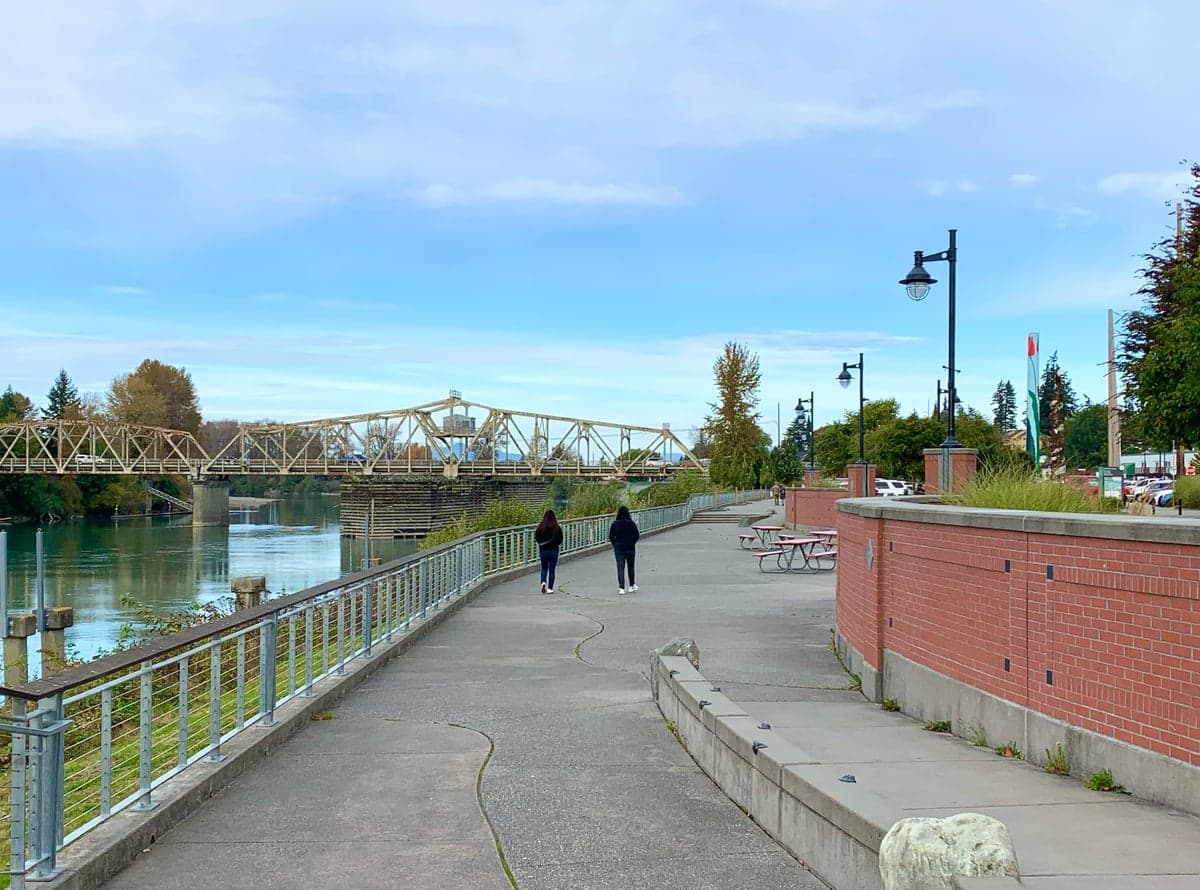
Photo: Wikipedia
Demographics of Mount Vernon, WA
Affluence Level in Mount Vernon, WA
A middle-class area roughly in line with national averages across income, home values, education, and employment.
People of Mount Vernon, WA
The people of Mount Vernon, Washington, today number 35,312, forming a community defined by its agricultural roots and a growing Hispanic majority. The city is notably more diverse than Skagit County as a whole, with a 54.6% white population and a 35.7% Hispanic or Latino share, creating a distinctive blend of long-standing farming families and newer immigrant communities. With only 25.6% of adults holding a bachelor’s degree, the population skews working-class, and the city’s identity remains tied to the Skagit Valley’s tulip fields, dairy farms, and berry crops. This is a place where the old-stock pioneer families and recent arrivals from Latin America coexist in a landscape still shaped by the river and the railroad.
How the city was settled and grew
Mount Vernon’s human history begins with the Coast Salish peoples, particularly the Swinomish and Upper Skagit tribes, who used the confluence of the Skagit River and its forks as a seasonal fishing and trading site. Euro-American settlement began in the 1870s, when pioneers like Jasper Gates and Harrison Clothier claimed land under the Donation Land Claim Act, drawn by the fertile floodplain. The arrival of the Seattle, Lake Shore & Eastern Railway in 1889 transformed the hamlet into a shipping hub for lumber, hops, and later dairy products. The original settlers were overwhelmingly of Northern European stock—English, German, and Scandinavian—who established farms along the river bottoms. The historic Downtown Mount Vernon district, centered on Kincaid Street and First Street, grew as the commercial core for these early families, while the Hillcrest neighborhood, rising east of downtown, became home to the merchant class and professionals by the early 1900s. A second wave of European immigrants—Dutch and Finnish farmers—arrived in the 1910s and 1920s, draining wetlands and establishing the dairy industry that would define the local economy for decades. These groups settled in the West Mount Vernon area, near the river, where small truck farms and creameries dotted the landscape.
Modern era (post-1965)
The post-1965 period brought the most significant demographic shift. The Immigration and Nationality Act of 1965 opened doors for new migration streams, but Mount Vernon’s Hispanic population began to grow noticeably in the 1980s and 1990s, driven by demand for agricultural labor in the Skagit Valley’s berry, tulip, and vegetable fields. Migrants from Mexico and Central America—primarily from Jalisco, Michoacán, and Guatemala—settled initially in the Riverside neighborhood, a working-class area along the Skagit River’s south bank, where older housing stock and proximity to farm jobs made it a natural entry point. By the 2000s, the Hispanic community had expanded into the South 13th Street corridor and the Fir Street area, where a cluster of Mexican grocery stores, taquerias, and Spanish-language churches now anchor daily life. The white population, meanwhile, has aged and suburbanized, with many families moving to the Lake McMurray area or the newer subdivisions east of Interstate 5. The Asian population remains small at 2.6% (East/Southeast Asian) and 0.5% Indian, concentrated in the College Way corridor near Skagit Valley College, where a handful of Filipino and Vietnamese families have settled since the 1990s. The Black population, at 1.3%, is tiny and dispersed, with no single neighborhood concentration. The foreign-born share of 9.6% is almost entirely Hispanic, reflecting the ongoing labor-driven migration that continues to reshape the city.
The future
Mount Vernon’s population trajectory points toward continued Hispanic growth and white demographic decline. The Hispanic share has risen from roughly 25% in 2000 to 35.7% today, and given the younger age structure of Hispanic families (median age around 26 versus 42 for whites), that share will likely approach 45-50% by 2040. The city is not tribalizing into hostile enclaves—neighborhoods like Riverside and South 13th are predominantly Hispanic, but there is no evidence of self-segregation by choice; rather, it reflects housing affordability and proximity to farm work. The white population is aging in place in Hillcrest and the newer subdivisions east of I-5, while younger white families increasingly choose suburbs like Burlington or Sedro-Woolley. The East/Southeast Asian and Indian communities are small and stable, unlikely to grow significantly without a major employer or university expansion. The city’s future is one of a working-class, bilingual community where the tulip fields and dairy farms remain central to the economy, but the workforce and culture are increasingly Latino. For a conservative-leaning newcomer, this means a place where traditional agricultural values persist, but where Spanish is heard as often as English in the grocery store and at school events.
Mount Vernon is becoming a majority-minority city in slow motion, driven by the same agricultural labor dynamics that have shaped the Skagit Valley for a century. The old pioneer families still hold civic power, but the demographic center of gravity has shifted to the Hispanic neighborhoods along the river. For someone moving in now, the city offers a stable, family-oriented environment with a strong sense of place—but the cultural and political landscape will continue to evolve as the Hispanic population grows and the white population ages. This is not a city in conflict, but one in transition, where the tulip fields bloom every spring regardless of who is tending them.

* Values derived from national, state, county, city and local statistics and may differ in a specific area. Last updated: 2026-04-21T11:08:52.000Z
Narrative content on this page is AI-generated and may contain mistakes. Verify any details that matter before acting on them.
ReloMaps may earn a commission from affiliate links at no extra cost to you.

