 Popular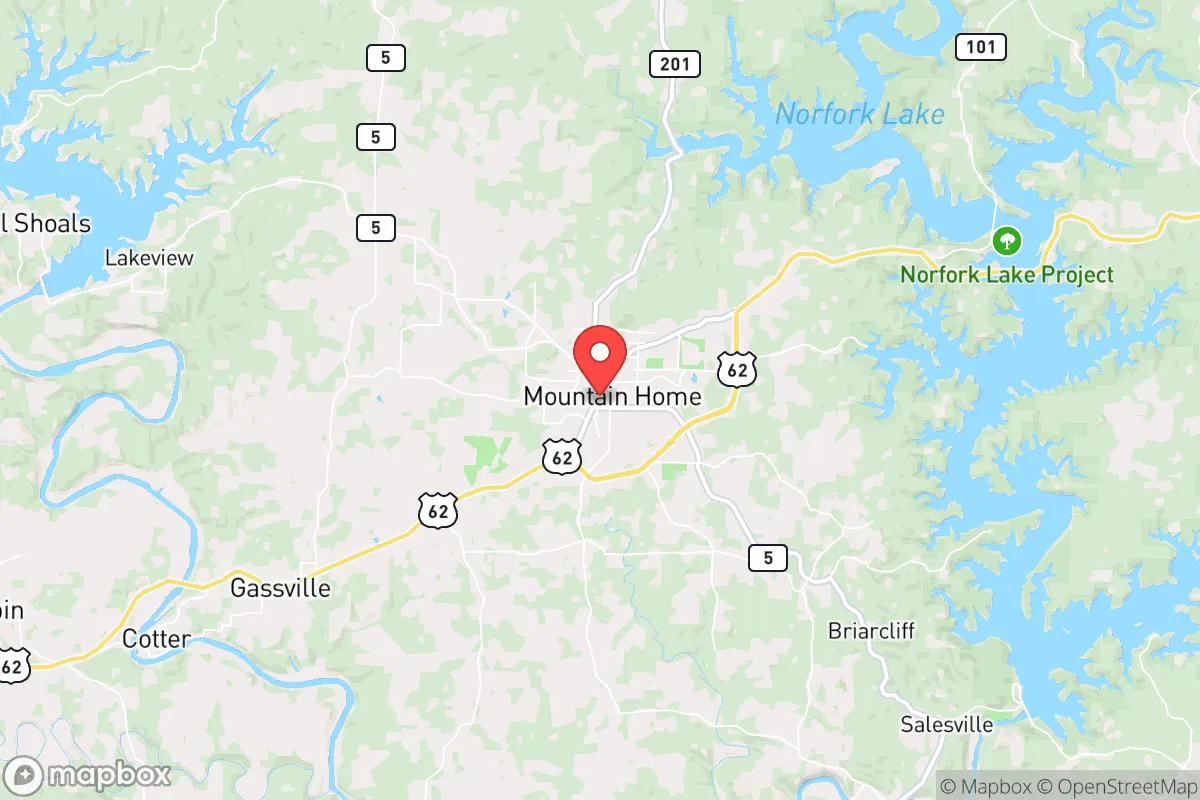
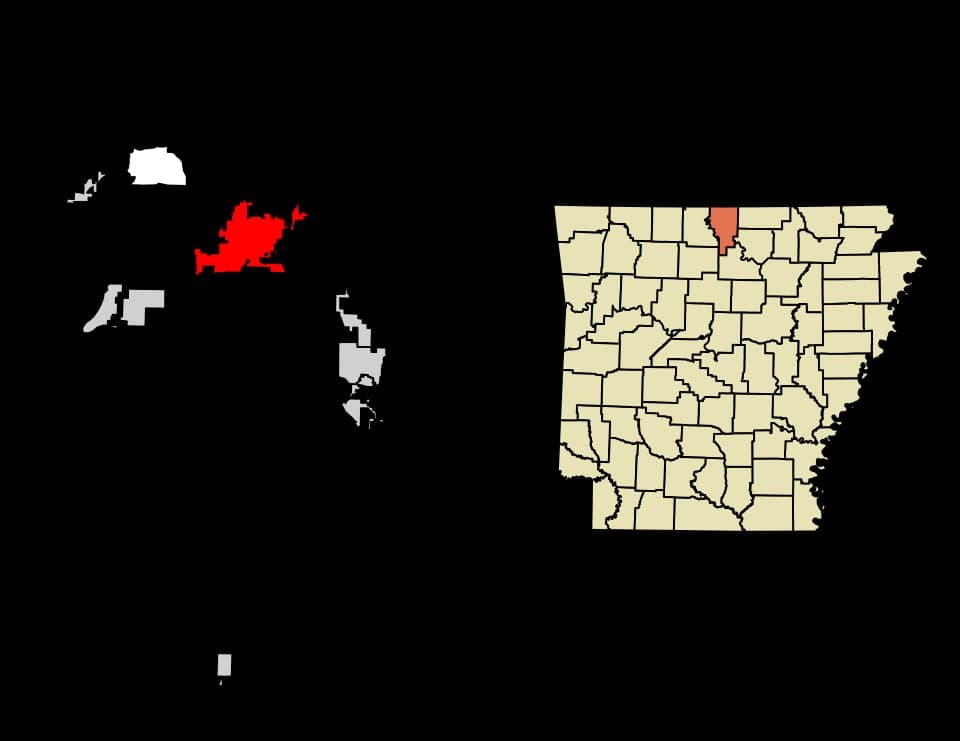
Photo: Wikipedia
Strategic Assessment of Mountain Home, AR
Workable tactical position. Some exposure to population density or targets, but generally defensible in a crisis.
What does the Strategic Assessment tell us?
Our Strategic Assessment grades tactical survivability of an area. Major population centers, military targets, fallout zones, natural disasters, and border exposure all drive risk — lower exposure means a more defensible position in a crisis.
This is heavily inspired by Joel Skousen's Strategic Relocation book. Highly recommended you checkout the book ($)What does this tell us?
Our Strategic Assessment grades tactical survivability of an area. Major population centers, military targets, fallout zones, natural disasters, and border exposure all drive risk — lower exposure means a more defensible position in a crisis.
This is heavily inspired by Joel Skousen's Strategic Relocation book. Highly recommended you checkout the book ($)Strategic Pillars

Key Distances
Regional Safe Places
Below is our recommended "safe zones" in Arkansas and the surrounding area based on our strategic heuristics. For most people, it's unrealistic to live in a “safe zone” full-time due to work, family or other personal reasons. They tend to be more rural. However, many of these areas are perfect for second homes and retreat properties that double as a vacation home or even a short-term rental.
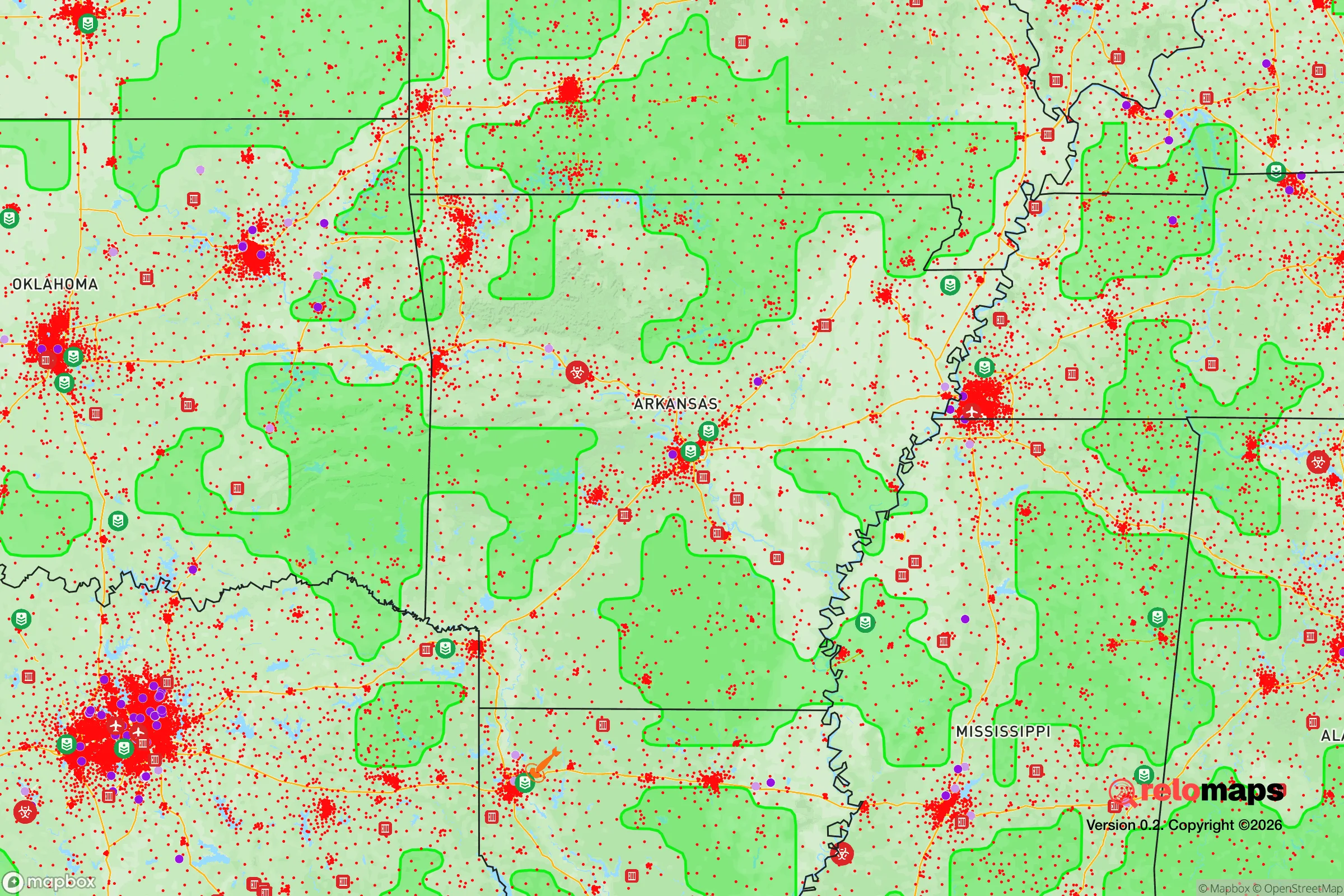
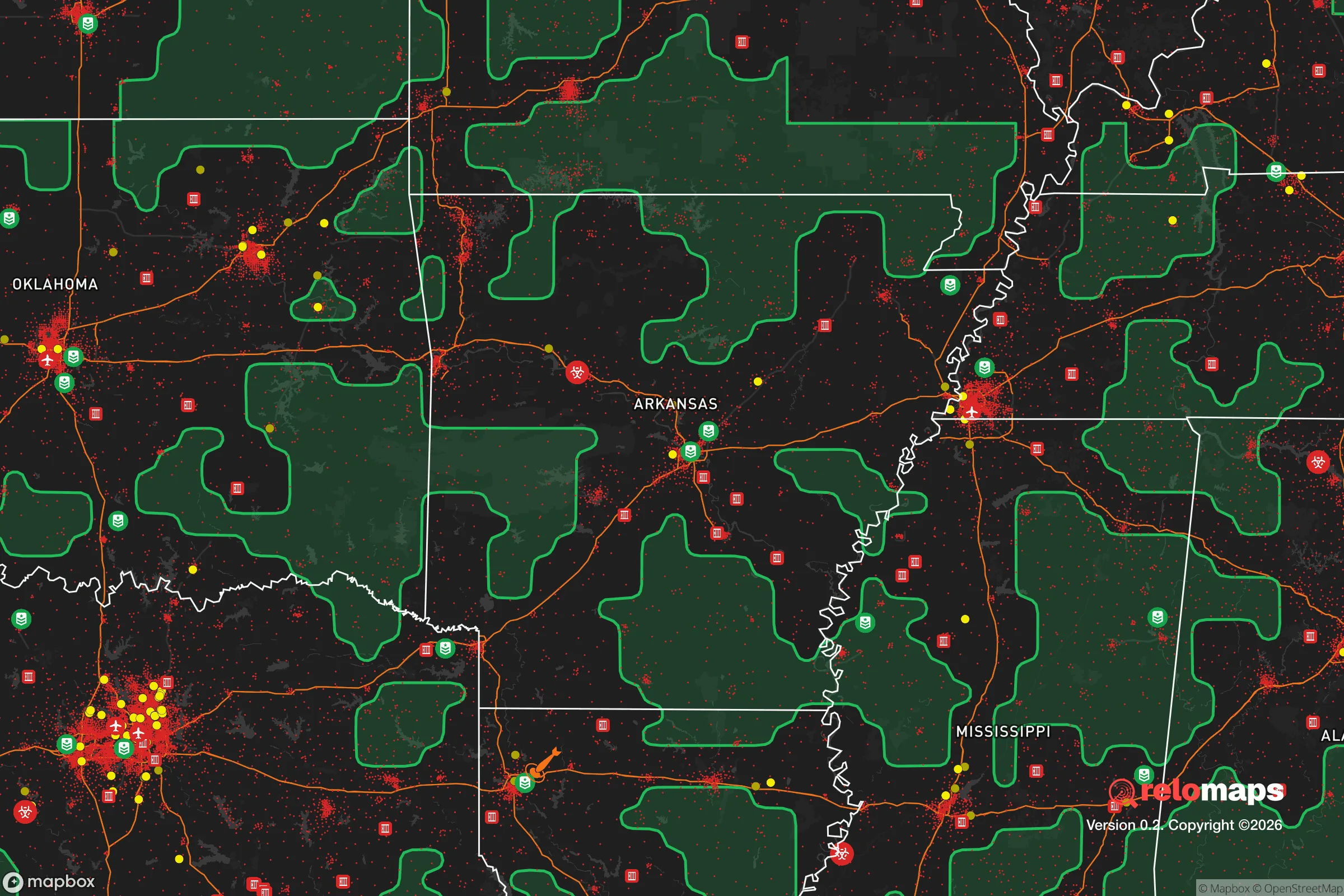


Important Note: For informational purposes only. This does not mean nothing bad ever happens in the green zones. Please use common sense. This is based on public data and modeled with AI. We tried to take a conservative approach but mistakes happen. We update this regularly as new information becomes available.
Solar Generator Recommendations
Backup power matters more here than in safer locations. We've picked three solar generators across budgets and capacity tiers — start with the budget unit if you only need a few essentials, or step up if you want to run a fridge and HVAC for days at a time.

Jackery Portable Power Station Explorer 300
Budget OptionPower on the Go: Weighing only 11 lbs, it's convenient to set up and store with book-sized foldable solar panels

BLUETTI Portable Power Station AC180
Designed for both indoor and outdoor scenarios, AC180 is highly capable as it has a robost capacity and continuous output power.

EF ECOFLOW DELTA Pro Ultra Power Station
Upgraded PickEcoFlow DELTA Pro Ultra is a whole-home energy system designed to grow with your family. Integrated with the Smart Home Panel 2, it scales to meet your evolving energy needs — keeping your home powered, intelligent, and secure through every stage of life.
We earn a commission, at no additional cost to you.
Strategic Assessment Analysis
Mountain Home, Arkansas, offers a compelling strategic position for those prioritizing resilience and self-sufficiency, anchored by its location in the north-central Ozarks and its distance from major population centers and primary fallout corridors. The area's topography, water resources, and relative isolation from interstate highways and major military or industrial targets make it a viable relocation option for individuals and families seeking to mitigate risks associated with civic unrest, economic collapse, or large-scale disasters. While no location is without vulnerabilities, Mountain Home's combination of natural barriers, a stable local economy, and a community culture that leans toward independence provides a foundation for long-term preparedness.
Geographic isolation and natural defensive advantages
Mountain Home sits in Baxter County, roughly 150 miles north of Little Rock and 120 miles south of Springfield, Missouri, placing it well outside the immediate blast and fallout zones of any major metropolitan area. The region is part of the Ozark Plateau, characterized by rugged hills, limestone bluffs, and dense hardwood forests that naturally restrict access and create defensible terrain. The Buffalo National River, one of the few remaining undammed rivers in the lower 48, runs just south of town, while Norfork Lake and Bull Shoals Lake—two large, federally managed reservoirs—flank the area to the east and west. These water bodies are not only recreational assets but also provide a reliable freshwater source and a buffer against rapid overland movement from potential threats. The nearest interstate highway (I-44) is over 70 miles north, and the closest major rail lines and power grid choke points are similarly distant, meaning that any disruption to national supply chains would take longer to reach this area, giving residents more time to adapt.
Risks, exposures, and proximity to fallout-relevant landmarks
Mountain Home's primary risk profile is low compared to coastal or urban areas, but it is not immune to threats. The region sits within the New Madrid Seismic Zone, which has a moderate probability of a major earthquake (magnitude 6.0 or greater) in the next 50 years—a risk that could disrupt infrastructure but is unlikely to cause catastrophic structural failure in the area's well-built homes. Tornadoes are a seasonal concern, though the Ozarks' hilly terrain tends to weaken storm systems compared to the flat plains to the west. The most significant strategic exposure is the proximity to the Arkansas Nuclear One plant in Russellville, about 90 miles south-southwest. While this is outside the typical 50-mile emergency planning zone, a major release could still affect air and water resources depending on wind patterns. Additionally, the nearby Little Rock Air Force Base (130 miles south) and the Fort Leonard Wood Army base in Missouri (120 miles north) are potential targets in a conflict, but Mountain Home's distance and intervening terrain make direct fallout contamination unlikely. The area's lack of major industrial or military infrastructure is actually a strength: there are no refineries, chemical plants, or large-scale data centers that would draw targeted attacks or cause secondary disasters.
Practical resilience for relocators: food, water, energy, and defensibility
For a relocator focused on self-sufficiency, Mountain Home offers several practical advantages. The region's limestone-based soil is not ideal for large-scale agriculture, but small-scale gardening, fruit orchards (especially apples and peaches), and livestock grazing are viable with proper soil amendment. The growing season runs roughly April through October, and local farmers' markets and co-ops provide a buffer for those still building their own food systems. Water is abundant: the two large lakes and the Buffalo River offer year-round surface water, and private wells are common in rural areas outside city limits. The Ozark aquifer, which underlies much of the region, is generally reliable and of good quality, though testing is recommended due to potential limestone contamination. Energy resilience is strong—the area has a mix of hydroelectric power from the dams on the lakes and a growing number of off-grid solar installations. The local electric cooperative, North Arkansas Electric Cooperative, has a reputation for stable service and is less prone to the rolling blackouts seen in larger grids. Defensibility is enhanced by the terrain: the winding, narrow roads that lead into the area from the south and east create natural chokepoints, and the dense forest cover provides concealment. The local population is predominantly rural, with a strong hunting and firearms culture—Baxter County has one of the highest per-capita rates of concealed carry permits in the state—which aligns with a self-defense mindset. The county's law enforcement presence is modest but professional, and the sheriff's office maintains a community-oriented approach that discourages crime.
The overall strategic picture for Mountain Home is one of moderate-to-high resilience for a relocator willing to invest in preparation. Its isolation from major targets, abundant water, and defensible terrain make it a strong candidate for those seeking to weather societal disruptions, whether from economic instability, natural disasters, or civil unrest. The trade-offs are real: limited employment opportunities outside healthcare and tourism, a slower pace of life that may not suit everyone, and the need to build local networks for mutual aid and information. But for a conservative-leaning individual or family who values independence, self-reliance, and a community that shares those priorities, Mountain Home represents a solid, unglamorous, and strategically sound choice in an increasingly uncertain world.

* Values derived from national, state, county, city and local statistics and may differ in a specific area. Last updated: 2026-04-23T02:11:34.000Z
Narrative content on this page is AI-generated and may contain mistakes. Verify any details that matter before acting on them.
ReloMaps may earn a commission from affiliate links at no extra cost to you.

