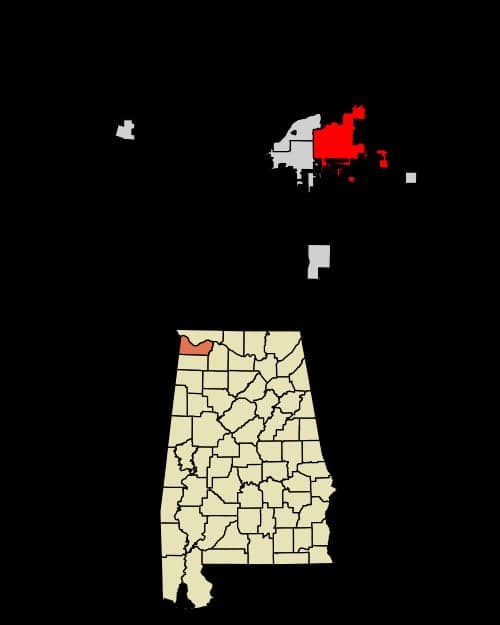
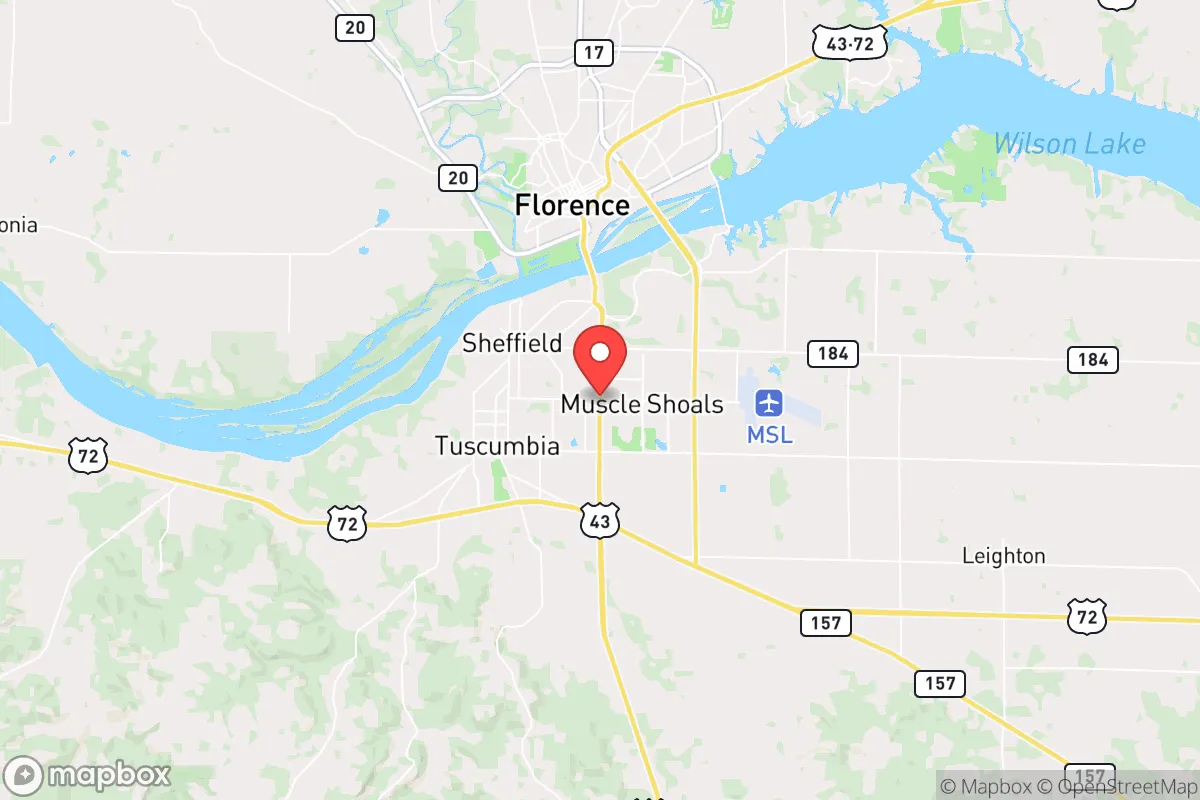
Photo: Wikipedia
Political ClimatePolitical Climate in Muscle Shoals, AL
District shown is the primary district for this city’s centroid. Cities may span multiple districts.
Local Political AnalysisPolitical Analysis of Muscle Shoals, AL
Muscle Shoals is about as solidly conservative as it gets in Alabama, with a Cook PVI of R+33 that puts it deep in the red column. That number isn't just a statistic—it reflects a community where traditional values and limited government aren't just talked about, they're lived. The Shoals area has long been a place where folks expect to be left alone to live their lives, work their jobs, and raise their families without a bunch of government interference. If you're looking for a place where the political winds haven't shifted toward the progressive agenda you see in so many other parts of the country, this is it.
How it compares
To really understand Muscle Shoals, you've got to look at the surrounding towns. Florence, just across the Tennessee River, leans conservative too, but it's a bit more moderate—you'll see more college influence from the University of North Alabama there, and that brings a slightly different vibe. Drive south to Russellville or east to Athens, and you're in even deeper red territory, places where the R+33 number might actually feel a little low. The real contrast comes if you head toward Huntsville, about an hour east. Huntsville's booming growth has brought in folks from all over, and while it's still conservative overall, you can feel the creeping influence of out-of-state transplants pushing for more government programs and progressive policies. Muscle Shoals hasn't seen that kind of influx, and that's a big reason why the political climate here has stayed steady. The local elections rarely see serious challenges from the left, and the county commission and school board reflect that conservative majority.
What this means for residents
For someone living here, the practical effect of that R+33 rating is pretty straightforward: you're not constantly fighting new regulations or tax hikes. The local government tends to take a hands-off approach, which means fewer zoning headaches, lower property taxes compared to states with more progressive tax structures, and a general sense that your personal freedoms aren't being chipped away at. You won't see mask mandates or business shutdowns like you did in other parts of the country during the pandemic—the local leadership here trusted people to make their own decisions. That's the kind of common-sense approach that keeps folks from feeling like they need to move to a more rural county just to get some breathing room. The downside, if you can call it that, is that if you're hoping for rapid change or big government-funded projects, you'll be disappointed. The pace here is slower, and that's by design.
One thing that's worth keeping an eye on is the cultural shift happening in the music and arts scene. Muscle Shoals is famous for its recording studios and musical heritage, and that draws in creative types from all over. So far, that hasn't translated into any serious political shift—most of the musicians and artists who move here seem to appreciate the low cost of living and the freedom to work without a bunch of red tape. But as the area grows, there's always the risk that outside influences could start pushing for more progressive policies, especially around things like land use and local ordinances. For now, though, the conservative foundation here is strong, and the community's resistance to government overreach is a point of pride. If you value personal liberty and a government that stays out of your way, Muscle Shoals is still a safe bet.

State Political ClimatePolitical Climate in Alabama
State Political AnalysisPolitical Environment in the State
Alabama is a deeply red state, with a Republican trifecta controlling the governorship, supermajorities in both legislative chambers, and a conservative-leaning Supreme Court. The state has not voted for a Democratic presidential candidate since 1976, and in 2024, Donald Trump carried it by over 30 points. Over the past 10-20 years, the GOP’s dominance has only solidified, driven by the realignment of rural white voters and the collapse of the old “Blue Dog” Democrat coalition that once held sway in the Black Belt and north Alabama. Today, the state’s political center of gravity is firmly in the suburbs and small towns, with the only real Democratic strongholds being the majority-Black counties of the Black Belt and the city of Birmingham.
Urban vs. rural divide
The political map of Alabama is a stark study in contrasts. The state’s largest metro, Birmingham (Jefferson County), is a Democratic bastion, delivering about 60% of its vote to Joe Biden in 2020. However, the surrounding suburbs—places like Hoover, Vestavia Hills, and Mountain Brook—are reliably Republican, often voting 70% or more for GOP candidates. Montgomery and Mobile are more competitive but lean Democratic in their urban cores, while their suburbs and exurbs (like Prattville near Montgomery and Daphne on the Eastern Shore) are solidly red. The real engine of Republican power is the vast rural expanse: counties like DeKalb in the northeast, Marshall in the north, and Baldwin on the coast routinely vote 80%+ Republican. The Black Belt—a crescent of counties stretching from Selma to Greene County—is the only region where Democrats consistently win, driven by high African American voter turnout. But these counties have shrinking populations, so their electoral weight diminishes every cycle.
Policy environment
Alabama’s policy environment is among the most conservative in the nation, with a strong emphasis on limited government and traditional values. The state has no state income tax on retirement income, and its overall tax burden is low, though it relies heavily on a regressive sales tax (including on groceries in many localities). The regulatory posture is business-friendly, with right-to-work laws and minimal zoning restrictions outside major cities. Education policy is a flashpoint: the state has a robust school choice movement, with the Alabama Accountability Act providing tax credits for private school tuition and the recent expansion of charter schools. However, public school funding remains low, and the state’s NAEP scores are among the worst nationally. Healthcare is a mixed bag: Alabama did not expand Medicaid under the Affordable Care Act, leaving a coverage gap for low-income adults, but the state has a strong network of rural hospitals and a growing telehealth sector. Election laws are strict: voter ID is required, early voting is limited, and absentee voting requires an excuse. The state also passed a 2021 law banning curbside voting and limiting ballot drop boxes, which Republicans say ensures integrity and Democrats call suppression.
Trajectory & freedom
Over the past five years, Alabama has moved decisively toward expanding personal liberty in several key areas, particularly gun rights and parental rights. In 2022, the state passed constitutional carry (permitless carry of a concealed handgun), making it one of over 20 states to do so. The same year, the legislature passed the Alabama Parental Rights Protection Act, which requires schools to notify parents of any “sex-based” instruction and prohibits classroom discussion of sexual orientation or gender identity in K-5. In 2023, the state banned nearly all abortions with the Human Life Protection Act, which makes performing an abortion a felony with no exceptions for rape or incest. On the tax front, the state has gradually cut income taxes, with a 2023 law reducing the top marginal rate from 5% to 4.99% and accelerating a phase-out of the state’s grocery tax. However, concerns remain about government overreach in areas like medical freedom: Alabama has some of the strictest vaccine mandates for schoolchildren in the South, and during COVID, the state maintained mask mandates in schools longer than many neighbors. Property rights are generally strong, with no statewide zoning and a homestead exemption that shields up to $4,000 of assessed value from property tax.
Civil unrest & political movements
Alabama has seen relatively little civil unrest compared to other states, but there are active political movements on both sides. On the right, the Alabama Citizens for Constitutional Freedom and local Tea Party groups remain influential, pushing for further tax cuts, school choice, and election integrity measures. The state has been a battleground over immigration: in 2011, Alabama passed one of the strictest anti-illegal immigration laws in the country (HB 56), which was largely gutted by federal courts but still symbolizes the state’s hardline stance. There are no sanctuary cities in Alabama; in fact, several municipalities, including Birmingham and Huntsville, have passed ordinances requiring cooperation with federal immigration authorities. On the left, the Alabama Poor People’s Campaign and the NAACP Alabama State Conference organize around voting rights, Medicaid expansion, and criminal justice reform. The most visible flashpoint in recent years was the 2022 controversy over the state’s new congressional map, which a federal court ruled diluted Black voting power; the resulting legal battle led to a new map with a second majority-Black district in 2023. Election integrity remains a hot-button issue, with Republican officials citing concerns about non-citizen voting and ballot harvesting, though no major fraud has been proven.
Projection
Over the next 5-10 years, Alabama’s political trajectory is likely to remain deeply conservative, but with some important shifts. In-migration is accelerating, particularly to the Huntsville metro area, which is booming due to the defense and aerospace industries. Huntsville is a unique political animal: it’s a growing, educated, and relatively moderate city that still votes Republican but is less culturally conservative than the rest of the state. This influx of tech and engineering professionals could moderate the GOP’s edge in Madison County over time, but it won’t flip the state. The Black Belt’s population decline will continue to weaken the Democratic base, while the growth of the Gulf Coast (Baldwin County) and the Auburn-Opelika area will reinforce Republican dominance. The biggest wildcard is the state’s education and healthcare outcomes: if Alabama continues to lag on these metrics, it could spur a backlash that pushes the GOP toward more pragmatic governance, especially on Medicaid expansion. For now, expect the state to remain a laboratory for conservative policy—constitutional carry, school choice, and abortion bans are here to stay, and further tax cuts are likely. A new resident moving in now should expect a state that is politically stable, culturally traditional, and increasingly assertive in protecting what it sees as personal freedoms, even as it grapples with the long-term consequences of its policy choices.
Bottom line for a new resident: If you value low taxes, strong gun rights, minimal government interference in family and school decisions, and a political culture that is unapologetically conservative, Alabama will feel like home. The trade-offs are real: public services are lean, infrastructure outside the metros is spotty, and the state’s health and education rankings are a concern. But for those who prioritize personal liberty and community values over government-provided amenities, Alabama offers a stable, predictable environment where your vote counts and your voice is heard. Just know that the political debate here is not about whether to be conservative, but how conservative to be—and that’s a conversation that’s likely to continue for decades.
* Values derived from national, state, county, city and local statistics and may differ in a specific area. Last updated: 2026-04-19T19:01:00.000Z
Narrative content on this page is AI-generated and may contain mistakes. Verify any details that matter before acting on them.
ReloMaps may earn a commission from affiliate links at no extra cost to you.

