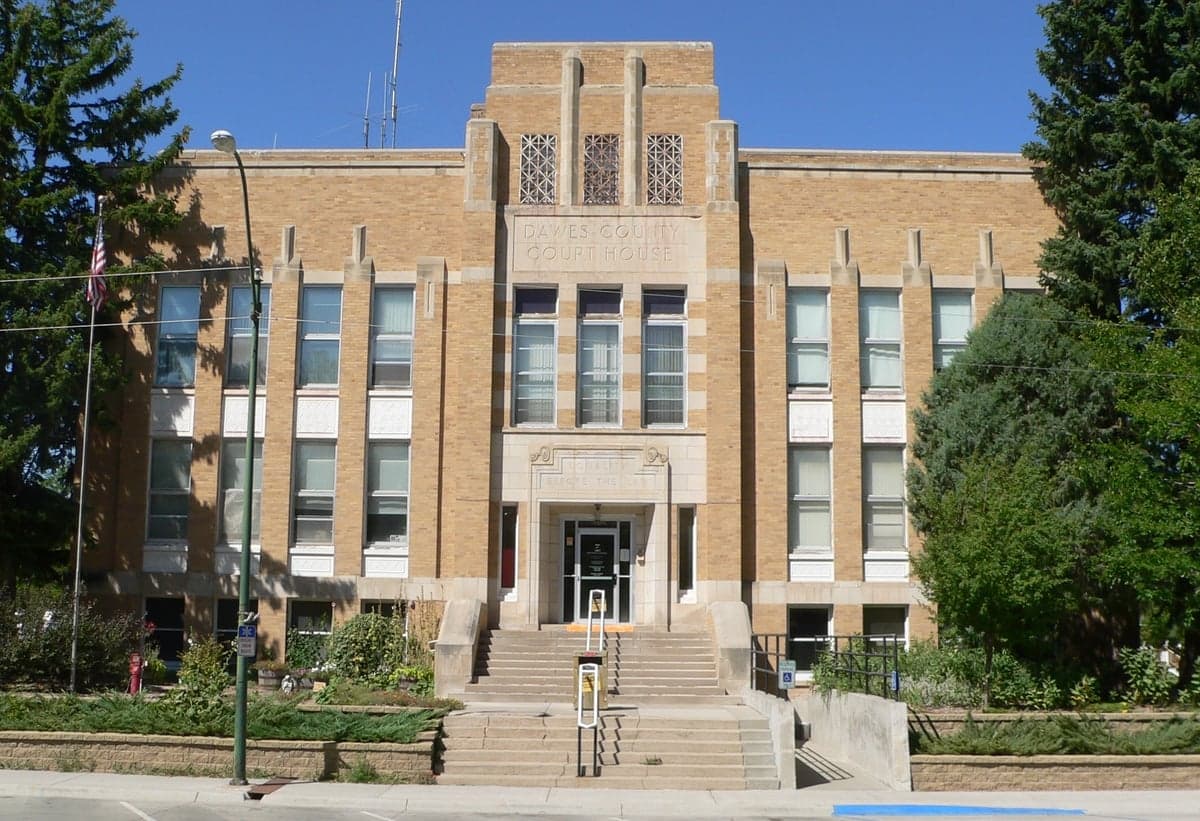
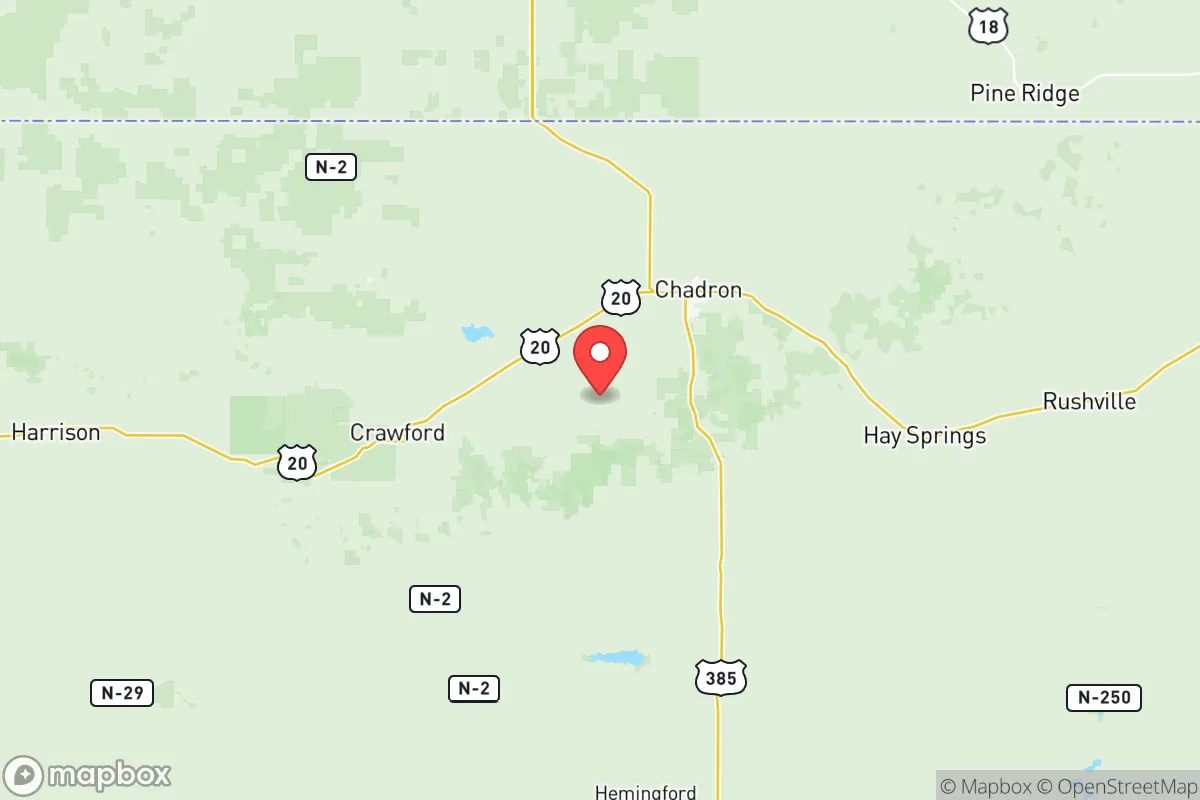
Photo: Wikipedia
Demographics of Dawes County
Affluence Level in Dawes County
A middle-class area roughly in line with national averages across income, home values, education, and employment.
People of Dawes County
Today, Dawes County in northwestern Nebraska is home to roughly 8,200 residents, a population that is overwhelmingly White (86.4%) and notably less diverse than the state as a whole, with a foreign-born population of just 0.1%. The county's character is defined by its small towns—Chadron, the county seat and home to Chadron State College, along with Crawford, Hemingford, and the unincorporated community of Whitney—and a deep-rooted sense of place tied to ranching, the railroad, and the Pine Ridge region. Distinctive markers include a strong college-town influence in Chadron, a significant Native American presence from the adjacent Pine Ridge Indian Reservation, and a population that is slightly older and more rooted than the national average, with 35.2% holding a college degree.
Settlement & growth (pre-1960)
Before Euro-American settlement, the area now known as Dawes County was part of the traditional territory of the Lakota people, particularly the Oglala and Brule bands, who followed bison herds across the High Plains. The region was not permanently occupied by European powers, but it fell within the vast Louisiana Purchase of 1803, bringing it under U.S. sovereignty. The first significant American presence came with the establishment of military outposts and the opening of the region to homesteading after the 1868 Treaty of Fort Laramie, which confined the Lakota to the Great Sioux Reservation to the north.
The real settlement wave began in the 1880s, driven by the expansion of the Fremont, Elkhorn and Missouri Valley Railroad (later part of the Chicago and North Western Railway), which reached the area in 1885. The railroad platted the town of Chadron that same year, and it quickly became a shipping point for cattle and a supply hub for homesteaders. The federal government's passage of the Homestead Act of 1862 and the Kinkaid Act of 1904—which offered 640-acre parcels in the Sandhills and surrounding areas—pulled in a diverse mix of settlers. The largest groups were native-born Americans from the Midwest and Great Lakes states, particularly from Iowa, Illinois, and Wisconsin, along with a significant number of German immigrants and German-Russians who had previously settled in the Dakotas. These families were drawn by the promise of cheap land and the opportunity to establish dryland farms and cattle ranches. The town of Crawford, founded in 1886 as a railroad division point, grew around the Fort Robinson military post, while Hemingford, established in 1887, became a farming and ranching center. Whitney, platted in 1888, served as a smaller agricultural service town. By 1900, the county's population had already reached 6,000, and it peaked at 11,493 in 1930, reflecting the region's agricultural prosperity before the Dust Bowl and Great Depression drove many families off the land.
The Dust Bowl of the 1930s hit Dawes County hard, as severe drought and wind erosion devastated dryland farms. Many homesteaders abandoned their claims, and the population declined sharply, dropping to 8,754 by 1940. The post-World War II period saw a modest stabilization, as the expansion of Chadron State College (founded in 1911 as a normal school) and the growth of the U.S. Forest Service's Pine Ridge Ranger District provided new employment anchors. The county's population held relatively steady through the 1950s, hovering around 9,000, as the ranching economy proved more resilient than row-crop farming.
Modern era (post-1965)
The 1965 Hart-Cellar Act, which fundamentally reshaped U.S. immigration, had almost no direct impact on Dawes County. The county's foreign-born population remains at 0.1% in 2026, meaning that virtually all demographic change since 1965 has come from domestic migration and natural increase among the existing population. The most significant shift has been the gradual outmigration of young adults seeking opportunities in larger cities, balanced by the in-migration of retirees and people seeking a lower cost of living and rural lifestyle. The county's population has declined from 9,021 in 2000 to 8,212 in 2026, a loss of about 9% over a quarter-century.
The Hispanic population, while still small at 4.8%, has grown modestly since the 1990s, driven primarily by families working in the region's meatpacking plants and agricultural support industries. These residents are concentrated in Chadron and, to a lesser extent, Crawford, where they have established small but stable communities. The Black population, at 1.4%, is largely tied to Chadron State College and the Nebraska Department of Corrections' facility near Crawford. The East and Southeast Asian population, at 1.0%, is also primarily associated with the college and the regional medical center in Chadron. The Indian subcontinent population is effectively zero, reflecting the county's limited draw for high-skilled immigration.
Suburbanization has not occurred in the conventional sense; Dawes County's towns remain compact, and new residential development has been limited to the edges of Chadron and Crawford. The most notable domestic migration trend has been the arrival of a small but steady stream of retirees and remote workers from Colorado and the Front Range, drawn by lower housing costs and the area's outdoor recreation opportunities in the Pine Ridge and the Nebraska National Forest. This group tends to be older, more educated, and more politically moderate than the long-term population.
The future
Dawes County is likely to continue its slow population decline, with projections suggesting a drop to around 7,500 by 2040 if current trends hold. The county is becoming slightly more diverse, but from a very low base: the Hispanic share may rise to 7-8% over the next two decades, while the White share will edge downward to the low 80s. The college-educated share, already above the state average at 35.2%, will likely increase as Chadron State College continues to attract faculty and staff and as remote workers and retirees from more expensive regions move in. The county's cultural identity will remain strongly tied to ranching, the college, and the nearby Pine Ridge Reservation, but it will also become more oriented toward outdoor tourism and second-home ownership, particularly around the Pine Ridge escarpment and the Fort Robinson State Park area.
New residents are concentrating in Chadron, which offers the best amenities, including the college, a hospital, and the only full-service grocery stores in the county. Crawford and Hemingford are likely to see continued population loss as young people leave and services consolidate. The county's political character, which has been reliably Republican for decades, may shift slightly toward the center as the in-migration of Colorado expats and college-affiliated residents brings a more moderate influence.
For someone moving to Dawes County now, the area offers a stable, safe, and affordable rural lifestyle with a strong sense of community, but it is not a place of rapid growth or demographic transformation. The population is aging, the economy is anchored by a few large employers—Chadron State College, the regional hospital, the state prison, and the cattle industry—and the social fabric remains overwhelmingly White and native-born. Newcomers will find a welcoming but insular environment where long-standing family names and local institutions still carry significant weight. The county is becoming more diverse and more educated, but slowly, and its future is one of gradual, managed decline rather than boom or bust.

* Values derived from national, state, county, city and local statistics and may differ in a specific area. Last updated: 2026-10-15T13:15:28.000Z
Narrative content on this page is AI-generated and may contain mistakes. Verify any details that matter before acting on them.
ReloMaps may earn a commission from affiliate links at no extra cost to you.

