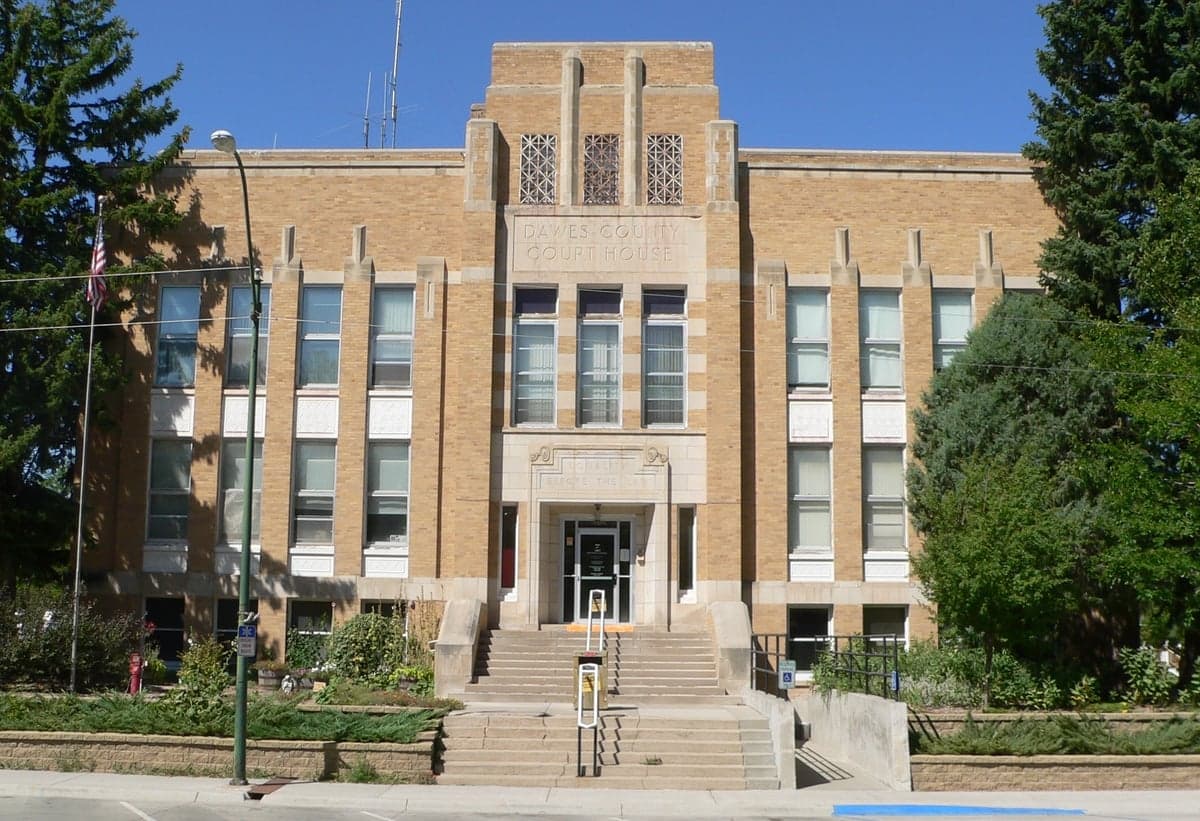
Photo: Wikipedia
Political ClimatePolitical Climate in Dawes County
Showing district-level results — no local-only data available.
Local Political AnalysisPolitical Analysis of Dawes County
Dawes County, Nebraska, is one of the most reliably Republican counties in the state, carrying a Cook Partisan Voting Index (PVI) of R+27 — a full 17 points more conservative than Nebraska’s statewide R+10 rating. That gap isn't just a number; it reflects a deep-rooted political culture that has held steady for decades, with little sign of shifting. The county has voted for the Republican presidential candidate by margins of 40 points or more in every election this century, and local offices from county commissioner to school board are almost entirely held by Republicans. If you’re looking for a swing county in the Panhandle, this isn’t it — but the political reality is more nuanced than the raw numbers suggest, especially when you zoom in on the towns.
How it compares to Nebraska as a whole
Nebraska’s R+10 PVI already marks it as a solidly red state, but Dawes County’s R+27 puts it in a different league. The statewide number is pulled left by Douglas County (Omaha) and Lancaster County (Lincoln), which together hold nearly half the state’s population and lean Democratic. Dawes County has no such counterweight. Its largest town, Chadron (population ~5,200), is home to Chadron State College, which introduces a modest liberal influence — but not enough to move the county needle. In the 2024 presidential election, Dawes County gave the Republican ticket 76% of the vote, compared to Nebraska’s statewide 59%. The difference is starkest in rural precincts outside Chadron: places like Crawford (pop. ~900) and Hemingford (pop. ~800) routinely deliver 80%+ Republican margins. Chadron itself is the only precinct where Democrats can break 30%, thanks to faculty and staff at the college, but even there, the city council and county board seats are held by Republicans. The county’s trajectory is stable — no signs of trending blue, but also no further rightward shift; it’s been at this level since the 1990s.
What this means for residents
For conservative residents, Dawes County feels like a place where their values are the default. Local government is low-tax and limited-scope; the county’s property tax levy is among the lowest in Nebraska, and there’s little appetite for new spending initiatives. Gun rights are broadly supported, and the county has passed symbolic Second Amendment sanctuary resolutions. For liberal residents, the reality is more isolating. There is no organized Democratic Party presence in the county; the local party chair position has been vacant for years. Socially, progressive views on issues like abortion or climate policy are rarely voiced in public forums. That said, the college town atmosphere in Chadron does create a small bubble where left-leaning residents can find community — the Chadron State College faculty association and a handful of local nonprofits provide some social infrastructure. Politically active liberals often focus on single issues like public education funding or healthcare access, where they can find common ground with moderate Republicans. The practical effect of the county’s lean is that primary elections are often more consequential than general elections, since the Republican nominee is virtually guaranteed to win in November.
Culturally, Dawes County stands apart from Nebraska’s more moderate eastern counties in its embrace of ranching and agricultural traditions. The county is home to the Pine Ridge region and the Oglala National Grassland, and land use debates — around grazing rights, water access, and federal land management — dominate local politics more than social issues. The county commission’s biggest fights in recent years have been over wind energy development and road maintenance funding, not culture war topics. That pragmatic, land-first orientation is the real political identity of Dawes County: deeply conservative, but in a way that’s more about preserving a way of life than about national partisan battles. For anyone moving here, the key takeaway is that politics is local, and the local conversation is about cattle, water, and keeping the county’s budget in the black.

State Political ClimatePolitical Climate in Nebraska
State Political AnalysisPolitical Environment in the State
Nebraska is a reliably Republican state with a Cook PVI of R+10, but its politics are far from monolithic. The state has a strong conservative majority, driven by its vast rural expanses and the reliably red Second Congressional District outside of Omaha, though a notable progressive stronghold in Lincoln and a growing Democratic presence in Omaha proper create a genuine urban-rural split. Over the past 10-20 years, the state has shifted rightward on cultural and economic issues, even as its largest city, Omaha, has become more competitive for Democrats, making Nebraska a fascinating case of a red state with a blue island.
Urban vs. rural divide
The political map of Nebraska is a textbook example of the urban-rural divide. The state's two major population centers, Omaha (Douglas County) and Lincoln (Lancaster County), are the primary engines of Democratic votes. Omaha, home to about half the state's population, has trended blue in presidential elections, with Joe Biden winning Douglas County by 10 points in 2020. Lincoln, while more moderate, also leans Democratic, with Lancaster County going for Biden by 8 points. In contrast, the rest of the state is deeply Republican. Counties like Scotts Bluff (west), Hall (Grand Island), and Platte (Columbus) routinely vote Republican by 30-40 points. The rural panhandle and central Nebraska are among the most conservative regions in the country, with some counties voting over 80% Republican. This split means that while Democrats can win city council and mayoral races in Omaha and Lincoln, they have almost no presence in the state legislature outside of those two metro areas.
Policy environment
Nebraska's policy environment is shaped by its unique unicameral, nonpartisan legislature, which often produces more moderate outcomes than other deep-red states. The state has no income tax on Social Security benefits and a relatively low flat income tax rate of 5.84%, with a push to lower it further. Property taxes are a perennial issue, with rural landowners and farmers frequently clashing with the state over school funding formulas. Education policy is largely local, but the state has seen a rise in school choice advocacy, including a 2023 law creating a tax-credit scholarship program for private school tuition. Healthcare is a mixed bag: Nebraska expanded Medicaid under the Affordable Care Act in 2020 via a ballot initiative, but the state has some of the most restrictive abortion laws in the region, banning the procedure after 12 weeks with exceptions for rape, incest, and medical emergencies. Election laws are relatively moderate for a red state: Nebraska has no voter ID requirement (though one was passed in 2024 and will take effect in 2026), and it allows same-day voter registration. The state also uses a unique system for allocating its electoral college votes, awarding two to the statewide winner and one to the winner of each congressional district, which has made the Second District a national battleground.
Recent policy direction
Nebraska's recent legislative sessions have been dominated by cultural and fiscal conservatism. In 2023, the state passed a 12-week abortion ban, overriding a filibuster by the legislature's progressive minority. The same year, lawmakers passed a permitless concealed carry law, allowing any legal gun owner to carry a concealed firearm without a permit. On education, the state enacted a school choice tax-credit program and banned transgender girls from participating in girls' sports in K-12 schools. Property rights saw a win for landowners with a 2024 law limiting the use of eminent domain for carbon pipeline projects, a major issue in rural Nebraska. On the tax front, the state passed a significant income tax cut in 2023, reducing the top rate from 6.84% to 5.84% and accelerating future cuts. Voting access saw a tightening with the passage of a voter ID law in 2024, though it includes a free ID provision. Medical and bodily autonomy remains a flashpoint: the 12-week abortion ban is among the strictest in the region, and there is ongoing debate about expanding exceptions. Privacy and surveillance are less contentious, with no major state-level data privacy laws passed recently. Overall, the direction is clearly conservative, but the unicameral system and the need to build a 33-vote supermajority to end filibusters often moderates the most extreme proposals.
Civil unrest & political movements
Nebraska has seen its share of political activism, though it rarely reaches the level of major unrest seen in coastal states. The most visible flashpoints in recent years have been around abortion and pipeline politics. In 2022, after the Dobbs decision, large protests and counter-protests occurred in Lincoln and Omaha, with the state capitol becoming a regular site for rallies. The Keystone XL pipeline, which was ultimately canceled in 2021, was a decade-long source of tension, with environmental activists and some Native American tribes clashing with state officials and landowners who supported the project. More recently, the proposed Carbon Pipeline projects (Summit Carbon Solutions and Navigator CO2) have sparked a fierce grassroots movement among rural landowners concerned about eminent domain and property rights, leading to the 2024 law limiting its use. Immigration politics are less heated than in border states, but there have been local controversies over sanctuary city policies, with Omaha and Lincoln both declaring themselves welcoming cities, drawing criticism from state lawmakers who have introduced bills to ban such policies. Election integrity has been a minor issue, with no major controversies in 2020 or 2022, though the voter ID law was driven by conservative concerns. The state's unique electoral college system has also made it a target for national political movements, with both parties investing heavily in the Second District.
Projection
Over the next 5-10 years, Nebraska is likely to remain a solidly Republican state, but the urban-rural divide will deepen. Omaha's continued growth and diversification will make the Second District more competitive, potentially flipping it to Democrats in presidential elections more often. Lincoln will also trend left, but the rest of the state will remain deeply conservative. The state's in-migration patterns are modest, with most new residents coming from other Midwestern states, which will not dramatically shift the political balance. The biggest wildcard is the state's unicameral legislature: if Democrats can maintain their current 17 seats (out of 49), they can continue to filibuster the most extreme conservative bills, but if they lose a seat or two, the legislature could move sharply right. On policy, expect continued tax cuts, further restrictions on abortion (possibly a near-total ban), and ongoing battles over school choice and property rights. The carbon pipeline issue will likely be resolved in the next few years, but it has already reshaped rural politics, with many traditionally Republican landowners becoming skeptical of corporate power. For a new resident, the state will feel politically stable but with a clear conservative tilt, especially outside of Omaha and Lincoln.
For a new resident, the bottom line is that Nebraska offers a politically stable, low-tax environment with a strong conservative majority, but with genuine progressive pockets in its two largest cities. If you're a conservative, you'll find a state that generally aligns with your values on taxes, guns, and cultural issues, though you may need to navigate the occasional moderate compromise in the legislature. If you're a liberal, you'll find a welcoming community in Omaha or Lincoln, but you'll be in a clear minority at the state level, with limited ability to influence policy outside of those cities. The state's unique unicameral system and electoral college allocation make it a fascinating place politically, but the practical reality is that your day-to-day life will be shaped more by your local community than by state politics. Whether you're in a red rural county or a blue urban neighborhood, Nebraska's politics are generally civil and pragmatic, with a focus on local issues rather than national culture wars.
* Values derived from national, state, county, city and local statistics and may differ in a specific area. Last updated: 2026-10-15T13:15:28.000Z
Narrative content on this page is AI-generated and may contain mistakes. Verify any details that matter before acting on them.
ReloMaps may earn a commission from affiliate links at no extra cost to you.

