
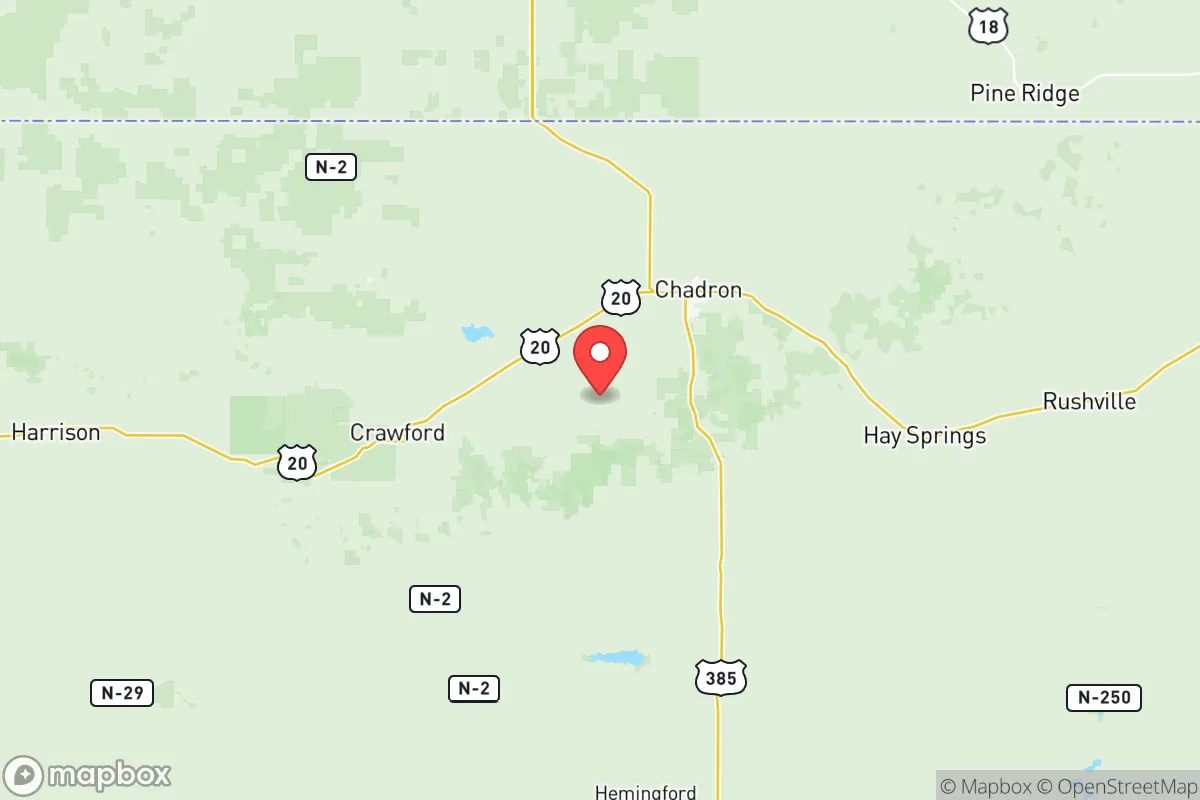
Photo: Wikipedia
Personal Sovereignty in Dawes County
Moderate friction. Expect trade-offs in some aspect of personal liberty and independence.
What does Personal Sovereignty tell us?
Personal Sovereignty measures your capacity for self-reliance and independence with minimal government friction. Higher scores mean fewer barriers between you and the way you want to live... but it assumes you have the space you need and good neighbors.
What does this tell us?
Personal Sovereignty measures your capacity for self-reliance and independence with minimal government friction. Higher scores mean fewer barriers between you and the way you want to live... but it assumes you have the space you need and good neighbors.
State Policy
Energy independence: Importer (35% of energy produced in-state)
Personal Liberty
Homesteading

Personal Liberty Analysis
Dawes County, Nebraska, offers a notably high degree of personal sovereignty, rooted in Nebraska’s generally low-tax, limited-government posture and the county’s rural, frontier character. For individuals and families prioritizing autonomy, the area presents a regulatory environment that is light-touch by national standards, with local governance in towns like Chadron, Crawford, and Whitney reflecting a hands-off approach to daily life. The county’s legal and cultural framework supports self-reliance, from permissive gun laws to viable off-grid living options, making it a compelling choice for those seeking to minimize external control over their personal and economic decisions.
Tax burden and regulatory posture in Dawes County
Nebraska’s state-level tax burden is moderate, but Dawes County benefits from a relatively low cost of local government. Property taxes in the county are levied at a rate that, while not the lowest in the state, is manageable compared to urban areas like Omaha or Lincoln. The county’s regulatory posture is decidedly light: there are no county-wide zoning ordinances outside of Chadron’s municipal code, meaning that in unincorporated areas and smaller towns like Whitney and Marsland, residents face minimal bureaucratic hurdles for home construction, business operations, or land use. Nebraska has no state income tax on Social Security benefits and offers a phased-in reduction of individual income tax rates, which directly benefits self-employed individuals and remote workers. The state’s corporate income tax rate is also being reduced, supporting small business formation. For a relocation-minded reader, the key takeaway is that Dawes County’s regulatory environment imposes few barriers to personal economic activity, with local officials generally deferring to individual judgment rather than imposing prescriptive rules.
Self-defense rights and gun law specifics in Nebraska
Nebraska is a shall-issue state for concealed carry permits, meaning that if a resident meets objective criteria (age, background check, training), the permit must be issued. Dawes County’s sheriff’s office in Chadron processes permits efficiently, and the local culture strongly supports firearm ownership for self-defense, hunting, and sport. In 2023, Nebraska enacted constitutional carry, allowing law-abiding residents to carry a concealed handgun without a permit, though a permit is still required for reciprocity with other states. The state has no magazine capacity restrictions, no assault weapon ban, and no firearm registration requirements. Stand-your-ground laws are in effect, with no duty to retreat in any place where a person has a legal right to be. In practice, this means that in Chadron, Crawford, or rural areas like Belmont, residents can exercise self-defense rights with minimal legal ambiguity. The county’s low crime rate further reduces the likelihood of defensive encounters, but the legal framework ensures that those who choose to arm themselves face no local impediments.
Self-reliance and homesteading viability: lot sizes, zoning, and off-grid feasibility
Dawes County is one of the most viable areas in Nebraska for homesteading and off-grid living. Outside of Chadron’s city limits, there is no county-wide zoning, which means residents in areas like Whitney, Marsland, and rural Crawford can build structures, keep livestock, and install alternative energy systems without seeking permits or variances. Minimum lot sizes in unincorporated areas are not regulated by the county, though state health department rules for septic systems effectively set a practical minimum of one to two acres for a dwelling with a well and septic. Off-grid living is entirely feasible: Nebraska has no state law prohibiting rainwater collection, and solar panel installation is unrestricted. The county’s low population density (roughly 8,000 residents spread over 1,400 square miles) means that neighbors are distant, and noise, odor, or appearance complaints are rare. For those seeking to raise animals, the county’s agricultural heritage means that livestock keeping is the norm, not an exception. The town of Chadron does have municipal zoning that restricts some activities within city limits, but the surrounding unincorporated areas offer near-total freedom for self-sufficient living.
Personal liberties: parental rights, medical autonomy, speech, and property
Nebraska law generally respects parental rights in education and healthcare decisions. The state has no universal vaccine mandate for schoolchildren, and parents can opt out of specific health requirements for religious or philosophical reasons. In Dawes County, local school boards in Chadron and Crawford have not adopted policies that override state-level parental deference. Medical autonomy is supported by Nebraska’s lack of a state-level vaccine passport system and its protection of conscientious objection for healthcare providers. Free speech is robustly protected under both the U.S. and Nebraska constitutions, and local government in Dawes County does not engage in content-based restrictions on public expression. Property rights are strongly protected: Nebraska has no statewide rent control, no inclusionary zoning mandates, and no restrictions on short-term rentals outside of Chadron’s municipal code. The state’s eminent domain laws require just compensation and a public purpose, with narrow definitions of blight that limit abuse. For a reader prioritizing personal liberties, Dawes County’s legal environment imposes few constraints on how individuals raise their families, manage their health, express their views, or use their property.
Compared to other rural counties in the Great Plains, Dawes County offers an above-average degree of personal sovereignty. Its combination of constitutional carry, no county-wide zoning, low tax burden, and strong property rights places it among the more freedom-oriented jurisdictions in Nebraska. While not as permissive as some counties in Alaska or Idaho, Dawes County provides a practical, legally sound environment for individuals and families who value self-reliance and minimal government interference. For those considering relocation, the county’s towns—Chadron for services, Crawford for quiet, Whitney and Marsland for true off-grid potential—offer distinct options within a single, autonomy-friendly region.

* Values derived from national, state, county, city and local statistics and may differ in a specific area. Last updated: 2026-10-15T13:15:28.000Z
Narrative content on this page is AI-generated and may contain mistakes. Verify any details that matter before acting on them.
ReloMaps may earn a commission from affiliate links at no extra cost to you.

