Photo: Wikipedia
Demographics of Madison County
Affluence Level in Madison County
A middle-class area roughly in line with national averages across income, home values, education, and employment.
People of Madison County
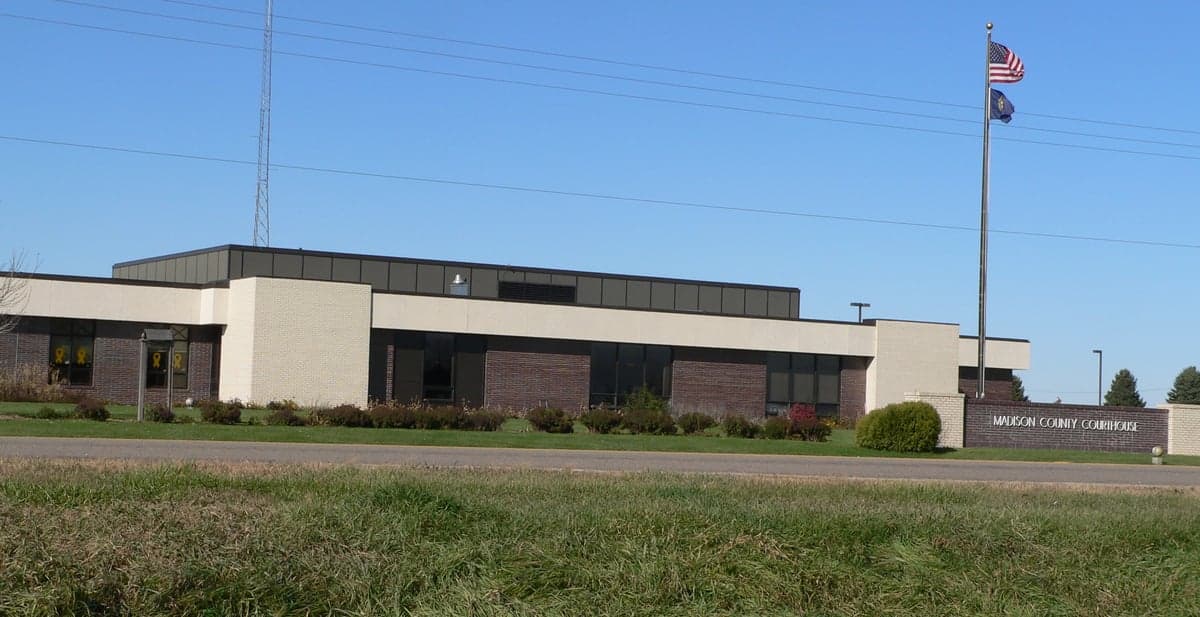
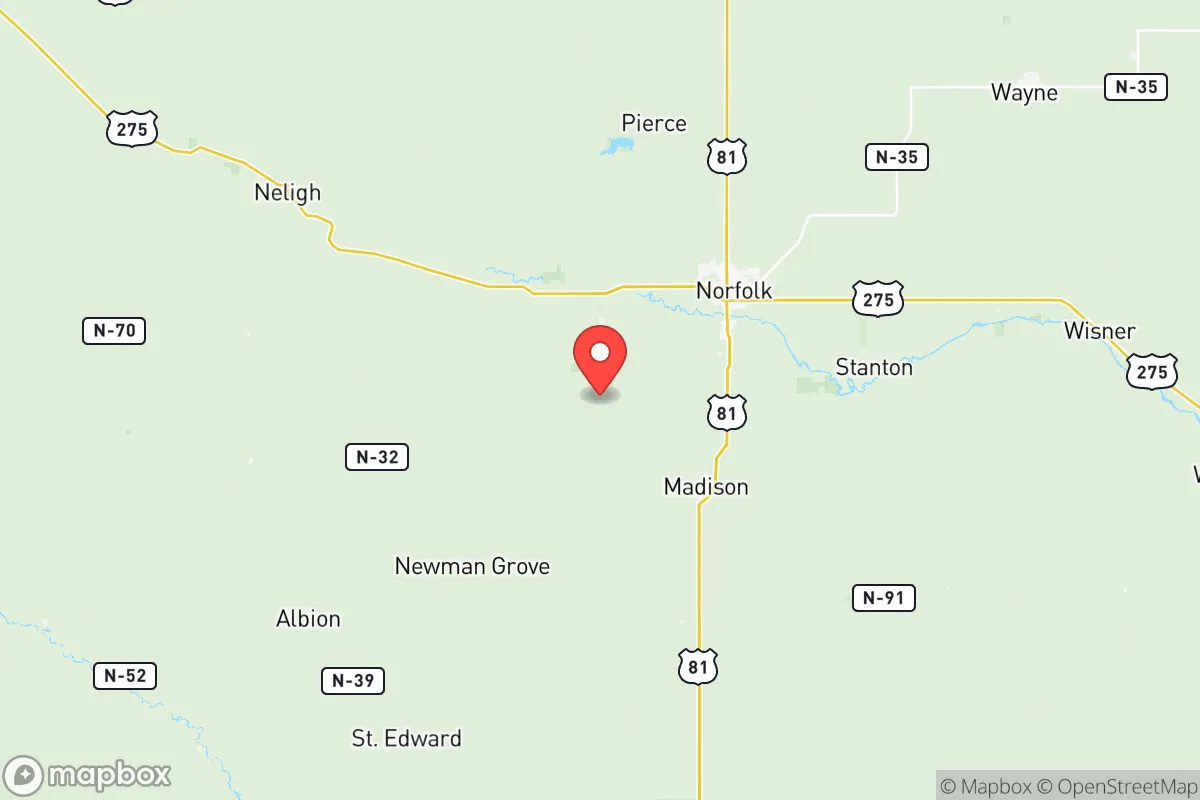
Madison County, Nebraska, is a predominantly White, rural community of 35,535 residents, anchored by the cities of Norfolk and Madison. The county’s identity is shaped by its deep agricultural roots, a strong German and Czech heritage, and a growing Hispanic population that now makes up 15.9% of the total. With a relatively low foreign-born share of 4.6% and a college attainment rate of 23.5%, the county remains a stable, family-oriented area where traditional values and community ties are central to daily life.
Settlement & growth (pre-1960)
Before American settlement, the land that is now Madison County was part of the traditional territory of the Ponca and Omaha nations, who lived along the Elkhorn River and its tributaries. The area was ceded to the United States through a series of treaties in the 1850s, opening it to homesteaders. The first permanent American settlers arrived in the mid-1860s, drawn by the Homestead Act of 1862, which offered 160 acres of land to anyone willing to farm it. These early pioneers were primarily of Yankee stock—English-descended families from New York, Ohio, and Iowa—who established the county’s first towns, including Norfolk (founded 1866) and Madison (founded 1867).
The real demographic transformation came in the 1870s and 1880s, when the Union Pacific Railroad extended its lines through the county, making it a hub for agricultural shipping. This period saw a massive influx of German and Czech immigrants, who were recruited by railroad companies and land agents to settle the fertile plains. German families concentrated in and around Norfolk, Battle Creek, and Meadow Grove, while Czech settlers formed tight-knit communities in Tilden and Newman Grove. These groups brought with them a strong work ethic, a commitment to Lutheran and Catholic churches, and a tradition of family farming that would define the county for generations. By 1900, the county’s population had surged to over 16,000, with foreign-born residents accounting for roughly a quarter of the total.
The early 20th century brought a second wave of European immigration, particularly from Poland and Sweden, though in smaller numbers. Polish families settled primarily in Norfolk, where they found work in the city’s growing meatpacking and milling industries. The Dust Bowl and Great Depression of the 1930s hit the county hard, causing a temporary population decline as some families moved west to California or Oregon. However, the post-World War II era brought renewed stability, as agricultural mechanization and the expansion of the Norfolk livestock market created steady employment. By 1960, the county’s population had stabilized at around 24,000, with a nearly entirely White, native-born population of German, Czech, and Scandinavian descent.
Modern era (post-1965)
The 1965 Hart-Cellar Act had a limited direct impact on Madison County, as the region did not attract the large-scale immigration seen in coastal cities. However, the late 20th century brought a gradual but significant demographic shift through domestic migration. Starting in the 1980s, Hispanic families—primarily of Mexican descent—began moving to the county, drawn by jobs in Norfolk’s meatpacking plants and agricultural processing facilities. Companies like IBP (now Tyson Foods) and Farmland Foods actively recruited workers from Texas and the Southwest, creating a new labor force that reshaped the county’s ethnic composition. By 2000, the Hispanic share of the population had risen to roughly 8%, and by 2024 it had reached 15.9%. Today, the Hispanic community is most concentrated in Norfolk, where it makes up over 20% of the city’s population, with smaller enclaves in Madison and Battle Creek.
At the same time, the county experienced a modest influx of East and Southeast Asian residents, primarily from Vietnam and Laos, who arrived as refugees in the 1970s and 1980s. This community remains small—just 1.2% of the county’s population—and is concentrated almost entirely in Norfolk, where a handful of families run small businesses and restaurants. The Black population, at 0.9%, is similarly small and largely centered in Norfolk, reflecting the city’s role as the county’s economic and social hub. The Indian subcontinent population is negligible at 0.0%, meaning there is no visible South Asian community in the county.
Suburbanization has been limited in Madison County, as the region lacks a major metropolitan center. Instead, the trend has been toward rural consolidation: smaller towns like Newman Grove, Tilden, and Meadow Grove have seen population declines as younger residents move to Norfolk or leave the county entirely for larger cities like Omaha or Lincoln. Norfolk itself has grown modestly, adding about 2,000 residents since 2000, and now accounts for roughly 70% of the county’s total population. The county’s overall population has remained flat over the past two decades, hovering between 35,000 and 36,000, as natural increase has been offset by out-migration of young adults.
The future
Madison County is likely to become slightly more diverse over the next 10-20 years, driven primarily by the continued growth of the Hispanic population. The Hispanic share, currently 15.9%, could reach 20-22% by 2040, as younger Hispanic families have higher birth rates and as ongoing recruitment by agricultural employers brings new arrivals from Texas and the Southwest. This growth will be concentrated in Norfolk, where Hispanic residents are already a significant presence in the local workforce and school system. The county’s White population, while still the majority at 78.2%, will continue to age and decline slightly, as younger White residents move to urban areas for education and employment.
The East/Southeast Asian and Black populations are expected to remain small, as the county lacks the economic diversity and cultural infrastructure to attract significant new immigration from these groups. The county’s overall population is projected to remain stable or decline slightly, as out-migration of young adults offsets natural increase. This means the county will likely become older and more dependent on its agricultural and manufacturing base, with Norfolk continuing to serve as the primary economic and social anchor.
Culturally, the county is evolving from a predominantly German-Czech agricultural community into a more diverse, bilingual region, particularly in Norfolk. Spanish-language services, bilingual education programs, and Hispanic-owned businesses are becoming more common, though the county’s overall character remains rooted in its rural, conservative traditions. For someone moving in now, Madison County offers a stable, family-oriented environment with a strong sense of community, but with a demographic profile that is slowly shifting toward greater Hispanic representation and an aging White population.

* Values derived from national, state, county, city and local statistics and may differ in a specific area. Last updated: 2026-08-08T11:49:34.000Z
Narrative content on this page is AI-generated and may contain mistakes. Verify any details that matter before acting on them.
ReloMaps may earn a commission from affiliate links at no extra cost to you.

