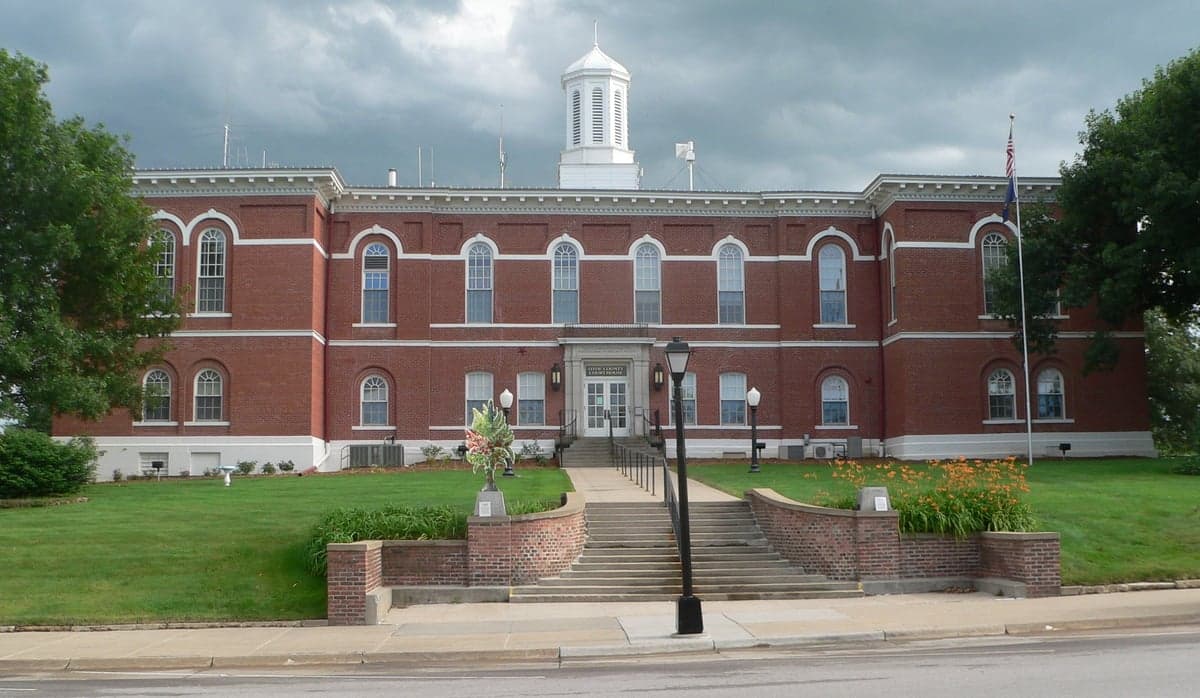
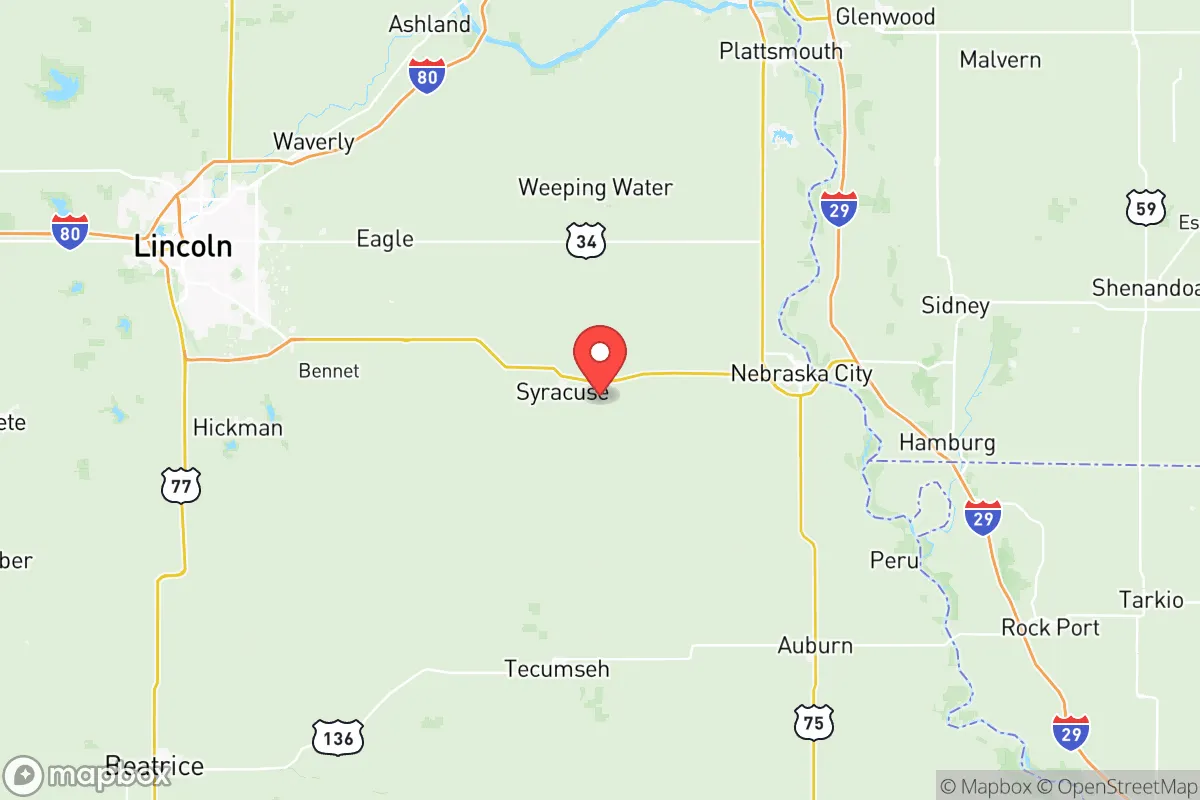
Photo: Wikipedia
Demographics of Otoe County
Affluence Level in Otoe County
A middle-class area roughly in line with national averages across income, home values, education, and employment.
People of Otoe County
Otoe County, Nebraska, is home to roughly 16,075 residents, a predominantly white population (86.5%) with a notable Hispanic minority (8.3%) and a small foreign-born share of 5.0%. The county’s identity is rooted in its agricultural heritage and small-town character, anchored by the county seat of Nebraska City and the historic river town of Syracuse. Its people are largely native-born, with a modest but growing Hispanic community reshaping the cultural landscape, while the population remains stable and slightly aging.
Settlement & growth (pre-1960)
Before American settlement, the area now known as Otoe County was inhabited by the Otoe and Missouri Native American tribes, who lived along the Missouri River and its tributaries. The Otoe people, from whom the county takes its name, were semi-nomadic, relying on hunting and agriculture. French fur traders and explorers passed through the region in the 18th century, but no permanent European settlements were established until after the Louisiana Purchase in 1803.
American settlement began in earnest in the 1850s, following the Kansas-Nebraska Act of 1854, which opened the territory to homesteading. The first wave of settlers were predominantly Anglo-American pioneers from the Upper Midwest and Ohio Valley, drawn by the promise of fertile farmland along the Missouri River. They founded Nebraska City in 1854, which quickly became a key river port and the county’s economic hub. The town of Syracuse was platted in 1871, followed by Dunbar in 1872 and Otoe in 1873, each serving as agricultural service centers for the surrounding farms.
A second major wave arrived in the 1870s and 1880s: German immigrants, many from the regions of Hanover and Westphalia, who were attracted by the availability of cheap land and the established German-speaking communities in the Midwest. They settled heavily in the northern and western parts of the county, founding the villages of Palmyra (originally called German Settlement) and Burr. These German settlers brought with them a strong work ethic, Lutheran and Catholic religious traditions, and a preference for family farming that persists in the county’s rural character today. Smaller numbers of Czech and Swedish immigrants also arrived during this period, though they were less concentrated than the Germans.
By 1900, Otoe County’s population peaked at over 18,000, driven by agricultural prosperity and the expansion of the Burlington and Missouri River Railroad. The early 20th century saw a gradual decline as younger generations left for urban jobs, a trend that accelerated during the Dust Bowl and Great Depression of the 1930s. The county’s population stabilized around 15,000 by 1950, with Nebraska City remaining the dominant population center, home to about half the county’s residents.
Modern era (post-1965)
The 1965 Hart-Cellar Act had a limited direct impact on Otoe County, as the region did not attract the large-scale immigration seen in coastal or urban areas. However, the broader national shift toward a more diverse population began to reach the county slowly. The most significant demographic change since the 1970s has been the growth of the Hispanic population, driven primarily by domestic migration from Texas and the Southwest, as well as some direct immigration from Mexico and Central America. These newcomers found work in agriculture, meatpacking, and food processing, particularly at the Nebraska City facilities of companies like Cargill and the Nebraska Beef plant. The Hispanic community has concentrated in Nebraska City, where they now make up an estimated 15-20% of the city’s population, and to a lesser extent in Syracuse and Palmyra.
Domestic migration patterns have been mixed. The county has experienced a modest outflow of young adults seeking education and employment in larger cities like Lincoln and Omaha, both within an hour’s drive. At the same time, some retirees and remote workers have moved in from the coasts, attracted by lower housing costs and a slower pace of life. This in-migration has been small but noticeable in the county’s more scenic areas along the Missouri River, such as the unincorporated community of Peru (home to Peru State College) and the rural areas around Lorton. The county’s racial composition has remained overwhelmingly white, with the Black population at just 0.8% and East/Southeast Asian communities at 0.1%, reflecting the region’s limited appeal to non-Hispanic minority groups.
Suburbanization has been minimal compared to Nebraska’s urban counties. Most new housing development has occurred on the outskirts of Nebraska City, with a few subdivisions catering to commuters who work in Lincoln or Omaha. The county’s population has hovered around 15,000-16,000 since 2000, with a slight uptick in the 2020 census due to Hispanic growth offsetting white outmigration.
The future
Otoe County’s population is projected to remain stable or decline slightly over the next 10-20 years, barring a major economic shift. The Hispanic community is the fastest-growing segment, likely to increase from 8.3% to 12-15% of the population by 2040, driven by higher birth rates and continued migration for agricultural and processing jobs. This growth is concentrated in Nebraska City, where Hispanic residents are forming a distinct enclave with Spanish-language churches, businesses, and community organizations. The white population, by contrast, is aging and declining, with a median age of 42 compared to 30 for Hispanics.
The county is not homogenizing; instead, it is slowly tribalizing along ethnic lines, with the Hispanic community becoming more visible and organized while the white majority remains culturally dominant. Assimilation is occurring gradually, with second-generation Hispanic youth increasingly bilingual and integrated into local schools and the workforce. The small East/Southeast Asian and Black populations are unlikely to grow significantly, as the county lacks the economic magnets or social networks to attract them.
In-migration from outside the region will likely remain modest, limited to retirees and remote workers drawn by low costs and the scenic Missouri River valley. The county’s cultural identity—rooted in German-American farming traditions, conservative politics, and a strong sense of local community—will persist, but it will be increasingly influenced by Hispanic culture, particularly in Nebraska City. The next decade will see a gradual blending of these two streams, with the county becoming more diverse but still overwhelmingly rural and agricultural.
For someone moving in now, Otoe County offers a stable, affordable, and safe environment with a strong sense of place, but it is not a place of rapid demographic change or urban amenities. The population is slowly diversifying, but the core identity remains white, rural, and conservative. New residents, especially those from outside the region, will find a welcoming but insular community where integration requires active participation in local institutions like churches, schools, and volunteer organizations.

* Values derived from national, state, county, city and local statistics and may differ in a specific area. Last updated: 2026-05-12T03:40:21.000Z
Narrative content on this page is AI-generated and may contain mistakes. Verify any details that matter before acting on them.
ReloMaps may earn a commission from affiliate links at no extra cost to you.

