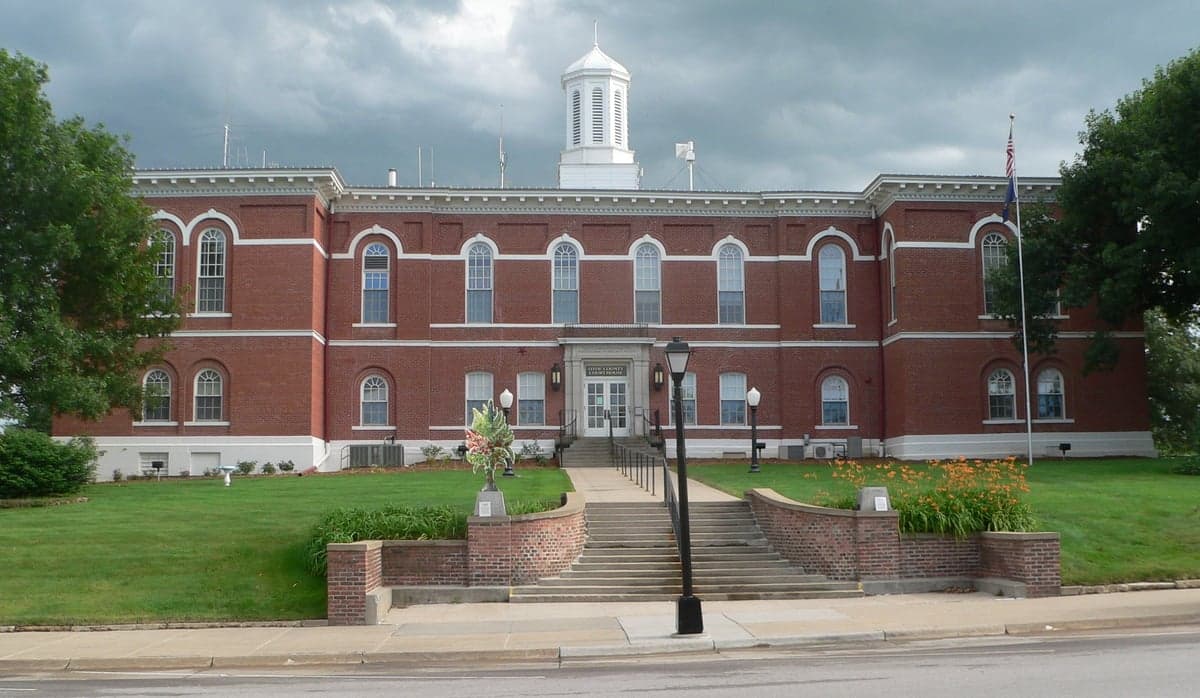
Photo: Wikipedia
Political ClimatePolitical Climate in Otoe County
Showing district-level results — no local-only data available.
Local Political AnalysisPolitical Analysis of Otoe County
Otoe County is about as solidly red as they come in Nebraska, with a Cook PVI of R+27 that puts it way to the right of the state as a whole, which sits at R+10. That’s not just a number—it reflects a deep-rooted, live-and-let-live conservative culture where folks have always been skeptical of government overreach into their personal freedoms and rights. The county has held that line for decades, and while you’ll see some shifts in the bigger towns, the overall trajectory is still firmly traditional, with most voters prioritizing local control and low taxes over any progressive experiments.
How it compares
Compared to Nebraska as a whole, Otoe County is a conservative stronghold. The state’s R+10 PVI already leans Republican, but Otoe County’s R+27 is a different league—think of it as the difference between a reliably red state and a deep-red county where Democrats rarely even bother to run serious campaigns. In the 2024 presidential race, the county went heavily for the GOP candidate, while Nebraska’s 2nd Congressional District (which includes Omaha) actually flipped blue, showing the urban-rural divide. Within Otoe County itself, you’ll see variation: Nebraska City, the county seat, is reliably red but has a few precincts near the downtown core that lean slightly more moderate, especially around the hospital and schools. Syracuse and Palmyra are even more conservative, with precincts often hitting 80% GOP turnout. Unadilla and Douglas are small farming communities where the vote is almost unanimous for conservative candidates—you’d be hard-pressed to find a yard sign for the other side. The only real swing precincts are in the Lourdes area, where a mix of newer residents and commuters to Lincoln have introduced a faint blue tint, but it’s still a solidly red pocket.
What this means for residents
For folks living here, the political climate means you can expect a government that stays out of your business—no heavy-handed mandates or overreaching regulations that tie up your property rights or personal choices. The county commission and school boards are dominated by conservatives who prioritize fiscal restraint and local decision-making, which is a relief if you’ve seen what’s happened in places like Lincoln or Omaha with their progressive tax hikes and zoning rules. That said, there’s a growing concern among long-time residents about the slow creep of progressive ideology, especially through state-level policies that trickle down from the legislature in Lincoln. For instance, recent debates over property tax relief and school funding have sparked worries that the state might impose uniform standards that ignore rural needs—a classic case of government overreach that Otoe County voters are watching closely.
Culturally, Otoe County stands apart from Nebraska’s more liberal pockets. You won’t find the same push for diversity initiatives or climate mandates that you see in the cities. Instead, the focus is on agriculture, small business, and community self-reliance. The county’s strong Second Amendment culture is a given—most folks see gun rights as a fundamental freedom, not a debate topic. And while Nebraska as a whole has seen some shifts toward legalizing medical cannabis and expanding gambling, Otoe County has been slower to embrace those changes, with many residents viewing them as government-sanctioned vices that erode traditional values. If you’re looking for a place where personal liberty and conservative principles still hold sway, Otoe County is a solid bet—but keep an eye on those state-level trends, because the fight to keep government out of your life is never really over.

State Political ClimatePolitical Climate in Nebraska
State Political AnalysisPolitical Environment in the State
Nebraska is a solidly Republican state with a Cook PVI of R+10, but don’t let that single number fool you into thinking it’s a monolith. The state’s political landscape has been remarkably stable for decades, with the GOP holding a firm grip on statewide offices and both U.S. Senate seats, but the real story is the growing tension between the conservative rural heartland and the increasingly progressive urban corridors of Omaha and Lincoln. Over the last 10-20 years, the state has actually shifted slightly rightward in its rural and exurban areas, while the cities have become more reliably Democratic, creating a sharper urban-rural divide that defines every election cycle.
Urban vs. rural divide
The political map of Nebraska is a textbook example of the American urban-rural split. The two major population centers—Omaha (Douglas County) and Lincoln (Lancaster County)—are the blue islands in a sea of red. Omaha, home to about half the state’s population, has trended steadily leftward, with Douglas County voting for Joe Biden by about 10 points in 2020 after being a swing county for years. Lincoln is even more Democratic, with Lancaster County going for Biden by nearly 15 points. These two counties alone deliver enough votes to make statewide races competitive for Democrats, but the rest of the state is overwhelmingly Republican. The 3rd Congressional District, which covers the vast western and central parts of the state, is one of the most Republican districts in the nation, with a Cook PVI of R+28. Places like Grand Island, Kearney, and North Platte are deep red, while Scottsbluff in the Panhandle is reliably conservative. The 2nd Congressional District (Omaha metro) is the only competitive seat in the state, and it flipped to Biden in 2020 and back to a Republican House member in 2022, reflecting its swing nature. The rural counties, especially in the Sandhills and along the Platte River, vote Republican by margins of 70-80% or more.
Policy environment
Nebraska’s policy environment is broadly conservative, but with some notable wrinkles. The state has a unicameral, nonpartisan legislature, which means party labels aren’t officially used, but in practice, the body is dominated by conservative Republicans. The tax structure is relatively friendly: there is no state tax on Social Security benefits, and the state has been gradually reducing its top individual income tax rate, which is currently 5.84% and set to drop further under LB 754, a 2023 law that accelerates rate cuts. Property taxes are a perennial complaint, however, with rates among the highest in the region, though the legislature has passed multiple relief measures, including LB 1107 (2020) which increased the property tax credit. Education policy is a major battleground. In 2023, the legislature passed LB 753, creating a school choice program that provides tax credits for private school scholarships, a win for parental rights advocates. On healthcare, Nebraska expanded Medicaid under the Affordable Care Act via a 2018 ballot initiative, a rare progressive victory that passed with 53% support. Election laws are solid: the state requires voter ID (passed in 2022 as a constitutional amendment with 65% support), has no-excuse absentee voting, and maintains a clean voter roll. There is no state-level gun permit requirement for concealed carry (constitutional carry was enacted in 2023 via LB 77), and the state has strong preemption laws preventing local gun control.
Trajectory & freedom
On the freedom front, Nebraska has been moving in a decidedly positive direction for conservatives over the last five years. The most significant expansion of personal liberty was the passage of LB 77 in 2023, which eliminated the permit requirement for concealed carry, making Nebraska the 27th constitutional carry state. This was a major win for Second Amendment advocates. On parental rights, the legislature passed LB 1084 in 2023, which prohibits instruction on sexual orientation and gender identity in grades K-3, and requires schools to notify parents of any changes to a student’s health or well-being. This law, while controversial, was a clear assertion of parental authority over classroom content. On the medical autonomy front, Nebraska has not gone the way of some neighboring states: there is no broad medical marijuana law (though a ballot initiative is pending for 2024), and the state maintains strict abortion restrictions, banning the procedure after 12 weeks with exceptions for rape, incest, and medical emergencies (LB 209, 2023). Property rights are generally respected, with no statewide rent control and limited eminent domain abuse. The biggest concern for freedom-minded residents is the state’s high property tax burden, which feels like a creeping infringement on ownership. However, the legislature’s recent tax cuts and the push for further relief suggest the trend is toward less government extraction, not more.
Civil unrest & political movements
Nebraska is not a hotbed of civil unrest, but there have been notable flashpoints. The 2020 George Floyd protests saw significant demonstrations in Omaha and Lincoln, with some property damage and clashes with police, but nothing on the scale of Portland or Seattle. The state has seen a growing rural-urban cultural divide that occasionally boils over into legislative fights. The most visible political movement in recent years has been the parental rights movement, which mobilized heavily around school curriculum and library books, particularly in the Omaha suburbs like Papillion and Gretna. These areas saw school board meetings packed with activists demanding transparency and conservative values. Immigration politics are relatively quiet, as Nebraska is not a border state and has a smaller immigrant population, but there have been localized tensions in meatpacking towns like Lexington and Schuyler, where large immigrant workforces have changed the demographic makeup. There is no sanctuary city policy anywhere in the state. Election integrity has been a low-key issue; the 2020 election in Nebraska was conducted smoothly, with no major controversies, and the state’s voter ID law passed with bipartisan support. The most notable political movement on the right is the Nebraska Republican Party’s internal factionalism between establishment conservatives and more populist, Trump-aligned activists, which has played out in primary battles but hasn’t disrupted governance.
Projection
Looking ahead 5-10 years, Nebraska is likely to remain a reliably Republican state, but the urban-rural divide will only deepen. The Omaha metro area is growing faster than the rest of the state, driven by tech and finance jobs, and this will make the 2nd Congressional District increasingly competitive. However, the rural areas are not depopulating as fast as some other Plains states, thanks to strong agriculture and manufacturing bases in places like Columbus and Norfolk. The biggest demographic shift is the in-migration of remote workers from coastal states, particularly to Lincoln and the smaller college towns like Kearney. These newcomers tend to be more moderate or left-leaning, which could slowly shift the urban centers further left. However, the state legislature’s nonpartisan structure and the GOP’s dominance in rural areas will likely keep the policy environment conservative for the foreseeable future. The key battleground will be property tax reform and school funding, as the tension between local control and state mandates grows. Expect continued fights over school choice, transgender policies, and abortion, with the legislature likely to maintain its current conservative trajectory. The biggest wildcard is whether the state’s unicameral system can withstand the nationalization of politics, as partisan pressure increases to abandon the nonpartisan tradition.
For a new resident, the bottom line is this: Nebraska offers a stable, conservative policy environment with a strong sense of community and low crime, but you’ll need to be comfortable with a growing cultural divide between the cities and the countryside. If you’re moving to Omaha or Lincoln, expect a more progressive local government and higher taxes, but if you choose a smaller town like Fremont or Beatrice, you’ll find a deeply conservative, family-oriented culture where your rights are broadly respected. The state is trending in the right direction on gun rights and parental control, but keep an eye on property taxes and the slow creep of urban progressive politics into state-level debates. It’s a good place to raise a family if you value personal freedom and community, but it’s not immune to the national trends—just moving slower than most.
* Values derived from national, state, county, city and local statistics and may differ in a specific area. Last updated: 2026-05-12T03:40:21.000Z
Narrative content on this page is AI-generated and may contain mistakes. Verify any details that matter before acting on them.
ReloMaps may earn a commission from affiliate links at no extra cost to you.

