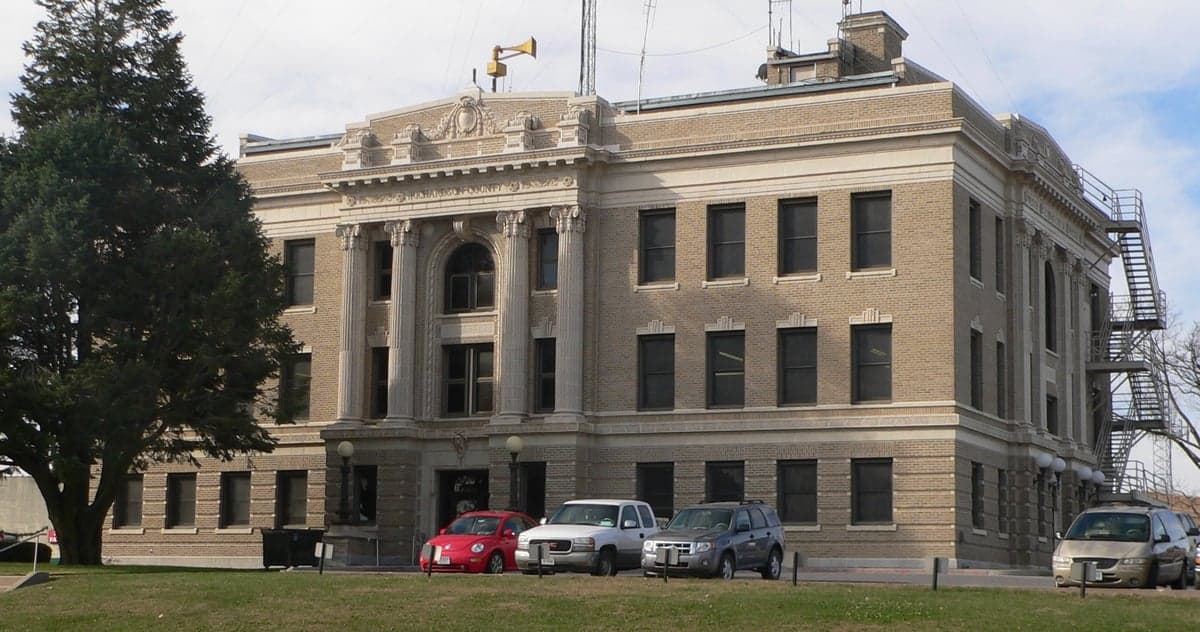
Photo: Wikipedia
Demographics of Richardson County
Affluence Level in Richardson County
A middle-class area roughly in line with national averages across income, home values, education, and employment.
People of Richardson County
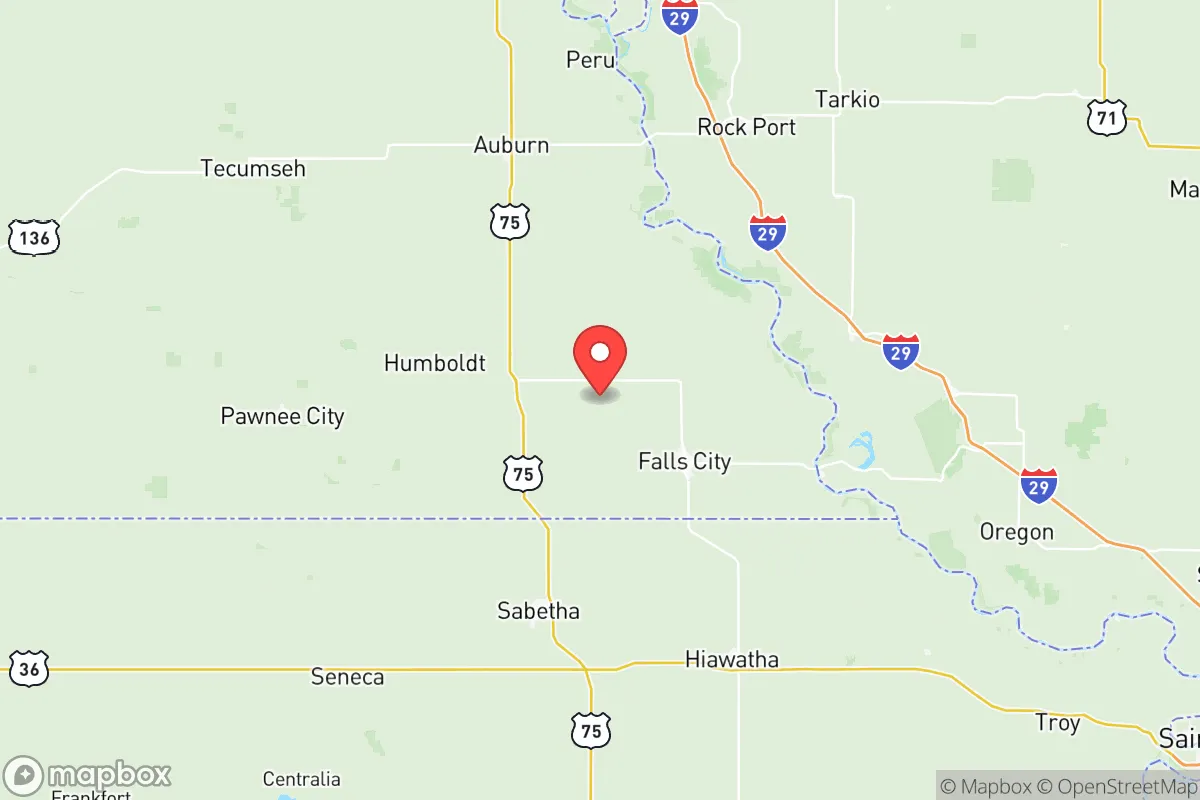
Richardson County, Nebraska, is a deeply rural, predominantly white community of 7,797 residents, where the population has been steadily declining for decades. The county’s identity is rooted in its agricultural heritage and small-town character, with a foreign-born population of just 0.6% and a racial makeup that is 90.9% white. Its people are concentrated in the county seat of Falls City and the smaller towns of Humboldt, Dawson, Salem, and Rulo, where a sense of self-reliance and neighborly connection defines daily life.
Settlement & growth (pre-1960)
Before American settlement, the area that is now Richardson County was part of the traditional territory of the Otoe, Missouria, and Pawnee nations. These Native peoples lived along the Nemaha and Missouri rivers, hunting bison and farming corn, beans, and squash. The first European Americans to arrive were French fur traders and trappers in the late 1700s, but they did not establish permanent settlements. The region was formally acquired by the United States through the Louisiana Purchase of 1803, and the first wave of American settlers—primarily of English, Scots-Irish, and German stock—began arriving in the 1850s after the Kansas-Nebraska Act of 1854 opened the territory for homesteading.
The earliest permanent settlements were along the Missouri River. Rulo, founded in 1856, was the first town in the county and served as a river port and trading post. Falls City, established in 1857, quickly became the county seat and the commercial hub, drawing farmers and merchants from the Midwest and the Upper South. The Homestead Act of 1862 accelerated settlement, attracting families from Illinois, Indiana, Ohio, and Pennsylvania who sought cheap land for corn and livestock farming. German immigrants, many from the regions of Hanover and Westphalia, arrived in the 1870s and 1880s, settling in and around Humboldt and Dawson, where they established Catholic and Lutheran churches that remain community anchors today.
The railroad’s arrival in the 1870s—the Atchison, Topeka and Santa Fe Railway and later the Missouri Pacific—transformed the county. Towns like Salem, Stella, and Verdon sprang up along the tracks, serving as grain-shipping points and supply centers. The population peaked at 15,848 in 1900, driven by intensive agriculture—corn, wheat, and hogs—and the establishment of small manufacturing in Falls City, including a flour mill and a brick plant. The early 20th century saw a modest influx of Czech and Polish families, who added to the county’s ethnic mix but remained a small minority. The Dust Bowl and Great Depression of the 1930s hit hard, causing many farm families to leave for California or urban centers, and the population began a long decline that has never reversed.
Modern era (post-1965)
The 1965 Hart-Cellar Act, which opened immigration to non-European nations, had virtually no impact on Richardson County. The county’s foreign-born population remains at 0.6%, and its racial composition has changed little since the 1960s. The white share has held steady at around 90%, while the Hispanic population—at 2.2%—is the only non-white group to show any growth, largely driven by a small number of Mexican-American families who work in agriculture and meatpacking. The Black population is 0.2%, and there are no recorded East/Southeast Asian or Indian-subcontinent residents.
The dominant demographic story of the modern era is out-migration. Since 1960, the county has lost roughly half its population, falling from 12,000 to 7,797. Young adults leave for college or jobs in larger Nebraska cities like Lincoln and Omaha, or in Kansas City, and few return. The remaining population is older—the median age is 47.6, well above the national average—and the county has a higher-than-average share of residents over 65. Suburbanization has not occurred; instead, the small towns have hollowed out. Falls City remains the largest community, with about 4,300 residents, but its downtown has lost many retail businesses. Humboldt and Dawson have seen their populations shrink to under 800 each, while Salem and Stella are now unincorporated villages with fewer than 100 people.
The economy has shifted from diversified agriculture to a heavy reliance on corn and soybean commodity farming, with some hog and cattle operations. The largest employers are the Falls City Public Schools, the county government, and a few manufacturing plants, including a plastics factory and a metal fabrication shop. The closure of the Falls City hospital in 2019 was a major blow, forcing residents to travel 30 miles or more for medical care. The county’s college-educated share is 22.4%, below the state average of 33%, reflecting the out-migration of younger, more educated workers.
The future
Richardson County’s population is projected to continue declining, likely falling below 7,000 by 2040. The county is not becoming more diverse; the Hispanic share may inch up to 3-4% as a few families move in for agricultural work, but the white share will remain above 90%. The lack of new housing construction, limited job opportunities, and the absence of any significant immigrant gateway mean that the county will continue to age and shrink. The remaining population will be concentrated in Falls City, with the smaller towns becoming bedroom communities or fading away entirely.
There are no signs of a reversal. The county has not attracted domestic migrants from coastal or Rust Belt states, and its rural character—while appealing to a niche of retirees or remote workers—is not drawing enough newcomers to offset natural decrease (more deaths than births). The cultural identity will remain rooted in its agricultural past, with a strong conservative political leaning and a reliance on local churches and community organizations for social cohesion. The county’s school districts are consolidating, and the Falls City school system now serves students from across the county.
For someone moving in now, Richardson County offers a quiet, safe, and affordable lifestyle—median home prices are under $100,000—but it requires accepting limited amenities, long drives for shopping and healthcare, and a social fabric that is aging and shrinking. The county is not a place of demographic change or growth; it is a place of stability and continuity, where the people who remain are deeply rooted in the land and in each other. The future is not one of transformation, but of gradual, gentle decline, with the character of the community preserved even as its numbers dwindle.

* Values derived from national, state, county, city and local statistics and may differ in a specific area. Last updated: 2026-06-12T10:34:06.000Z
Narrative content on this page is AI-generated and may contain mistakes. Verify any details that matter before acting on them.
ReloMaps may earn a commission from affiliate links at no extra cost to you.

