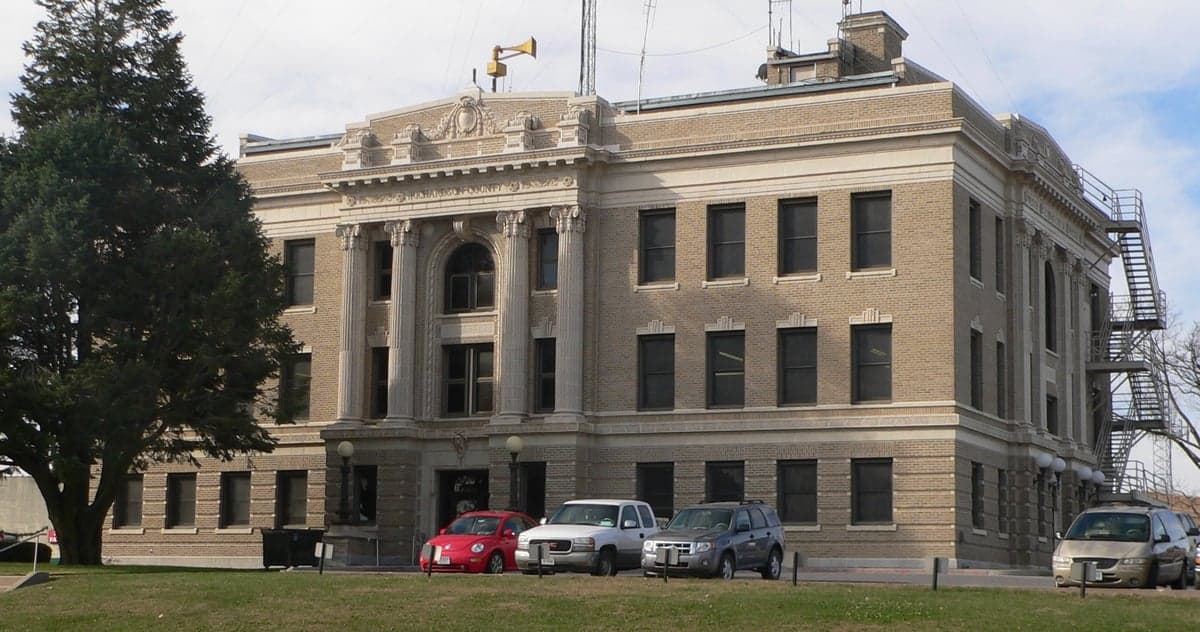
Photo: Wikipedia
Political ClimatePolitical Climate in Richardson County
Showing district-level results — no local-only data available.
Local Political AnalysisPolitical Analysis of Richardson County
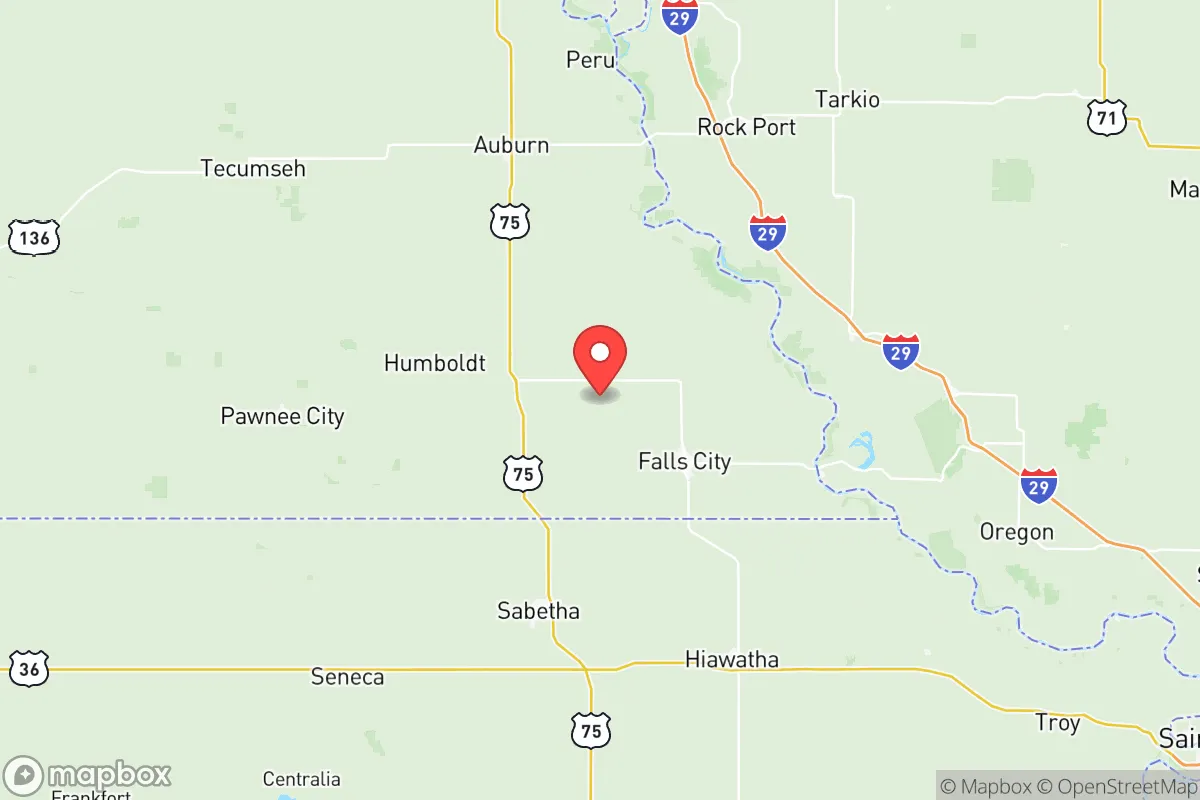
Richardson County, Nebraska, is one of the most reliably Republican corners of the state, with a Cook Partisan Voting Index (PVI) of R+27—meaning it votes about 27 points more Republican than the national average. That’s a full 17 points redder than Nebraska as a whole (R+10), and it’s been that way for decades. The county hasn’t backed a Democrat for president since Lyndon Johnson in 1964, and even then it was a squeaker. The real story, though, is how that deep-red blanket hides some interesting local variation, especially between the county seat of Falls City and the smaller towns like Humboldt, Dawson, and Verdon.
How it compares
Nebraska’s R+10 PVI already makes it a solidly red state, but Richardson County is in a different league. To put it in perspective: while Nebraska’s 2nd Congressional District (Omaha) is a genuine swing district, Richardson County votes more like the Panhandle than the Platte River valley. The county’s Republican margin in 2024 was roughly 78% to 20% for president, compared to about 59% to 38% statewide. The biggest difference isn’t just the raw numbers—it’s the lack of competitive precincts. In Falls City, which has the county’s largest population and a small but consistent Democratic base around the hospital and school district, you’ll see precincts that hit 65-70% Republican instead of 80-85%. Humboldt and Dawson are reliably red, but Verdon and Rulo—tiny towns along the Missouri River—can sometimes show a slightly more moderate lean, often driven by union ties from the old railroad and barge work. Still, no precinct in the county has voted Democratic in a presidential race since at least 2000.
What this means for residents
For conservative residents, Richardson County is about as comfortable as it gets. Local offices—county commission, school board, sheriff—are almost always held by Republicans, and the primary election is often the real contest. The local GOP is active but not factionalized; there’s no sharp divide between establishment and populist wings here. For liberal residents, it’s a different story. You’re not going to find many elected allies, but you’re also not likely to face open hostility. The culture is live-and-let-live, especially in Falls City, where the hospital, schools, and a few small manufacturers employ a mix of people. The biggest practical effect is on policy: property taxes are a perennial issue, and the county’s conservative lean means resistance to new spending, even for roads or broadband. There’s no local sales tax, and the county commission is wary of any new levies. Socially, you’ll see a few Trump signs and a few “In God We Trust” displays, but the real dividing line is less about politics and more about whether you’re from “town” or “the country.”
Culturally, Richardson County is distinct from Nebraska’s more liberal enclaves like Lincoln or Omaha. There’s no local public transit, no bike lanes, and the only Uber driver covers a 50-mile radius. The county’s biggest annual event is the Richardson County Fair in Humboldt, which is heavy on 4-H and tractor pulls—not exactly a political rally. The local newspaper, the Falls City Journal, covers county board meetings in detail but rarely editorializes on national politics. For newcomers, the biggest adjustment isn’t the politics—it’s the pace. People here vote Republican, but they also leave their doors unlocked and wave at strangers. That’s the real Richardson County: red on the map, but neighborly on the ground.

State Political ClimatePolitical Climate in Nebraska
State Political AnalysisPolitical Environment in the State
Nebraska is a solidly Republican state with a Cook PVI of R+10, but that label hides a more complicated reality than you might expect. The state hasn't voted for a Democratic presidential candidate since Lyndon Johnson in 1964, yet it's one of only two states that splits its Electoral College votes by congressional district, and that system has delivered a Democratic elector from the Omaha-based 2nd District in three of the last four presidential elections. Over the past 20 years, the rural-to-urban population shift has deepened the partisan divide, with the eastern I-80 corridor growing more competitive while the rest of the state becomes more uniformly Republican.
Urban vs. rural divide
The political map of Nebraska is essentially a three-way split. Omaha and its Douglas County suburbs are the state's Democratic stronghold, consistently delivering margins of 55-60% for Democratic candidates in statewide races. Lincoln, home to the University of Nebraska, is more moderate but still leans Democratic, though its surrounding Lancaster County has been trending right in recent cycles. The real action is in the suburban ring around Omaha — places like Papillion, La Vista, and Gretna in Sarpy County, which have shifted from reliably Republican to competitive swing territory as young families and professionals move in. Meanwhile, the vast rural expanse — from the Sandhills ranching counties like Cherry and Hooker to the agricultural powerhouse of the Platte Valley — votes 75-85% Republican. The 3rd Congressional District, which covers all of western and central Nebraska, is the most Republican district in the country by PVI (R+29). The 1st District, anchored by Lincoln and stretching east to the Missouri River, is a solid R+14 but has shown some competitive tendencies in state legislative races.
Policy environment
Nebraska's policy environment reflects its conservative lean but with a pragmatic, non-ideological streak. The state has no personal or corporate income tax on the books, but it does have a progressive income tax structure with a top rate of 6.84% — though the legislature has been steadily cutting rates, with a goal of reaching a flat 5.84% by 2027. Property taxes are a perennial flashpoint, among the highest in the nation relative to home values, and the state relies heavily on sales tax revenue. The regulatory posture is generally business-friendly, with a right-to-work law on the books and no state-level minimum wage above the federal $7.25 (though a 2022 ballot initiative will raise it to $15 by 2026). Education policy is a mixed bag: Nebraska has a robust system of public schools, but the state also has one of the nation's most generous school choice programs, with tax-credit scholarships and open enrollment across district lines. Healthcare is dominated by the Nebraska Medicine and CHI Health systems in Omaha, with rural areas facing significant provider shortages. Election laws are moderately restrictive: voter ID is required (implemented in 2024), no-excuse absentee voting is available, and same-day registration is not permitted. The state has a unique unicameral, nonpartisan legislature — officially no party labels, though in practice members caucus and vote along party lines.
Recent policy direction
The last five years have seen Nebraska move decisively to the right on several fronts, while maintaining some moderate positions. On gun rights, the state enacted constitutional carry in 2023, allowing permitless concealed carry for anyone 21 or older, and preempted local gun ordinances. Parental rights in education gained traction with a 2023 law requiring schools to notify parents of curriculum changes and allowing them to opt their children out of certain instruction. The state also passed a near-total abortion ban in 2023, prohibiting the procedure after 12 weeks with exceptions for rape, incest, and medical emergencies — a compromise that fell short of the six-week ban some conservatives wanted. On property rights, the legislature has resisted statewide zoning preemption, leaving local control largely intact. Tax policy has been the dominant issue: the state cut the top income tax rate from 6.84% to 5.84% over four years, and in 2024 passed a major property tax relief package funded by a sales tax expansion on certain services. Election integrity saw the implementation of voter ID in 2024, with a free state-issued ID available to those without one. On privacy and surveillance, Nebraska has no comprehensive data privacy law, though a bill is pending. Medical freedom saw the state ban COVID-19 vaccine mandates for state employees and contractors in 2023.
Civil unrest & political movements
Nebraska's political activism is generally low-key compared to coastal states, but there have been notable flashpoints. The 2020 George Floyd protests in Omaha were the largest in state history, with several nights of unrest and property damage, leading to a lasting divide between the city's progressive activists and the state's conservative leadership. The abortion debate has been particularly heated: after the 2023 12-week ban, activists on both sides launched competing ballot initiatives for 2024 — one to enshrine abortion rights up to viability, another to ban abortion after conception — though the latter failed to gather enough signatures. Immigration politics flared in 2023 when the legislature debated a bill to require local law enforcement to cooperate with ICE, which ultimately failed after a filibuster by Omaha-area senators. There's been no serious secession or nullification rhetoric, though some rural counties have passed symbolic resolutions asserting local control over federal land management. Election integrity controversies have been minimal compared to other states, with no major fraud cases and bipartisan acceptance of the 2020 and 2022 results. The most visible political movement in recent years has been the property tax revolt, with grassroots groups like Nebraskans for Property Tax Reform holding rallies at the state capitol and successfully pushing for the 2024 relief package.
Projection
Over the next 5-10 years, Nebraska's political trajectory points toward continued Republican dominance at the state level, but with growing tension between the Omaha metro and the rest of the state. The 2nd Congressional District will remain competitive, potentially flipping between parties depending on national trends. The state's population growth is concentrated in the Omaha suburbs and Lincoln, which will slowly shift the political center of gravity eastward. However, the rural population is aging and shrinking, which could accelerate the urban-rural polarization. The unicameral legislature's nonpartisan structure may come under pressure as national partisan dynamics intrude more heavily into local races. On policy, expect continued income tax cuts, further property tax reform (likely shifting more burden to sales taxes), and ongoing battles over abortion access as the 12-week ban faces legal challenges and potential ballot measures. The state's relatively low cost of living and business-friendly climate will continue to attract in-migration from higher-tax states like California and Illinois, which may bring a more diverse set of political views to the Omaha area. For a new resident, the bottom line is this: if you're conservative, you'll find Nebraska's state government largely aligned with your values, especially on taxes, guns, and education. If you're liberal, you'll find a solid community in Omaha and Lincoln, but you'll be swimming against the current in statewide politics. The state's practical, non-ideological culture means that even contentious issues tend to be resolved through compromise rather than confrontation — a trait that's becoming increasingly rare in American politics.
* Values derived from national, state, county, city and local statistics and may differ in a specific area. Last updated: 2026-06-12T10:34:06.000Z
Narrative content on this page is AI-generated and may contain mistakes. Verify any details that matter before acting on them.
ReloMaps may earn a commission from affiliate links at no extra cost to you.

