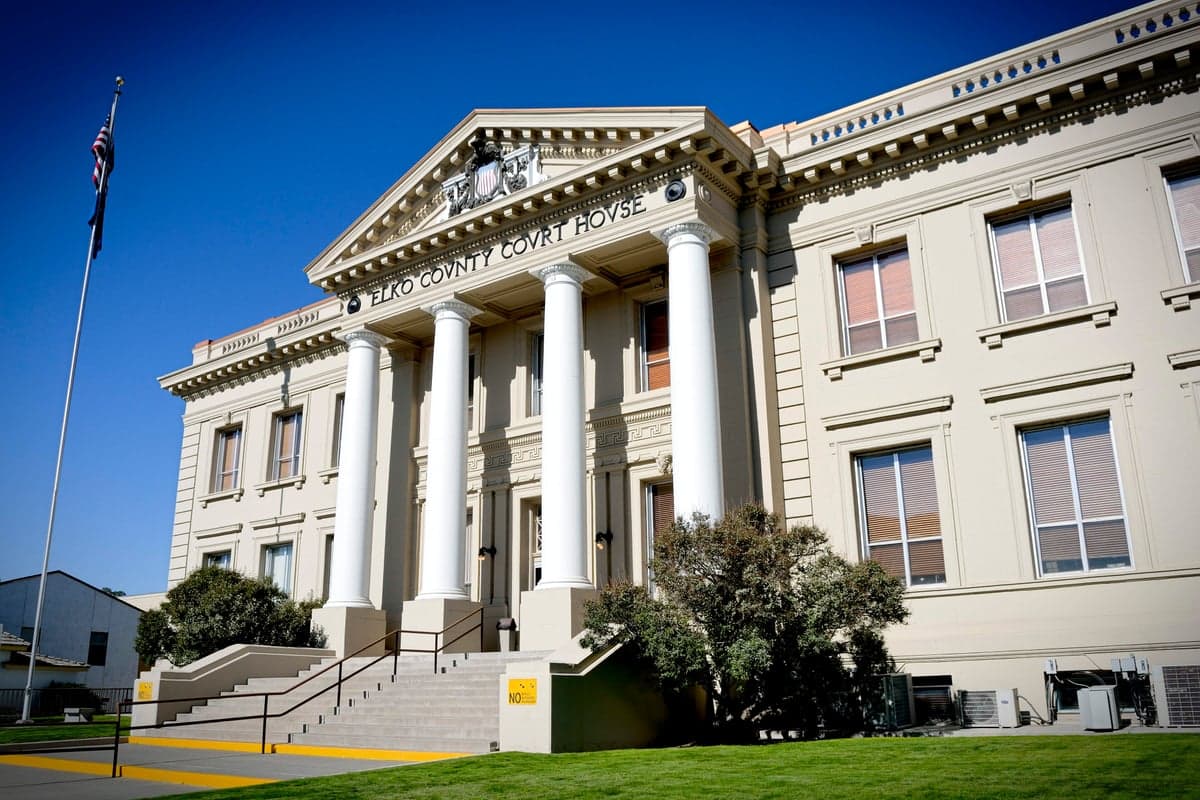
Photo: Wikipedia
Political ClimatePolitical Climate in Elko County
Showing district-level results — no local-only data available.
Local Political AnalysisPolitical Analysis of Elko County
Elko County has long been a rock-ribbed conservative stronghold, and honestly, that hasn't changed much. The Cook PVI of R+7 tells the real story here—this isn't just red, it's deep crimson, especially when you stack it against Nevada's statewide R+1, which is already trending purple. The county voted for Trump by a massive 40-point margin in 2020, and that kind of loyalty isn't fading. You see it in the local elections, the school board meetings, and the way folks talk about property rights and the Second Amendment. It's a place where the old Western values of self-reliance and limited government aren't just slogans; they're how people live.
How it compares
The difference between Elko County and the rest of Nevada is night and day. While Clark County (Las Vegas) and Washoe County (Reno) have been shifting left for years, dragging the state to a near-toss-up status, Elko has held the line. The R+1 statewide PVI is deceptive—it's only that close because of the massive population in the urban south. Drive an hour north of Reno, and you're in a different world. In Elko County, you'll find towns like Spring Creek and Carlin that are reliably conservative, but even here there's nuance. The city of Elko itself has a few precincts near the college that lean a bit more moderate, but they're still solidly red. The real outliers are Wells and West Wendover—West Wendover, right on the Utah border, has a more mixed political scene thanks to its casino economy and transient population, but it's still a far cry from anything you'd call progressive. The swing precincts? They're almost nonexistent. This county doesn't swing; it stays put.
What this means for residents
For folks living here, the political climate means a government that mostly stays out of your business. You don't see the kind of overreach you hear about in places like California or even Las Vegas. Property taxes are low, zoning is minimal, and there's a strong cultural presumption that you can do what you want on your own land—whether that's building a shop, keeping livestock, or carrying a firearm. That said, there's a growing concern among long-time residents about the influx of new people from blue states, drawn by the mining jobs and affordable land. They bring different ideas, and you can feel the tension at county commission meetings when issues like land use or public health mandates come up. The shift is slow, but it's real. If you value personal freedom and don't want a government telling you how to live your life, Elko County is still one of the best places in Nevada to be. But keep an eye on the local elections—that's where the fight for the county's soul is happening.
Culturally, Elko County is a world apart from the rest of Nevada. The Gold Rush days are still alive in the ranching and mining heritage, and the annual National Cowboy Poetry Gathering in Elko is a testament to that. Policy-wise, you'll find strong support for the Second Amendment, opposition to new taxes, and a general skepticism of federal land management—the Bureau of Land Management controls a huge chunk of the county, and that's a constant source of friction. The county has also pushed back hard on state-level mandates, from COVID restrictions to renewable energy targets that threaten the mining industry. It's a place where the motto "Live and let live" still means something, as long as you're not asking for a handout or a new regulation. If that sounds like your kind of place, you'll fit right in.

State Political ClimatePolitical Climate in Nevada
State Political AnalysisPolitical Environment in the State
Nevada is a true battleground state with a Cook PVI of R+1, meaning it leans just slightly Republican but remains highly competitive. Over the past 10-20 years, the state has shifted from a reliably blue stronghold—thanks to powerful union and casino interests in Las Vegas—to a purple state where rural and exurban growth is pulling it rightward. The 2024 presidential race saw Trump win the state by roughly 2 points, a flip from Biden’s 2.4-point win in 2020, signaling a realignment driven by an influx of conservative-leaning transplants from California and the West Coast.
Urban vs. rural divide
The political map of Nevada is starkly divided. Clark County (Las Vegas) is the Democratic engine, home to nearly three-quarters of the state’s population, with strong union and minority voter turnout. Washoe County (Reno) has trended purple, flipping narrowly for Biden in 2020 but returning to Trump in 2024. The real story is the rural expanse: counties like Elko, Nye, and White Pine vote Republican by 30-40 point margins. The fastest-growing conservative stronghold is Minden and Gardnerville in Douglas County, where California refugees have created a deep-red enclave. Mesquite, on the Utah border, is another reliably conservative retirement community. Meanwhile, Henderson (a Las Vegas suburb) is a key swing area—once reliably red, it’s now a toss-up as younger families and service workers move in. The urban-rural split is so pronounced that state legislative maps are drawn to pack Democratic votes in Clark County, giving rural areas outsized influence in the state senate.
Policy environment
Nevada’s policy environment is a mixed bag for conservatives. The good news: there’s no state income tax, a major draw for high-earners and business owners. Property taxes are capped at 3% annual growth, keeping housing costs predictable. The regulatory posture is generally business-friendly, especially for mining and gaming. However, the state has a Democratic-controlled legislature and governor as of 2025, which has pushed progressive priorities. Education policy is a sore spot: Nevada ranks near the bottom nationally in K-12 outcomes, and the state has resisted school choice expansion, though a modest Education Savings Account program was passed in 2023. Healthcare policy is dominated by the state’s Medicaid expansion under Obamacare, which covers about 20% of residents. Election laws are a flashpoint: Nevada has universal mail-in voting (enacted during COVID and made permanent in 2021), same-day registration, and no voter ID requirement—a setup that concerns many conservatives about election integrity. The state also has a “sanctuary” law (SB 223, 2023) that limits local cooperation with federal immigration enforcement, which has become a major issue in rural areas.
Trajectory & freedom
On personal freedom, Nevada is a tale of two trends. On the positive side for conservatives, the state has constitutional carry (no permit needed to carry a concealed firearm) since 2021, and there’s no red flag law. Property rights are strong, with no statewide rent control and minimal zoning restrictions outside Clark County. However, the trajectory is concerning. The 2023 legislative session saw the passage of AB 116, which expanded “gender identity” protections in public accommodations, and SB 163, which codified abortion access as a “fundamental right” in state law—both seen as government overreach into personal and parental rights. The state also passed a “clean energy” mandate (SB 358) requiring 100% carbon-free electricity by 2050, which critics say will drive up energy costs and limit property rights for solar development. The biggest freedom concern is the erosion of parental rights: a 2023 law (AB 285) allows minors to consent to certain medical procedures without parental notification, a red flag for families. On the bright side, the state’s tax structure remains a beacon of economic freedom, and the lack of a state income tax is unlikely to change given the constitutional supermajority required to enact one.
Civil unrest & political movements
Nevada has seen its share of political flashpoints. The 2020 election integrity controversy was intense, with the Clark County election department facing lawsuits over ballot signature verification and processing. The “Stop the Steal” movement had a strong presence in rural counties, particularly Elko and Nye, where local officials passed resolutions questioning the election results. On the left, the “Vegas Strong” labor movement remains powerful, with the Culinary Union (representing 60,000 casino workers) being a major Democratic force. Immigration politics are heated: the sanctuary law (SB 223) has led to clashes between state and local law enforcement, with the Nye County sheriff publicly refusing to comply. In 2023, a “Parents’ Bill of Rights” movement gained traction in Douglas County, where school board meetings became battlegrounds over critical race theory and library books. The “Rural Nevada” secession movement—a push to form a new state called “New Nevada” from the 15 rural counties—has gained some online traction but little legislative progress. A new resident would notice the stark cultural divide: drive 30 minutes outside Las Vegas or Reno, and you’re in Trump country with “Don’t Tread on Me” flags flying.
Projection
Over the next 5-10 years, Nevada is likely to become more competitive but not reliably red. The key demographic driver is in-migration: about 50,000 new residents per year, mostly from California, Oregon, and Washington. These transplants are a mixed bag—some are conservative refugees fleeing high taxes and progressive policies, but many are moderate or left-leaning tech workers and retirees. The fastest-growing areas are Reno (the “Silicon Valley of the Sierra”) and Henderson, both of which are trending purple. Rural counties will continue to vote red but are losing population share. The state’s electoral college votes (6) will remain in play, but the state legislature is likely to stay under Democratic control due to gerrymandered maps in Clark County. The biggest wildcard is election integrity: if the state doesn’t tighten its mail-in voting laws, conservatives may become disillusioned and turnout could drop. A new resident moving in now should expect a state that is politically divided but economically free—a place where your personal liberty is largely respected at the state level, but local politics (especially in Clark County) can feel like a progressive bubble.
Bottom line for a new resident: Nevada offers a unique blend of economic freedom (no income tax, low property taxes) and cultural conservatism in its rural and exurban areas, but you’ll need to be politically engaged to protect those freedoms. If you’re moving to Minden, Mesquite, or Elko, you’ll find a like-minded community. If you’re in Las Vegas or Reno, expect to be in the minority politically but still able to live your life without much government interference—for now. The state’s trajectory is uncertain, but its tax structure and gun laws are unlikely to change, making it a solid choice for conservatives who value economic and Second Amendment rights.
* Values derived from national, state, county, city and local statistics and may differ in a specific area. Last updated: 2026-05-12T09:34:01.000Z
Narrative content on this page is AI-generated and may contain mistakes. Verify any details that matter before acting on them.
ReloMaps may earn a commission from affiliate links at no extra cost to you.

