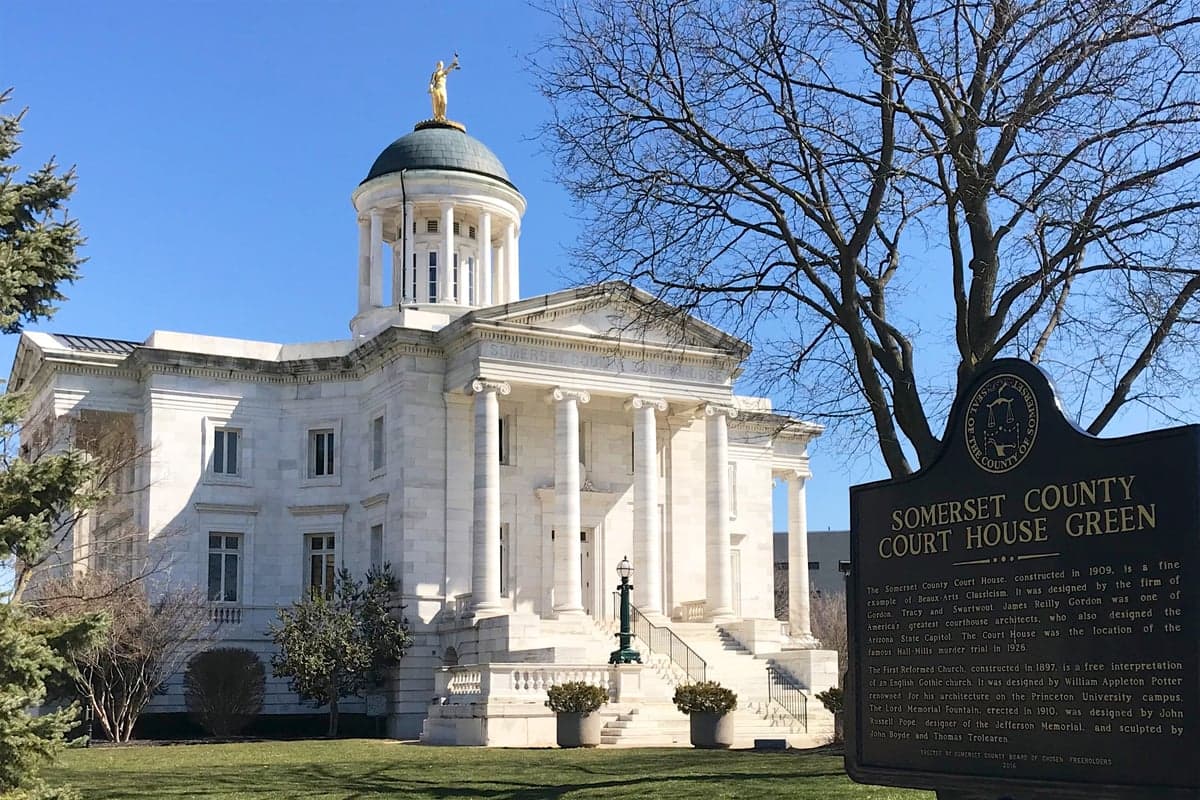
Photo: Wikipedia
Demographics of Somerset County
Affluence Level in Somerset County
An upper-middle-class area. Household wealth, education levels, and homeownership run ahead of national benchmarks.
People of Somerset County
The people of Somerset County, New Jersey today form one of the most highly educated and ethnically diverse populations in the state, with a character shaped by successive waves of migration from colonial Dutch and English settlers to 21st-century professionals from India and East Asia. With a population of 346,203, the county is 50.6% white, 17.0% Hispanic, 11.7% Indian (subcontinent), 9.3% Black, and 7.4% East/Southeast Asian, and 57.4% of adults hold a college degree. This demographic profile reflects a suburban landscape that blends historic farming villages with corporate headquarters and commuter rail access to New York City, creating a distinctive identity as a prosperous, family-oriented region where old-stock American roots coexist with vibrant immigrant communities.
Settlement & growth (pre-1960)
The original inhabitants of what is now Somerset County were the Lenape people, specifically the Unami-speaking bands who lived in seasonal villages along the Raritan River and its tributaries. Dutch traders from New Netherland began exploring the area in the 1620s, but permanent European settlement did not begin until the late 17th century, after the English took control in 1664. The first English and Dutch settlers arrived in the 1680s, drawn by land grants in the fertile Raritan Valley. They established the county's oldest towns: Bound Brook (settled 1681) and Somerville (settled 1684), which became the county seat in 1784. These early communities were agrarian, with wheat and livestock farming dominating the economy through the 18th and early 19th centuries.
The 19th century brought two transformative developments: the Delaware and Raritan Canal (completed 1834) and the arrival of railroads. The canal connected the Raritan River to the Delaware River, turning Bound Brook and Manville into industrial hubs for shipping grain, coal, and manufactured goods. The Central Railroad of New Jersey reached Somerville in 1842, and the subsequent rail network spurred the growth of commuter suburbs like Bernardsville and Far Hills, where wealthy New York families built summer estates. Irish immigrants arrived in large numbers during the 1840s and 1850s to dig the canal and lay railroad tracks; many settled in Raritan and Somerville, where their descendants remain today. German immigrants followed in the 1850s-1880s, working as farmers, brewers, and craftsmen, particularly in the northern hill towns like Bedminster and Peapack-Gladstone.
The early 20th century saw Italian and Polish immigrants arrive to work in the county's growing manufacturing sector. Manville became a company town for the Johns-Manville asbestos plant, which employed thousands of Eastern European immigrants from the 1910s through the 1970s. North Plainfield and Bound Brook attracted Italian immigrants who worked in textile mills and foundries. The Great Migration of Black Americans from the South began reaching Somerset County in the 1940s and 1950s, drawn by industrial jobs in Manville and Somerville. By 1960, the county's population was roughly 90% white, with small but established Black and Italian enclaves concentrated in the older industrial boroughs along the Raritan River.
Modern era (post-1965)
The 1965 Hart-Cellar Act fundamentally reshaped Somerset County's demographics, as did the simultaneous expansion of the pharmaceutical and technology industries along the Interstate 287 corridor. The county's transformation began in the 1970s and accelerated through the 1990s, driven by two forces: corporate relocations and the growth of the Indian-American professional class. Major employers like Johnson & Johnson (headquartered in New Brunswick, adjacent to Somerset), AT&T Bell Labs (in Warren and Bridgewater), and Sanofi (in Bridgewater) recruited highly skilled engineers and scientists from India, China, and Taiwan. The Indian-subcontinent population, now 11.7% of the county, concentrated heavily in Bridgewater, Franklin Township, and Hillsborough, where large homes and top-rated school districts attracted families. Franklin Township in particular became a major hub for Indian-American professionals, with a thriving commercial corridor along Route 27 featuring Indian grocery stores, restaurants, and cultural centers.
East and Southeast Asian communities, now 7.4% of the population, followed a similar pattern. Chinese and Korean immigrants settled in Warren, Watchung, and Bernards Township, drawn by the same combination of corporate employment and excellent public schools. The Hispanic population, now 17.0%, grew through a different pathway: Puerto Rican migrants arrived in the 1970s and 1980s for manufacturing jobs, followed by Dominican and Mexican immigrants in the 1990s and 2000s for construction, landscaping, and service work. Bound Brook and North Plainfield became the primary Hispanic enclaves, with vibrant commercial districts along Main Street and Route 22. The Black population, now 9.3%, grew more slowly, with established communities in Somerville and Manville supplemented by middle-class Black families moving to Franklin Township and Hillsborough from the 1990s onward.
Domestic migration also reshaped the county. From the 1980s through the 2010s, Somerset County attracted white-collar families leaving New York City and northern New Jersey for larger homes and better schools. This "suburban flight" from Essex and Union counties boosted the populations of Bernardsville, Far Hills, and Bedminster, which remain predominantly white and affluent. The county's overall white share declined from roughly 85% in 1980 to 50.6% today, but the absolute number of white residents has remained stable, as new white arrivals from other parts of New Jersey and the Northeast offset natural attrition.
The future
Somerset County is becoming more diverse, but the nature of that diversity is shifting. The Indian-subcontinent population, already the largest non-white group at 11.7%, is projected to continue growing as family reunification and H-1B visa holders settle in Bridgewater, Franklin Township, and Hillsborough. These communities are dispersing beyond the initial enclaves into Montgomery and Branchburg, where new housing developments cater to multi-generational families. The East/Southeast Asian population is also growing, though more slowly, with second-generation Chinese and Korean families moving from Warren and Watchung into Bernards Township and Basking Ridge.
The Hispanic population, concentrated in Bound Brook and North Plainfield, is becoming more established, with second- and third-generation families moving into Manville and Somerville. The Black population is stable but aging, with younger Black families more likely to move to Franklin Township or out of the county entirely to more affordable areas in central New Jersey. The white population is aging fastest, particularly in the wealthy northern towns like Bernardsville and Far Hills, where housing costs limit in-migration by younger families. Over the next 10-20 years, Somerset County will likely become a "majority-minority" county, with no single racial or ethnic group holding a majority, but with the Indian-subcontinent and Hispanic populations each approaching 20%.
The county's cultural identity is evolving from an old-stock WASP and Catholic industrial past into a polyglot professional suburb. The school systems in Bridgewater-Raritan, Franklin Township, and Hillsborough now routinely celebrate Diwali and Lunar New Year alongside Christmas and Thanksgiving. The political character, once reliably Republican, has shifted to a competitive lean-Democratic, driven by the growing immigrant and college-educated populations. The county's high cost of living—median home values exceed $500,000—means that future growth will be driven primarily by high-income professionals, reinforcing the county's character as a place where diversity is stratified by education and income.
For someone moving in now, Somerset County offers a stable, prosperous environment with excellent schools and a genuinely multicultural population, but it is not a place of cheap housing or rapid change. The county's trajectory is toward greater diversity within a framework of affluence, where the children of Indian engineers and Korean doctors attend school alongside the grandchildren of Irish canal-diggers and Italian factory workers. The old industrial towns along the Raritan are gentrifying slowly, while the northern hill towns remain bastions of old money. The result is a county that feels both settled and dynamic—a place where the past is visible in every historic village center, but the future is being written in the accents of a dozen languages in the corridors of corporate office parks.

* Values derived from national, state, county, city and local statistics and may differ in a specific area. Last updated: 2026-09-30T11:10:15.000Z
Narrative content on this page is AI-generated and may contain mistakes. Verify any details that matter before acting on them.
ReloMaps may earn a commission from affiliate links at no extra cost to you.

