Photo: Wikipedia
Demographics of Lea County
Affluence Level in Lea County
A below-average socioeconomic profile. Incomes, home values, and educational attainment trail the U.S., with higher poverty and unemployment.
People of Lea County
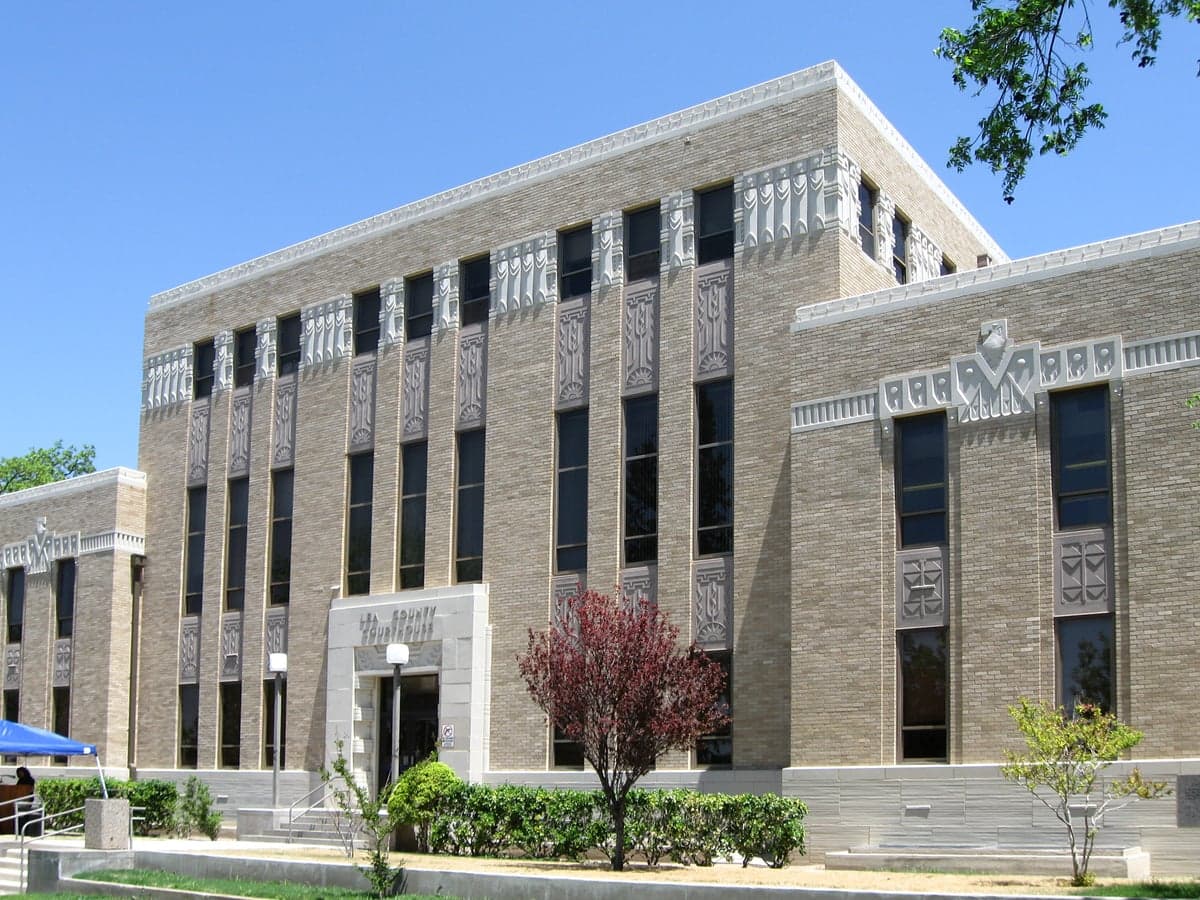
Lea County, New Mexico, is a predominantly Hispanic (61.6%) and white (32.1%) community of 73,154 people, shaped by a century of oil booms, agricultural settlement, and cross-border migration. The county’s identity is rooted in the Permian Basin’s extractive economy, producing a population that is younger, more male-skewed, and less college-educated (15.3%) than the national average. Foreign-born residents make up 13.8% of the population, a figure driven almost entirely by Mexican and Central American immigration tied to the energy and construction sectors. The county’s cultural character is a blend of West Texas pragmatism, New Mexican Hispanic traditions, and a transient workforce that rotates through its two main population centers: Hobbs and Lovington.
Settlement & growth (pre-1960)
Before Anglo-American settlement, Lea County was part of the vast Llano Estacado, a high plains region inhabited by the Mescalero Apache and, earlier, the Jornada Mogollon peoples. Spanish and Mexican claims to the area were nominal; no permanent colonial settlements were established in what is now Lea County. The region remained largely unpopulated by non-Native people until after the U.S. acquired it via the 1848 Treaty of Guadalupe Hidalgo and the 1853 Gadsden Purchase.
The first permanent Anglo settlers arrived in the 1880s and 1890s, drawn by the promise of open-range cattle ranching. These were primarily families from Texas and the Southern Plains—many of Scots-Irish and English descent—who established ranches around what would become Lovington (founded 1908) and Hobbs (founded 1907). The county was formally created in 1917 from parts of Chaves and Eddy counties, named after Captain Joseph C. Lea, a Confederate veteran and New Mexico rancher. The early economy was entirely agricultural: cattle, cotton, and sorghum.
The discovery of oil in the Permian Basin in the 1920s transformed Lea County’s population overnight. The Hobbs oil field, discovered in 1928, triggered a boom that brought thousands of workers from Oklahoma, Texas, and Arkansas—many of them Dust Bowl refugees fleeing the agricultural collapse of the 1930s. These “Okie” and “Texan” migrants were predominantly white, Protestant, and rural, and they established the county’s enduring cultural alignment with West Texas rather than with northern New Mexico. Jal (founded 1911) and Eunice (founded 1909) grew as oil-patch company towns, with populations that swelled and contracted with drilling cycles. By 1940, Lea County’s population had reached 21,000, nearly all white and native-born.
Mexican immigration began in earnest during the 1940s and 1950s, driven by the Bracero Program (1942–1964) and the labor demands of both agriculture and the oil fields. Mexican workers settled in barrios on the south and east sides of Hobbs and in rural colonias around Tatum and Lovington. These early Hispanic residents were overwhelmingly from the northern Mexican states of Chihuahua and Coahuila, and they formed the foundation of what would become the county’s majority-Hispanic population by the 21st century.
Modern era (post-1965)
The 1965 Hart-Cellar Act did not dramatically alter Lea County’s immigration patterns, as the county’s foreign-born population remained overwhelmingly Mexican. However, the act’s family-reunification provisions accelerated chain migration from Mexico, and the county’s Hispanic share grew steadily from roughly 30% in 1970 to over 60% today. The 1980s oil bust caused a temporary population decline—from 55,000 in 1982 to 48,000 in 1990—but the county rebounded with the Permian Basin’s resurgence after 2000.
Domestic migration since 1965 has been dominated by two flows: Anglo retirees and workers from Texas, and a smaller but significant influx of Black workers from Louisiana and East Texas drawn to oil-field service jobs. The Black population, now 3.4%, is concentrated in Hobbs, particularly around the oil-field service corridors on the city’s north side. The Asian population remains negligible at 0.2%, with a handful of Filipino and Vietnamese families working in the energy sector. The Indian-subcontinent population (0.4%) is almost entirely composed of motel and convenience-store owners, a pattern common across rural New Mexico and West Texas.
Suburbanization has been limited by the county’s low density and flat terrain. Hobbs has expanded westward along U.S. 62/180, with new subdivisions catering to oil-field professionals and commuters. Lovington has grown more slowly, retaining its small-town character. The unincorporated community of Monument has seen scattered exurban development, while Maljamar and Caprock remain near-ghost towns, their populations having dwindled as oil operations consolidated.
The county’s college-educated share (15.3%) is well below the national average, reflecting the dominance of blue-collar extraction jobs. New Mexico Junior College in Hobbs serves as the primary postsecondary institution, with a strong vocational focus on petroleum technology and welding. The foreign-born share (13.8%) is nearly triple the New Mexico average, driven by Mexican immigrants who work in construction, oil-field maintenance, and the service sector.
The future
Lea County is becoming more Hispanic and more foreign-born, but not more diverse in other dimensions. The white share (32.1%) is declining as older Anglo residents retire and move to Texas cities, while the Hispanic share continues to rise through both higher birth rates and ongoing immigration. The Black and Asian shares are likely to remain stable or grow only slightly, as the county lacks the professional job base that attracts more diverse populations to urban centers.
The next 10–20 years will see continued population growth tied to Permian Basin oil production, but with significant volatility. If oil prices remain above $70/barrel, Hobbs could grow to 50,000 residents, with new subdivisions spreading toward the Texas line. If a green-energy transition reduces fossil-fuel demand, the county could lose 20–30% of its population within a decade, as it did in the 1980s. The cultural identity will likely remain a hybrid of Hispanic New Mexico and Anglo West Texas, with Spanish increasingly heard in public spaces but English remaining dominant in business and government.
For someone moving in now, Lea County offers a low-cost, low-regulation environment with strong job prospects in energy and construction, but limited cultural amenities, a weak educational infrastructure, and a population that is heavily transient. The county is not becoming a diverse melting pot; it is becoming a more uniformly Hispanic working-class community with a shrinking Anglo minority and a small but stable Black presence. The character is pragmatic, conservative, and oriented toward the oil field—a place where boom-and-bust cycles are a fact of life, not a surprise.

* Values derived from national, state, county, city and local statistics and may differ in a specific area. Last updated: 2026-06-12T19:35:15.000Z
Narrative content on this page is AI-generated and may contain mistakes. Verify any details that matter before acting on them.
ReloMaps may earn a commission from affiliate links at no extra cost to you.

