
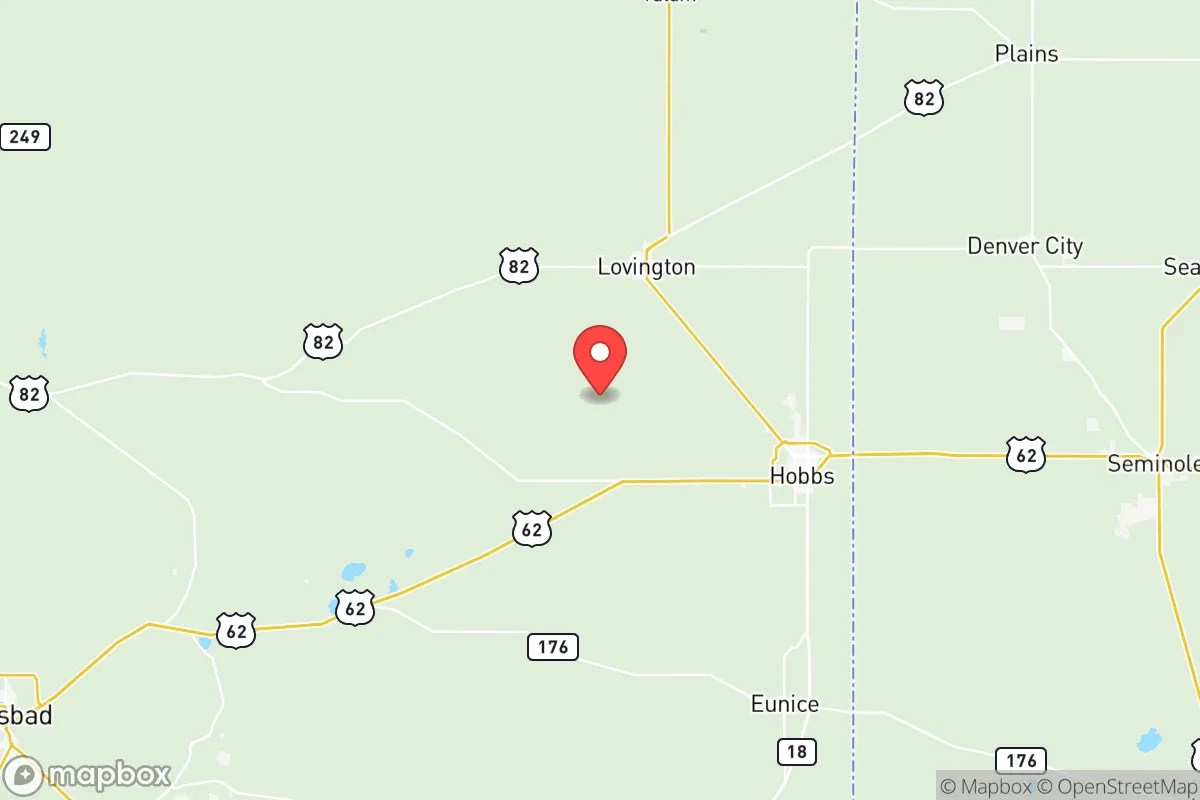
Photo: Wikipedia
Personal Sovereignty in Lea County
Viable for self-reliance. Generally workable, though some barriers may limit total independence.
What does Personal Sovereignty tell us?
Personal Sovereignty measures your capacity for self-reliance and independence with minimal government friction. Higher scores mean fewer barriers between you and the way you want to live... but it assumes you have the space you need and good neighbors.
What does this tell us?
Personal Sovereignty measures your capacity for self-reliance and independence with minimal government friction. Higher scores mean fewer barriers between you and the way you want to live... but it assumes you have the space you need and good neighbors.
State Policy
Energy independence: Net exporter (250% of energy produced in-state)
Personal Liberty
Homesteading

Personal Liberty Analysis
Lea County, New Mexico, offers one of the strongest personal sovereignty environments in the Southwest, combining a light-touch regulatory posture with deep-rooted traditions of self-reliance and individual liberty. The county's political culture leans heavily conservative, and its legal framework—from tax policy to self-defense law—reflects a consistent preference for minimal government interference in personal and economic decisions. For single individuals and families prioritizing autonomy, Lea County stands in stark contrast to more regulated urban centers like Santa Fe or Albuquerque, with Hobbs, Lovington, Eunice, Jal, and Tatum each presenting distinct but uniformly freedom-oriented conditions.
Tax burden and regulatory posture: How Lea County compares to New Mexico state norms
Lea County benefits from New Mexico's relatively moderate state tax structure, but the local regulatory environment is notably lighter than state averages. The state's personal income tax is progressive, with rates from 1.7% to 5.9%, but Lea County's economy—driven by oil and gas, agriculture, and small business—keeps effective rates low for most residents through deductions and credits. Property taxes are among the lowest in the nation, with Lea County's effective rate averaging 0.55% of assessed value, roughly half the national average. There is no county-level sales tax surcharge beyond the state's 5.125% base, though municipalities like Hobbs and Lovington add local option rates totaling 7.8125% and 7.5625% respectively. Business regulation is minimal: no county-level business licensing requirements exist outside of oil and gas operations, and zoning in unincorporated areas is virtually nonexistent. The county's approach is consistently permissive, with no local ordinances restricting short-term rentals, home-based businesses, or agricultural activities within city limits—a sharp contrast to the strict land-use codes found in Bernalillo or Santa Fe counties.
Self-defense and gun law specifics: What the Second Amendment landscape looks like here
Lea County is one of the most gun-friendly jurisdictions in the United States, operating under New Mexico's permissive state framework with a distinctly pro-self-defense local culture. New Mexico is a shall-issue state for concealed carry permits, with no discretionary denial by local authorities, and Lea County's sheriff's office processes permits efficiently—typically within 30 days. The state allows open carry without a permit for anyone 19 or older, and Lea County residents exercise this right routinely in Hobbs, Lovington, and Eunice. Stand-your-ground laws apply statewide, with no duty to retreat in any place where a person has a legal right to be. Local law enforcement in Lea County is notably supportive of firearm ownership: the Hobbs Police Department and Lea County Sheriff's Office both maintain active community outreach programs emphasizing lawful self-defense. No county-level gun restrictions exist, and municipalities like Jal and Tatum have explicitly declined to adopt any local firearms ordinances. Magazine capacity limits, waiting periods, and firearm registration are absent at both state and local levels. For context, Lea County's gun culture is comparable to rural Texas counties like Andrews or Gaines, with the added advantage of no state-level red-flag law as of 2026.
Self-reliance and homesteading viability: Lot sizes, zoning, and off-grid feasibility across Lea County
Lea County offers exceptional conditions for self-reliant living, particularly in its unincorporated areas and smaller towns. Zoning in unincorporated Lea County is essentially nonexistent—there are no county-wide building codes, no minimum square footage requirements, and no restrictions on livestock or agricultural structures. Lot sizes vary widely: in Hobbs and Lovington, standard residential lots range from 6,000 to 10,000 square feet, but outside city limits, parcels of 1 to 40 acres are readily available for under $5,000 per acre. Off-grid living is fully feasible: no county regulations prohibit solar panels, rainwater collection, composting toilets, or alternative energy systems. The New Mexico State Construction Code applies only within incorporated municipalities, meaning rural properties in areas like the Tatum plains or the Jal outskirts can be built entirely to owner specifications. Water access is the primary constraint—most rural parcels require well drilling, with depths averaging 200-400 feet and costs around $15,000-$25,000. Septic systems are permitted under state health department guidelines but with minimal county oversight. Eunice and Tatum are particularly attractive for homesteaders due to their lower land prices and proximity to essential services in Hobbs. The county's arid climate (12-14 inches of annual rainfall) necessitates drought-tolerant gardening and livestock management, but the regulatory freedom to experiment with permaculture, earthship construction, or small-scale farming is unmatched in most of New Mexico.
Personal liberties: Parental rights, medical autonomy, speech, and property rights in practice
Lea County's personal liberties environment is shaped by a strong local preference for individual decision-making over government mandates. Parental rights are robust: the county's school districts—Hobbs Municipal Schools, Lovington Public Schools, and Eunice Public Schools—all maintain policies that require parental consent for any medical or mental health services provided to minors, and the state's 2023 parental rights law (HB 12) is actively enforced locally. Homeschooling is common, with no county-level registration requirements beyond a simple state notification. Medical autonomy is respected in practice: Lea County has no local vaccine mandates, no mask requirements, and no restrictions on alternative or complementary medicine. The county's health department does not enforce state-level mandates beyond basic public health reporting. Free speech is protected by a local culture that values open debate; public meetings in Hobbs and Lovington regularly feature robust citizen commentary without the time limits or content restrictions common in more progressive jurisdictions. Property rights are strongly defended: Lea County has no county-level eminent domain actions beyond state highway projects, and the county assessor's office is known for fair valuations. The county's approach to property disputes consistently favors the landowner, with minimal interference in land use or development decisions. For families and individuals who prioritize making their own choices about education, healthcare, and lifestyle, Lea County's legal and cultural environment is among the most accommodating in the region.
Overall, Lea County offers a personal sovereignty environment that ranks among the strongest in the Southwest, comparable to rural Texas counties like Loving or Winkler but with the added benefit of New Mexico's lower property taxes and less restrictive land-use laws. The county's combination of minimal regulation, strong self-defense protections, viable off-grid living options, and robust personal liberties creates a framework where individuals and families can exercise genuine autonomy over their lives. For those seeking a place where government stays out of personal decisions and local culture rewards self-reliance, Lea County—particularly its smaller communities like Eunice, Jal, and Tatum—represents a compelling alternative to the increasingly regulated environments of larger cities and more progressive states.

* Values derived from national, state, county, city and local statistics and may differ in a specific area. Last updated: 2026-06-12T19:35:15.000Z
Narrative content on this page is AI-generated and may contain mistakes. Verify any details that matter before acting on them.
ReloMaps may earn a commission from affiliate links at no extra cost to you.

