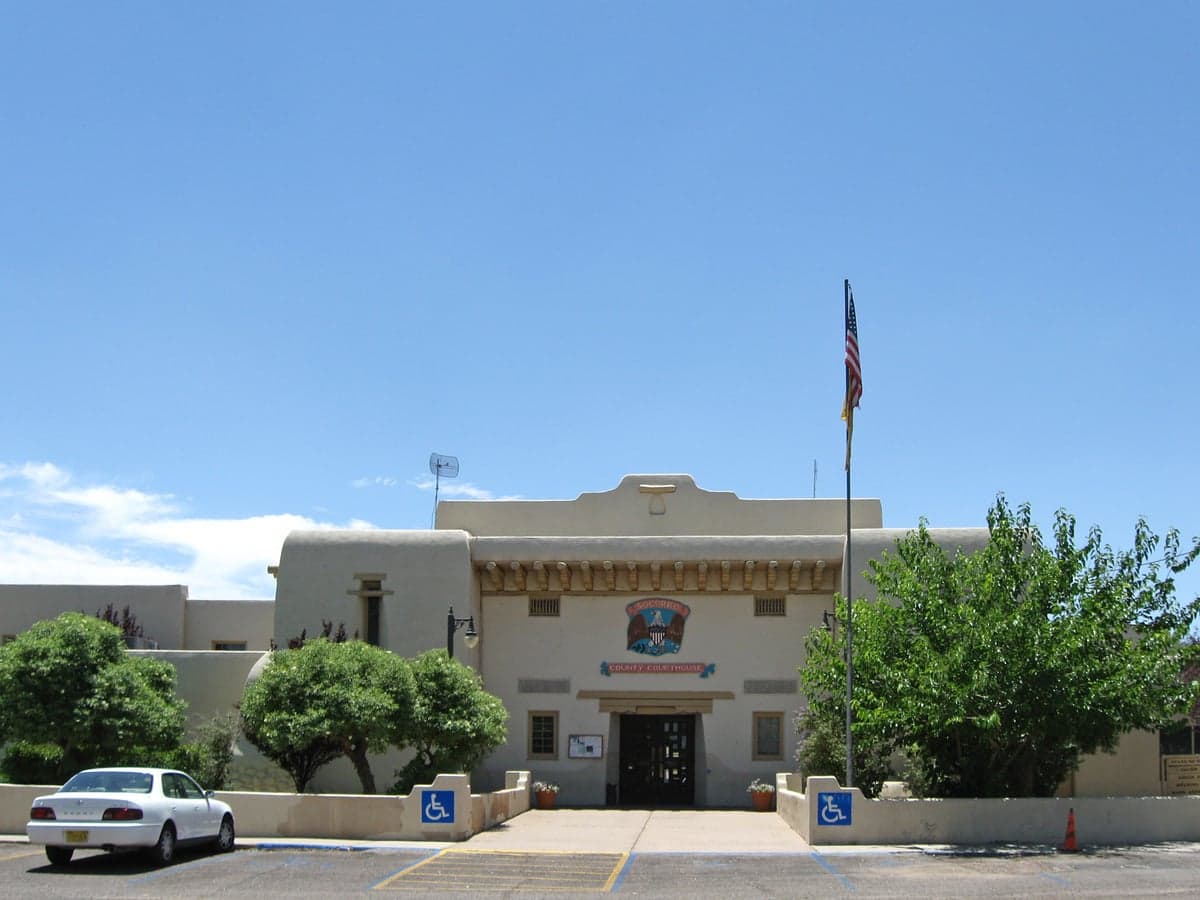
Photo: Wikipedia
Demographics of Socorro County
Affluence Level in Socorro County
A middle-class area roughly in line with national averages across income, home values, education, and employment.
People of Socorro County
Socorro County today is a sparsely populated, predominantly Hispanic region anchored by the historic Rio Grande corridor, where a 50.3% Hispanic majority and a 32.9% non-Hispanic white population coexist with small but notable Indian (1.2%) and East/Southeast Asian (0.6%) communities. With just 16,308 residents spread over 6,649 square miles, the county has a population density of roughly 2.5 people per square mile — one of the lowest in New Mexico. Its distinctive identity is shaped by deep Spanish colonial roots, a 20th-century boom tied to the White Sands Missile Range and New Mexico Tech, and a modern stability that resists the rapid growth seen elsewhere in the Sun Belt.
Settlement & growth (pre-1960)
The human history of Socorro County begins with the Piro people, a Tiwa-speaking Pueblo group who inhabited the Rio Grande valley near present-day Socorro and San Antonio for centuries before Spanish contact. The Spanish entrada of Juan de Oñate in 1598 established the first European presence, and by the 1620s Franciscan missionaries had founded the Mission of Nuestra Señora de Socorro at the Piro village of Teypana. The Pueblo Revolt of 1680 drove out Spanish settlers, but reconquest under Diego de Vargas in the 1690s brought back colonists, who established land grants along the river. The county's Hispanic character was set during this period: Spanish-Mexican settlers, many of mixed Indigenous and European ancestry, formed the core population that persists today in communities like Veguita, Polvadera, and Lemitar.
After the U.S. takeover of New Mexico in 1848, Anglo-American settlement arrived slowly. The 1880s brought the Atchison, Topeka and Santa Fe Railway through the county, spurring the founding of Magdalena as a cattle-shipping hub and Bingham as a mining supply point. The railroad also brought a small wave of European immigrants — primarily Irish and German railroad workers and merchants — who settled in Socorro city and Magdalena but never rivaled the Hispanic majority. The early 20th century saw the rise of the Kelly mining district near Magdalena, which produced lead, zinc, and silver and attracted a transient workforce of Anglo miners and Mexican laborers. By 1930, the county's population peaked at around 20,000, driven by mining and ranching.
The most transformative event for modern Socorro County was the 1945 establishment of the White Sands Missile Range, which expanded into the county's western reaches and brought a steady influx of military personnel, engineers, and scientists. The founding of the New Mexico Institute of Mining and Technology (New Mexico Tech) in Socorro in 1889 had already created a small academic community, but the post-war era turned the city of Socorro into a hub for defense-related research. This period also saw the displacement of the small Hispanic farming community of San Marcial, which was abandoned after repeated Rio Grande floods and ultimately absorbed into the missile range. The Dust Bowl and Great Depression pushed some Anglo families from the Great Plains into the county, but the overall population declined after 1930 as mining faded and agriculture mechanized.
Modern era (post-1965)
The 1965 Hart-Cellar Act had a muted effect on Socorro County compared to urban areas. The foreign-born population today stands at just 3.9%, well below the national average. The most notable post-1965 shift has been the growth of the Indian (subcontinent) community, which now makes up 1.2% of the population — a small but visible presence concentrated in Socorro city, where many are employed as faculty, researchers, and graduate students at New Mexico Tech. This Indian population is primarily professional and highly educated, reflecting the university's recruitment of STEM talent from India. East/Southeast Asian residents (0.6%) follow a similar pattern, with families tied to the university and the missile range.
Domestic migration has been more consequential. The expansion of the White Sands Missile Range and the nearby Very Large Array radio telescope facility near Datil drew engineers and technicians from across the country, many of whom settled in Socorro city or commuted from Alamo and other rural communities. However, the county has not experienced the explosive suburban growth seen in Santa Fe or Albuquerque. Instead, the Hispanic population has remained stable as a majority, with younger generations often leaving for larger cities while retirees and university-affiliated newcomers arrive. The Black population (0.2%) remains negligible, and there is no significant Arab community. The county's college-educated share is 21.0%, a figure lifted by New Mexico Tech but still below the national average, reflecting the large rural and agricultural workforce.
Suburbanization has been minimal. The only real growth node is the city of Socorro itself, which has expanded modestly with new subdivisions and retail development along U.S. 60. The historic Hispanic villages along the Rio Grande — Escondida, La Joya, Sabinal — have seen population decline as farming consolidates and young people move away. The county's overall population has hovered between 16,000 and 18,000 since 1980, making it one of New Mexico's most demographically stable counties.
The future
Socorro County is likely to remain a low-growth, predominantly Hispanic region for the next 10-20 years. The Hispanic majority is aging but is being slowly replenished by natural increase and some return migration of retirees. The Indian and East/Southeast Asian communities, while small, are likely to grow modestly as New Mexico Tech continues to recruit internationally and the missile range maintains its research mission. However, these groups are not forming distinct ethnic enclaves; they are integrating into the existing social fabric of Socorro city, with children attending local schools and families participating in community life.
The county is not homogenizing into a generic American suburb, nor is it tribalizing into separate enclaves. Instead, it is becoming a stable, bicultural region where a Hispanic majority coexists with a white minority and small professional immigrant communities. The biggest demographic risk is continued out-migration of young adults, which could accelerate population decline if New Mexico Tech and the missile range do not expand. The county's remote character and limited economic diversification mean it will not attract the rapid in-migration seen in Texas or Arizona. For a conservative-leaning individual or family moving in, the county offers a slow-paced, rural lifestyle with a strong sense of place — but little demographic dynamism.
Bottom-line: Socorro County is becoming a quiet, stable, Hispanic-majority rural area with a small but growing professional class tied to research and defense. For someone moving in now, the appeal is not growth or diversity but rootedness — a place where the population has been shaped by the same Rio Grande valley, Spanish land grants, and Cold War institutions for generations. The future looks much like the present: slow, stable, and deeply local.

* Values derived from national, state, county, city and local statistics and may differ in a specific area. Last updated: 2026-05-28T03:36:19.000Z
Narrative content on this page is AI-generated and may contain mistakes. Verify any details that matter before acting on them.
ReloMaps may earn a commission from affiliate links at no extra cost to you.

