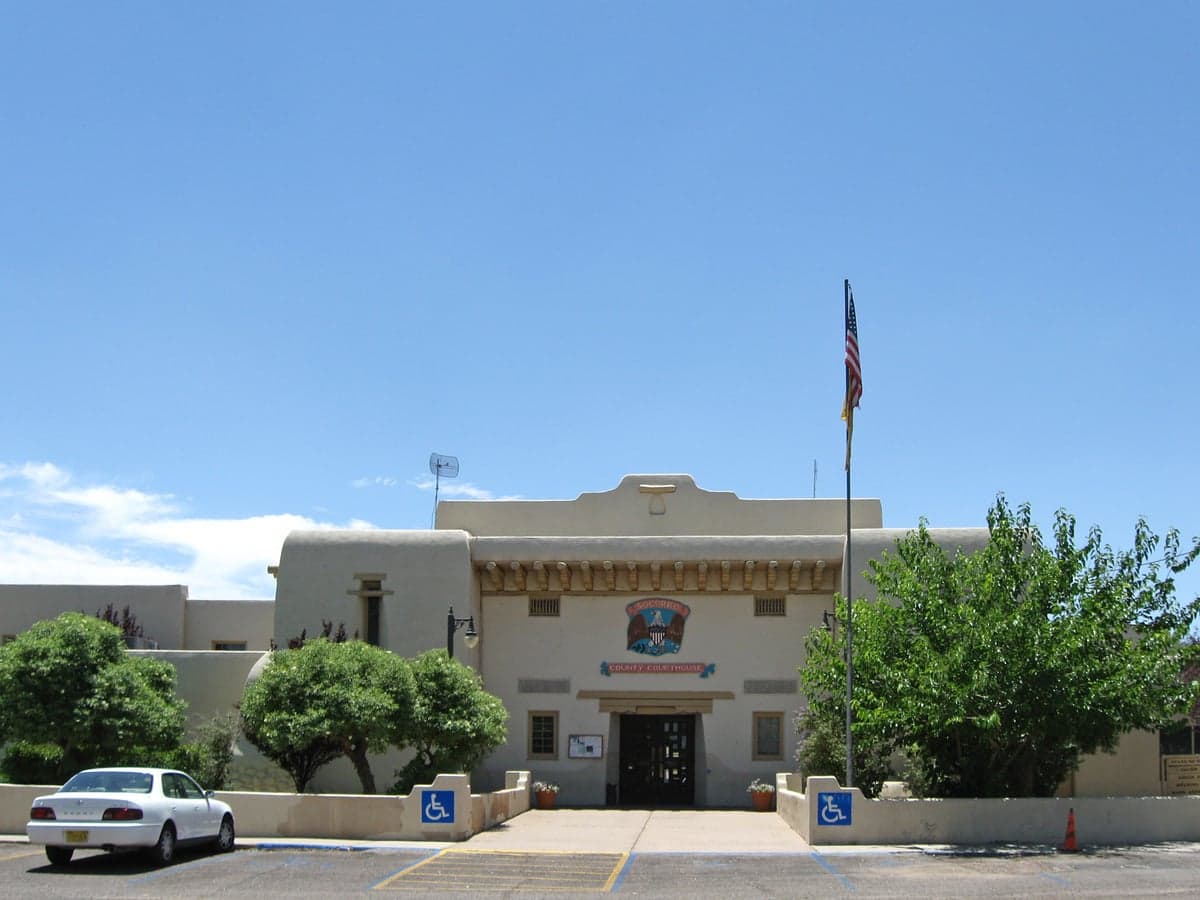
Photo: Wikipedia
Personal Sovereignty in Socorro County
Viable for self-reliance. Generally workable, though some barriers may limit total independence.
What does Personal Sovereignty tell us?
Personal Sovereignty measures your capacity for self-reliance and independence with minimal government friction. Higher scores mean fewer barriers between you and the way you want to live... but it assumes you have the space you need and good neighbors.
What does this tell us?
Personal Sovereignty measures your capacity for self-reliance and independence with minimal government friction. Higher scores mean fewer barriers between you and the way you want to live... but it assumes you have the space you need and good neighbors.
State Policy
Energy independence: Net exporter (250% of energy produced in-state)
Personal Liberty
Homesteading

Personal Liberty Analysis
Socorro County, New Mexico, offers one of the strongest personal sovereignty environments in the Southwest for those seeking to minimize government interference in daily life. The county’s sparse population—roughly 17,000 residents spread across 6,600 square miles—creates a de facto buffer against the regulatory creep common in urban centers like Albuquerque or Santa Fe. For conservative-leaning individuals and families prioritizing autonomy, the area presents a compelling mix of low taxation, permissive gun laws, and genuine off-grid feasibility, though the state-level political climate in Santa Fe requires careful navigation.
Tax burden and regulatory posture in Socorro County
New Mexico’s state-level tax structure is moderate compared to high-tax states like California or New York, but Socorro County’s local posture amplifies the advantages. The county’s gross receipts tax rate is 7.5625%, slightly below the state average, and property taxes are among the lowest in the nation—typically 0.5% to 0.8% of assessed value. A $200,000 home might carry an annual tax bill of just $1,200 to $1,600. The county assessor’s office is known for practical, non-adversarial valuations, unlike the aggressive reassessments seen in Bernalillo County (Albuquerque). Regulatory enforcement is minimal outside the city limits of Socorro (the county seat) and the small towns of Magdalena and Veguita. Building permits are rarely required for rural structures under 200 square feet, and the county planning department operates with a light touch. However, the state’s Energy Transition Act and renewable portfolio standards can complicate off-grid solar installations if you connect to the grid; staying fully off-grid avoids those entanglements entirely.
Self-defense and gun law specifics in Socorro County
New Mexico is a shall-issue state for concealed carry, meaning the sheriff’s office in Socorro County cannot deny a permit if you meet basic requirements—no subjective “good cause” hurdle like in California or New York. The county sheriff, historically, is pro-Second Amendment and processes permits efficiently. Open carry is legal without a permit for anyone 19 or older, and the state preempts local governments from enacting stricter ordinances, so towns like Socorro, Magdalena, and San Antonio cannot ban firearms in public spaces. Stand-your-ground laws apply statewide, with no duty to retreat in any place you are lawfully present. Magazine capacity restrictions do not exist at the state level, and private firearm sales between individuals require no background check—a significant advantage over states like Colorado or Washington. The county’s rural nature means law enforcement response times can exceed 30 minutes in areas like Polvadera or Lemitar, making personal firearm ownership a practical necessity for self-defense against both human and animal threats.
Self-reliance and homesteading viability in Socorro County
Homesteading and off-grid living are not just possible in Socorro County—they are the norm for many residents. The county’s zoning code is minimal: outside the municipal boundaries of Socorro and Magdalena, there are no minimum lot sizes for agricultural use, and the county does not enforce building codes for owner-built dwellings on private land. Parcels of 5 to 40 acres are common and affordable, with raw land prices ranging from $500 to $2,000 per acre depending on proximity to water and paved roads. In areas like La Joya and Escondida, residents rely on rainwater catchment, solar panels, and propane generators without interference. The state’s Water Rights Act is the primary regulatory hurdle—you must own or lease water rights to drill a well, and those rights can be expensive (often $5,000–$15,000 per acre-foot). However, many older properties have grandfathered domestic wells. Sewage is handled via septic systems with a simple county permit (no inspection required for standard systems). The county’s attitude is essentially: “If you can build it yourself and it doesn’t create a public nuisance, we don’t care.” This stands in stark contrast to the restrictive codes of Santa Fe County or the Rio Grande Valley.
Personal liberties in Socorro County: parental rights, medical autonomy, speech, and property
Parental rights are broadly respected in Socorro County. The Public Education Department in Santa Fe mandates state curriculum standards, but local school boards in Socorro Consolidated Schools and Magdalena Municipal Schools have resisted controversial CRT and gender-identity materials more than urban districts. Homeschooling is straightforward: file a simple notice with the state, no curriculum approval or testing requirements. Medical autonomy is a mixed bag. New Mexico has no state-level vaccine mandate for adults, and the county’s healthcare providers—primarily Socorro General Hospital and small clinics—do not pressure patients into treatments. However, the state’s Medical Cannabis Program is well-established, and recreational cannabis is legal, which may be a positive or negative depending on your views. Free speech is protected robustly; the county has no hate speech ordinances or social media policing. Property rights are strong: the county does not enforce HOA-style covenants on unincorporated land, and eminent domain is rarely used outside of state highway projects. The Right to Farm Act protects agricultural operations from nuisance lawsuits, a critical safeguard for homesteaders raising livestock or running equipment.
Overall, Socorro County ranks among the top 10% of U.S. counties for personal sovereignty, particularly for those willing to live outside municipal limits. The combination of low taxes, minimal building codes, permissive gun laws, and a live-and-let-live culture creates an environment where self-reliant individuals can thrive. The primary trade-offs are state-level overreach in water rights and energy regulations, and the need to drive 45 minutes to Socorro for groceries or medical care. For families and singles who prioritize freedom over convenience, this area offers a genuine alternative to the increasingly restrictive urban corridors of the West.

* Values derived from national, state, county, city and local statistics and may differ in a specific area. Last updated: 2026-05-28T03:36:19.000Z
Narrative content on this page is AI-generated and may contain mistakes. Verify any details that matter before acting on them.
ReloMaps may earn a commission from affiliate links at no extra cost to you.

