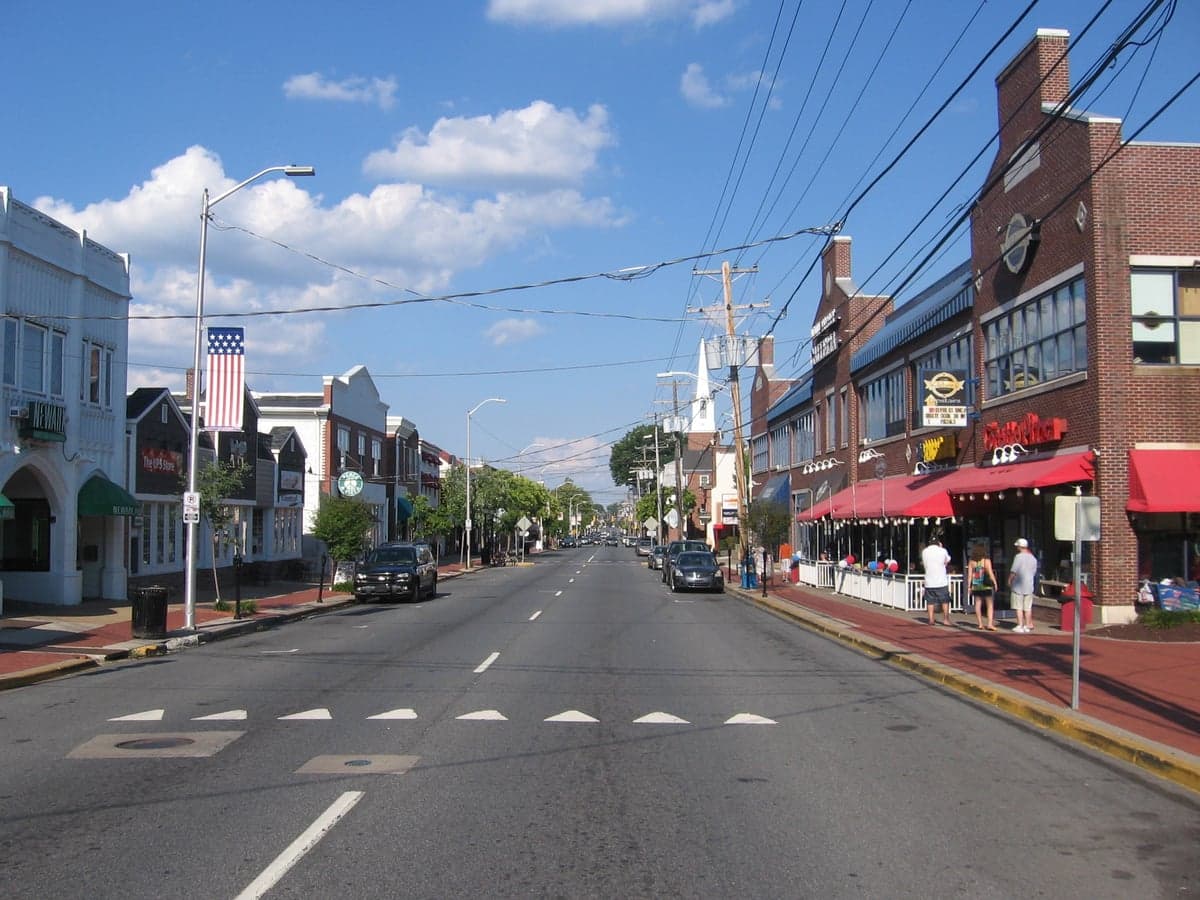
Photo: Wikipedia
Demographics of Newark, DE
Affluence Level in Newark, DE
A middle-class area roughly in line with national averages across income, home values, education, and employment.
People of Newark, DE
The people of Newark, Delaware today form a dense, highly educated college town of 30,309 residents, with a character shaped by the University of Delaware's gravitational pull. The city is notably white (65.9%) but increasingly diverse, with significant Hispanic (10.0%), Black (10.7%), and East/Southeast Asian (6.7%) communities, plus a smaller Indian-subcontinent population (1.3%). A striking 57.5% of adults hold a bachelor's degree or higher, and the foreign-born share sits at 8.0%, reflecting a population that is both transient—driven by students and young professionals—and anchored by long-standing family networks in older neighborhoods.
How the city was settled and grew
Newark's original population was drawn by the same forces that shaped much of the Mid-Atlantic: land grants and agriculture. Founded in 1694 by Scots-Irish and English settlers, the town grew slowly as a farming and milling center along the Christina River. The arrival of the railroad in the 1830s and the founding of Newark College (now the University of Delaware) in 1834 shifted the population's character. By the late 19th century, the area around Main Street and the College Avenue corridor housed a mix of faculty, merchants, and laborers, while the surrounding rural areas remained predominantly white and Protestant. The first significant non-white population arrived in the early 20th century as Black families moved north during the Great Migration, settling in the South College Avenue area and the historic Newark Heights neighborhood, which became a hub for the city's Black community. These early waves were small—Newark's population hovered around 3,000 until the post-World War II boom.
Modern era (post-1965)
The 1965 Hart-Cellar Act and the expansion of the University of Delaware transformed Newark's demographics. The university's growth as a research institution drew faculty and graduate students from around the world, creating the city's first substantial foreign-born population. East/Southeast Asian immigrants—particularly Chinese and Korean families—began settling in the Kells Avenue and Paper Mill Road neighborhoods, drawn by proximity to campus and good schools. Hispanic migration, primarily from Mexico and Central America, accelerated in the 1990s and 2000s, with families clustering in the Brookside area and along East Cleveland Avenue, where affordable housing and service-sector jobs were concentrated. The Indian-subcontinent population grew more slowly, with many professionals working in nearby Wilmington's chemical and finance sectors, settling in newer subdivisions like Whitehall and Lantana Square. Meanwhile, domestic in-migration from the Northeast and Mid-Atlantic continued, with white families moving into established neighborhoods like Windsor Hills and Fairfield. By 2020, Newark's Black population had grown to 10.7%, with many descendants of the original Great Migration families still living in Newark Heights and South College Avenue, though some have dispersed to newer subdivisions.
The future
Newark's population is trending toward greater diversity, but not necessarily integration. The East/Southeast Asian community is growing steadily, driven by university hiring and the region's life sciences sector, and is likely to become the largest non-white group within a decade. The Hispanic population is also expanding, though at a slower pace, and is increasingly concentrated in the Brookside and East Cleveland Avenue corridors. The Indian-subcontinent population, while small (1.3%), is growing through professional migration and is likely to double in share over the next 10-15 years. The white population, while still the majority, is aging and slowly declining as younger, more diverse families move in. The city is not homogenizing; rather, it is tribalizing into distinct enclaves—university-adjacent neighborhoods remain diverse and transient, while older subdivisions like Windsor Hills and Fairfield are becoming more uniformly white and affluent. The Black population is stable but not growing, with younger Black residents often moving to larger cities after graduation.
For someone moving to Newark now, the city is becoming a more diverse, education-driven community where neighborhood choice increasingly determines social experience. The university's gravitational pull ensures a steady flow of new residents, but the city's character is increasingly shaped by the distinct enclaves that have formed around different immigrant and domestic groups. The next decade will likely see continued growth in East/Southeast Asian and Hispanic populations, with the Indian-subcontinent community expanding as well, while the white majority slowly shrinks. Newark is not a melting pot—it is a mosaic of distinct neighborhoods, each with its own demographic trajectory.

* Values derived from national, state, county, city and local statistics and may differ in a specific area. Last updated: 2026-04-29T23:51:10.000Z
Narrative content on this page is AI-generated and may contain mistakes. Verify any details that matter before acting on them.
ReloMaps may earn a commission from affiliate links at no extra cost to you.

