
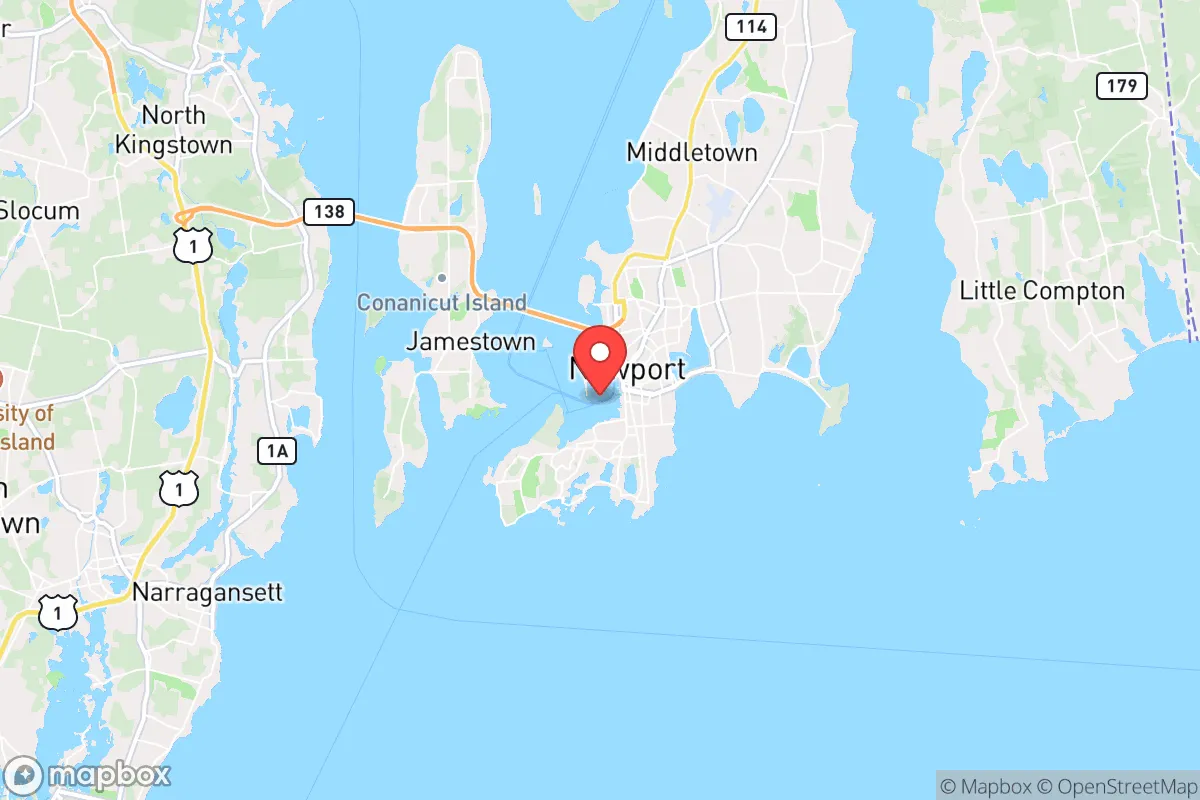
Photo: Wikipedia
Personal Sovereignty in Newport, RI
Viable for self-reliance. Generally workable, though some barriers may limit total independence.
What does Personal Sovereignty tell us?
Personal Sovereignty measures your capacity for self-reliance and independence with minimal government friction. Higher scores mean fewer barriers between you and the way you want to live... but it assumes you have the space you need and good neighbors.
What does this tell us?
Personal Sovereignty measures your capacity for self-reliance and independence with minimal government friction. Higher scores mean fewer barriers between you and the way you want to live... but it assumes you have the space you need and good neighbors.
State Policy
Energy independence: Importer (1% of energy produced in-state)
Personal Liberty
Homesteading

Personal Liberty Analysis
Newport, Rhode Island, presents a complex and often contradictory environment for personal sovereignty, where the state’s aggressive regulatory and tax posture frequently clashes with the individual’s desire for autonomy. While the city’s historic charm and coastal location are undeniable, the underlying legal and political framework is heavily tilted toward centralized control, making it a challenging location for those prioritizing self-reliance and minimal government interference. For a conservative-leaning individual or family evaluating relocation, Newport requires a clear-eyed assessment of where the state’s reach ends and where personal freedom begins—and the answer is often not in your favor.
Tax burden and regulatory posture: How Rhode Island’s fiscal policies affect your autonomy
Rhode Island’s tax burden is among the highest in the nation, and Newport residents feel this acutely. The state imposes a progressive income tax with rates up to 5.99%, and property taxes in Newport are notably steep, with a mill rate around $12.50 per $1,000 of assessed value—meaning a $500,000 home carries an annual tax bill of roughly $6,250. This directly reduces the financial autonomy of residents, as a larger portion of income and property value is funneled to state and local governments. The regulatory environment is equally dense: Rhode Island is known for its extensive permitting requirements, strict environmental regulations (especially in coastal zones like Newport), and a business climate that ranks poorly for ease of starting and operating a small enterprise. For the prepper or survivalist, this means that building a self-sufficient workshop, adding a rainwater catchment system, or even running a home-based business can trigger layers of bureaucratic hurdles. The state’s reliance on property taxes and fees also means that local government has a direct financial interest in maintaining high property values and dense regulation, leaving little room for the kind of low-cost, low-interference lifestyle that fosters true independence.
Self-defense and gun law specifics: What Newport’s legal landscape means for your right to keep and bear arms
Rhode Island is not a gun-friendly state, and Newport operates within that restrictive framework. The state requires a permit to purchase a handgun, a five-day waiting period for long guns, and a background check for all firearm sales, including private transfers. Concealed carry is shall-issue, but the process is controlled by local police chiefs, and Newport’s chief has historically been cautious, making permits harder to obtain than in more rural parts of the state. Magazine capacity is limited to 10 rounds for long guns and 10 rounds for handguns, and the state bans certain “assault weapons” as defined by its own list. For the self-reliant individual, this means that building a robust personal armory for defense or prepping is legally constrained. There is no stand-your-ground law in Rhode Island; instead, a duty to retreat applies in most public spaces before using deadly force. Castle doctrine applies only within one’s home, and even then, the burden of proof can shift unfavorably. Newport’s dense urban layout and proximity to high-value targets (naval bases, tourist areas) also mean that local law enforcement is quick to respond to any perceived threat, but that response can also involve overreach—such as red flag law enforcement, which Rhode Island has on the books. For those who view the Second Amendment as a cornerstone of personal sovereignty, Newport’s legal climate is a significant liability.
Self-reliance and homesteading viability: Lot sizes, zoning, and off-grid feasibility in Newport
Newport’s urban and suburban character makes traditional homesteading nearly impossible. Typical residential lot sizes range from 5,000 to 10,000 square feet, with many homes on smaller parcels in historic districts. Zoning is strict: keeping chickens, goats, or other livestock is heavily restricted, and in most residential zones, it is outright prohibited. The city’s historic district commission has authority over exterior modifications, meaning even installing solar panels, a wood stove chimney, or a rainwater collection system can require lengthy approvals. Off-grid living is effectively illegal in Newport, as the city requires connection to municipal water and sewer systems, and building codes mandate grid-tied electrical service. For the prepper seeking to reduce dependency on centralized systems, this is a dealbreaker. The cost of land in Newport is also prohibitive—vacant lots, if available, often exceed $200,000—making it financially impractical to acquire space for a self-sufficient setup. The nearest areas with more permissive zoning and larger parcels are in rural Washington County or western Rhode Island, but those are a 30- to 45-minute drive, undermining the convenience of living in Newport itself. In short, Newport is a place to live within the system, not to build an independent life outside of it.
Personal liberties: Parental rights, medical autonomy, speech, and property in Newport
Rhode Island’s progressive policies extend deeply into personal liberties, and Newport reflects this. Parental rights are notably weak: the state has mandatory vaccination laws for school attendance with limited exemptions, and recent legislation has expanded the ability of minors to consent to certain medical treatments without parental knowledge, including mental health care and reproductive services. Medical autonomy is further constrained by state mandates on health insurance coverage and a strong public health apparatus that can impose quarantines or vaccine requirements during emergencies. Free speech is legally protected, but Newport’s dense social environment and strong local government mean that public expression—especially on controversial topics—can face social or bureaucratic pushback, such as permit requirements for demonstrations or noise ordinances that limit amplified speech. Property rights are heavily circumscribed by zoning, historic preservation, and environmental regulations; the state’s coastal management program, for example, can restrict what you do on your own land if it affects wetlands or shoreline views. For the conservative individual who values the ability to make decisions for their family without government interference, Newport’s environment is one of constant friction. The state’s approach is one of active management of personal choices, from healthcare to education to property use, leaving little room for the kind of rugged individualism that many relocating families seek.
Overall, Newport offers a low level of personal sovereignty relative to other areas in the United States, particularly when compared to states like Texas, Florida, or New Hampshire. The combination of high taxes, restrictive gun laws, prohibitive zoning, and weak parental rights creates an environment where the individual is often subordinate to the state. For the survivalist or prepper, Newport is a place to visit for its history, not a place to build a resilient, self-reliant life. If your priority is maximizing personal freedom and minimizing government overreach, look to the interior West or the rural South—Newport’s charm comes at the cost of your autonomy.

* Values derived from national, state, county, city and local statistics and may differ in a specific area. Last updated: 2026-04-30T01:47:55.000Z
Narrative content on this page is AI-generated and may contain mistakes. Verify any details that matter before acting on them.
ReloMaps may earn a commission from affiliate links at no extra cost to you.

