
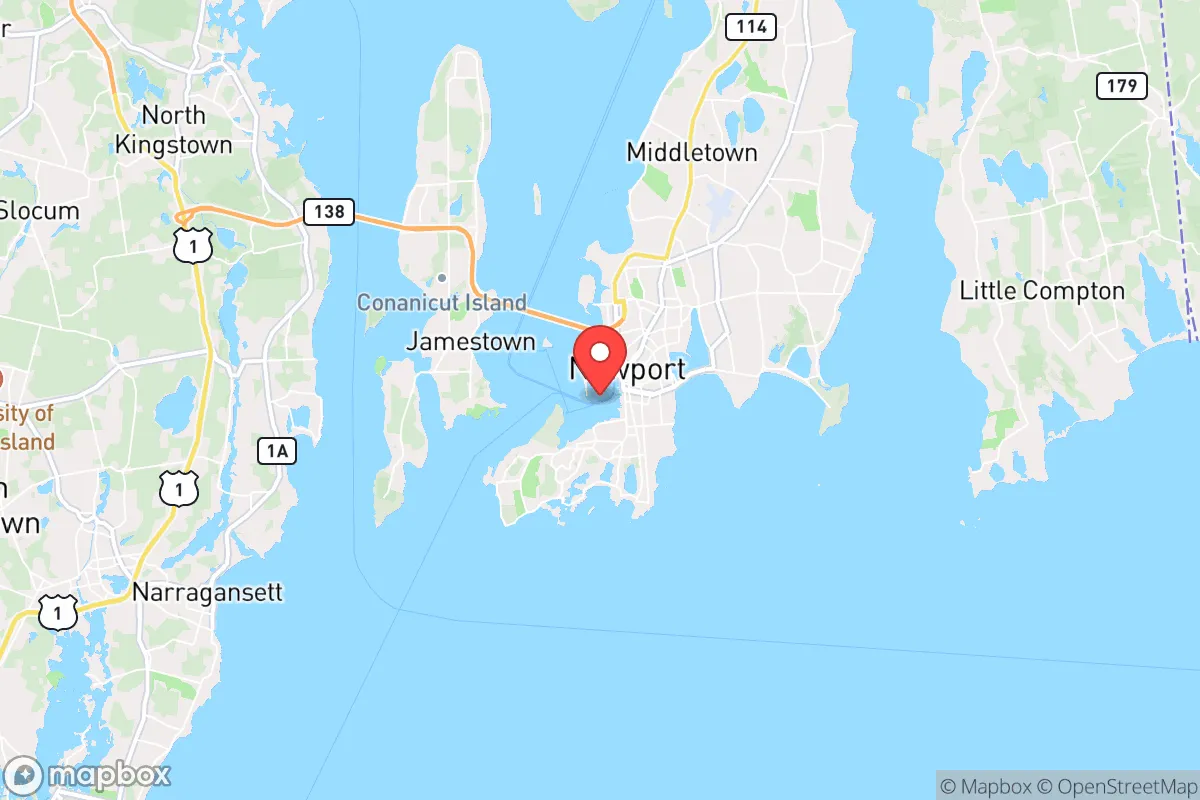
Photo: Wikipedia
Political ClimatePolitical Climate in Newport, RI
District shown is the primary district for this city’s centroid. Cities may span multiple districts.
Local Political AnalysisPolitical Analysis of Newport, RI
Newport, Rhode Island, has always been a bit of an outlier in this state, but the political winds have shifted hard over the last decade. The Cook PVI of D+12 tells you the official story, but the real picture is that this town has gone from a place with a healthy mix of old-school Yankee independence and military-rooted conservatism to a reliably progressive stronghold. You can feel it in the air—the city council votes, the local ordinances, the way people talk about things at the coffee shop. It wasn't always this way, and for those of us who remember when Newport had a more balanced political conversation, the current trajectory is genuinely concerning.
How it compares
If you drive just a few miles north or west, you hit a completely different world. Towns like Middletown and Portsmouth still have a noticeable conservative undercurrent, especially around the naval base and among the working-class families who actually live here year-round. Jamestown is more of a toss-up, but it's nothing like Newport proper. The contrast is stark: Newport's city leadership has embraced the full progressive playbook—from symbolic resolutions to zoning changes that prioritize density over neighborhood character. Meanwhile, the surrounding communities are fighting to keep property taxes reasonable and to push back against state-level mandates that feel like they come from a different planet. It's a tale of two Aquidneck Islands, really.
What this means for residents
For the average person living here, the political shift translates into real, tangible headaches. Property taxes have climbed steadily as the city funds new social programs and green initiatives that sound noble on paper but hit your wallet hard. There's a growing sense that local government is more interested in making national political statements than in fixing the potholes or keeping the beaches clean. Small business owners I talk to are frustrated with the permitting process and the constant pressure to adopt policies that cater to a transient summer crowd rather than the people who keep the lights on in February. The school board has become a battleground over curriculum and parental rights, and the general vibe is that if you don't fall in line with the progressive consensus, you're better off keeping your head down.
Looking ahead, I don't see this changing anytime soon. The real estate market has been flooded with out-of-state buyers who bring their politics with them, and the old guard—the Navy families, the fishermen, the tradesmen—are being priced out. Newport is becoming a playground for the wealthy and the ideologically uniform, and that's a loss for anyone who values genuine diversity of thought. The city's cultural identity is being reshaped by people who see it as a weekend destination, not a home. If you're considering a move here and you lean right, or even just center, you need to go in with your eyes wide open. The beaches are beautiful, the history is rich, but the political climate is increasingly hostile to anyone who questions the direction things are headed.

State Political ClimatePolitical Climate in Rhode Island
State Political AnalysisPolitical Environment in the State
Rhode Island has long been a deep blue state, but don’t let the small size fool you—the political climate here is more layered than the national headlines suggest. The Ocean State has voted Democratic in every presidential election since 1988, and in 2024, Joe Biden carried it by about 18 points, a slight tightening from 2020’s 20-point margin. Over the past two decades, the dominant coalition has been a mix of Providence-based progressives, union labor, and suburban moderates, but a quiet conservative undercurrent persists in the western and southern reaches. For a conservative considering relocation, the key question isn’t whether the state leans left—it’s how much room there is for your values to breathe, and where you can find like-minded neighbors.
Urban vs. rural divide
The political map of Rhode Island is a tale of two worlds. Providence, the capital and largest city, is the engine of the state’s progressive tilt—home to Brown University, Rhode Island School of Design, and a dense concentration of government workers and activists. In 2024, Providence County delivered over 70% of its vote to Biden, with precincts in the city itself hitting 85% Democratic. But drive 20 minutes west to Cranston or Warwick, and you’ll find a more moderate, working-class electorate that often splits tickets—these suburbs have voted for Republican governors like Donald Carcieri (2002–2010) and Lincoln Chafee (who later became an independent). Head further south to South Kingstown or Narragansett, and the coastal towns lean left due to university influence (University of Rhode Island) and tourism, but the rural interior tells a different story. Burrillville, Glocester, and Foster in the northwest are the state’s reddest pockets—these towns voted for Trump by 10–15 points in 2024, driven by gun rights, property rights, and a distrust of Providence’s one-party rule. The divide isn’t just partisan; it’s cultural. In these rural towns, you’ll see Trump flags on pickup trucks and “Don’t Tread on Me” plates, a stark contrast to the “Black Lives Matter” signs in Providence’s East Side.
Policy environment
Rhode Island’s policy environment is a mixed bag that should give any conservative pause. The state has one of the highest tax burdens in the nation—the combined state and local tax rate is about 11.5%, ranking 6th highest nationally. Property taxes are especially punishing in places like Barrington and East Greenwich, where rates exceed $20 per $1,000 of assessed value. Income tax is progressive, topping out at 5.99% on income over $155,050, but the real killer is the car tax—a relic that taxes vehicles annually based on value, though it’s being phased out slowly. On education, the state spends over $18,000 per pupil, among the highest in the country, yet outcomes are mediocre—only about 40% of students are proficient in reading and math. School choice is limited; charter schools exist but face constant political headwinds from the teachers’ union. Healthcare is heavily regulated, with a state-run exchange (HealthSource RI) that adds bureaucracy. Election laws are a sore point: Rhode Island has no voter ID law, same-day registration, and automatic mail-in ballots for all—a system that conservatives argue invites fraud, though no major scandals have surfaced. The state also has a “sanctuary” policy in Providence, where local police are barred from cooperating with ICE on routine immigration enforcement.
Trajectory & freedom
On personal freedom, Rhode Island has been moving in the wrong direction for conservatives over the past five years. The most glaring example is gun rights: in 2022, the legislature passed a ban on “assault weapons” and large-capacity magazines, and in 2024, they added a “safe storage” law that mandates guns be locked up or face criminal penalties—a direct infringement on the Second Amendment as many see it. Governor Dan McKee, a Democrat, signed these without hesitation. Parental rights took a hit in 2023 when the state passed a law requiring schools to allow students to use names and pronouns without parental consent if they’re transgender—a move that sparked protests in North Kingstown and Coventry. Medical autonomy is also constrained: Rhode Island has strict vaccine mandates for schoolchildren and healthcare workers, and during COVID, it had one of the longest-lasting mask mandates in New England. Property rights are under pressure from a 2021 law that allows municipalities to impose rent control on mobile home parks, and a 2024 “just cause” eviction bill that makes it harder for landlords to remove tenants. On the plus side, the state has no income tax on Social Security benefits, which helps retirees, and the phase-out of the car tax is a small win. But the overall trend is clear: more regulation, more mandates, and less room for individual choice.
Civil unrest & political movements
Rhode Island has seen its share of political flashpoints. In 2020, Providence was rocked by protests after George Floyd’s death, with some turning violent—stores were looted on Westminster Street, and a statue of Christopher Columbus was toppled and thrown into the Providence River. The city’s progressive mayor, Jorge Elorza, was criticized for not intervening quickly. On the right, the Rhode Island Second Amendment Coalition has been active, organizing rallies at the State House in 2022 and 2023 against the gun ban, drawing hundreds of supporters from West Warwick and Johnston. Immigration politics are tense: Providence’s sanctuary policy has led to clashes with ICE, and in 2023, a controversy erupted when a Venezuelan migrant was arrested for a violent crime after being released by local police under the policy. Election integrity remains a hot-button issue—the state’s use of mail-in ballots without signature verification has led to calls for reform from the Rhode Island Republican Party, though no major fraud has been proven. A notable movement is the “Rhode Island for Limited Government” group, which pushes for tax caps and school choice, but it’s a small voice against the dominant progressive machine.
Projection
Looking ahead 5–10 years, Rhode Island is likely to become more, not less, progressive. The state’s population is aging and shrinking—it lost about 3% of its residents between 2020 and 2025, with many leaving for Florida, Texas, and the Carolinas. Those who stay tend to be younger, more educated, and more left-leaning, drawn to Providence’s tech and biotech sectors. In-migration from Massachusetts and New York is accelerating this shift, as remote workers seek lower housing costs (though Rhode Island’s are still high). The Republican Party is in disarray—it hasn’t won a statewide office since 2014, and its base is confined to a few rural towns. Expect more gun control, more rent control, and more mandates on businesses. The one wild card is the state’s fiscal crisis: pension liabilities are massive (over $4 billion unfunded), and if taxes rise further, the exodus could accelerate, potentially flipping some suburban districts in a backlash. But for now, the trajectory is blue, and getting bluer.
For a conservative moving to Rhode Island, the bottom line is this: you can find your tribe in the rural northwest or the working-class suburbs, but you’ll be fighting an uphill battle on policy. The state’s tax burden, gun laws, and education system are all tilted against your values. If you’re a single individual or parent who values low taxes, school choice, and Second Amendment rights, Rhode Island is a tough sell—you’d be better off in New Hampshire or even parts of Connecticut. But if you’re tied to the region for family or work, pick a town like Burrillville or Foster, get involved in local politics, and brace for a long, cold fight. The Ocean State is beautiful, but its political climate is anything but free.
* Values derived from national, state, county, city and local statistics and may differ in a specific area. Last updated: 2026-04-30T01:47:55.000Z
Narrative content on this page is AI-generated and may contain mistakes. Verify any details that matter before acting on them.
ReloMaps may earn a commission from affiliate links at no extra cost to you.

