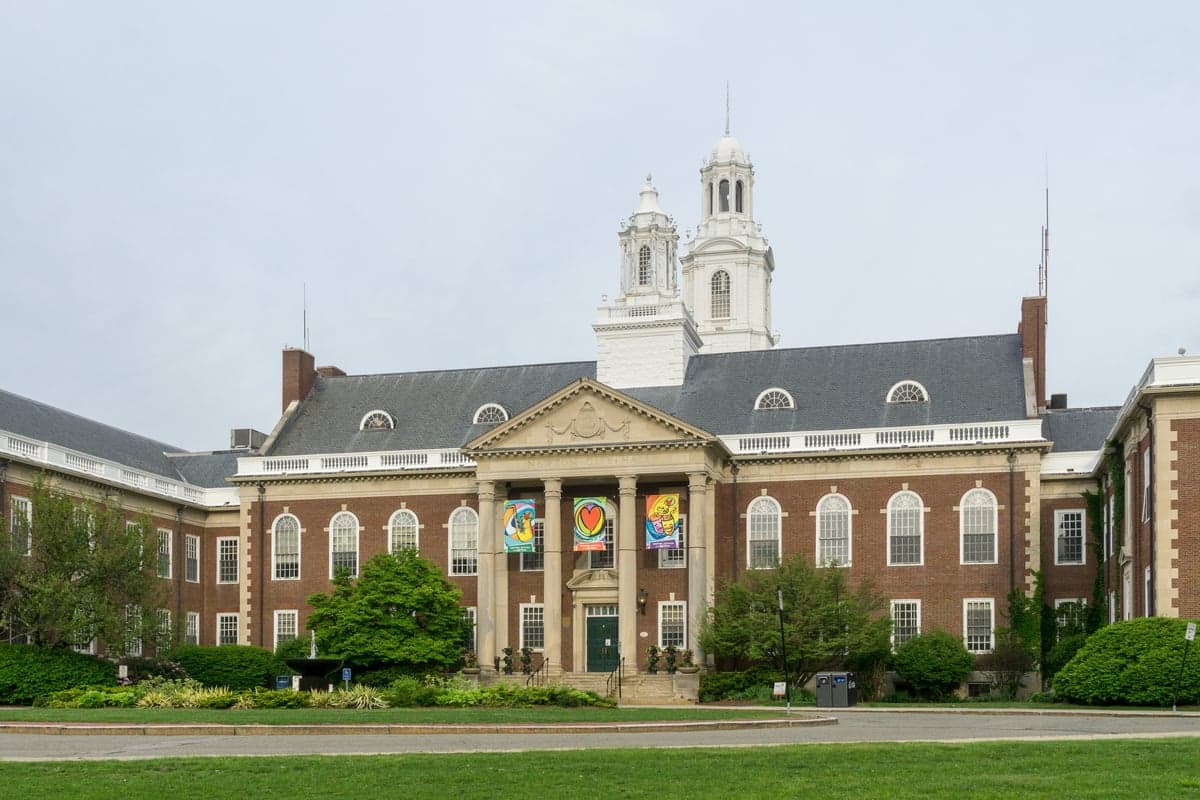
Photo: Wikipedia
Personal Sovereignty in Newton, MA
Viable for self-reliance. Generally workable, though some barriers may limit total independence.
What does Personal Sovereignty tell us?
Personal Sovereignty measures your capacity for self-reliance and independence with minimal government friction. Higher scores mean fewer barriers between you and the way you want to live... but it assumes you have the space you need and good neighbors.
What does this tell us?
Personal Sovereignty measures your capacity for self-reliance and independence with minimal government friction. Higher scores mean fewer barriers between you and the way you want to live... but it assumes you have the space you need and good neighbors.
State Policy
Energy independence: Importer (5% of energy produced in-state)
Personal Liberty
Homesteading

Personal Liberty Analysis
For a conservative-leaning individual or family weighing personal sovereignty, Newton, Massachusetts presents a complex trade-off: you get top-tier public services and a highly educated, civically engaged community, but you surrender significant autonomy to one of the most interventionist state governments in the nation. The city itself is a wealthy, liberal-leaning suburb of Boston, and its local ordinances generally align with state-level progressive priorities. While you won't face the same degree of regulatory friction as in rural, anti-government enclaves, the cumulative weight of taxes, gun laws, and zoning restrictions makes Newton a place where personal sovereignty is heavily circumscribed by collective decision-making. For a prepper or survivalist mindset, the core question isn't whether you can live freely here—it's whether the trade-offs for safety, education, and infrastructure are worth the constant erosion of individual choice.
Tax burden and regulatory posture: how much of your income and property stays yours
Massachusetts is a high-tax state, and Newton sits near the top of the local tax pyramid. The state's income tax is a flat 5.0% on all earned income, with no standard deduction for most filers—meaning every dollar you earn is taxed from the first one. Property taxes in Newton are substantial: the 2025 residential rate is roughly $11.50 per $1,000 of assessed value, and with median home prices hovering around $1.5 million, a typical homeowner pays over $17,000 annually in property tax alone. There is no homestead exemption for primary residences, so your tax bill is directly tied to market appreciation. The state also levies a 6.25% sales tax on most goods, and a 0.5% payroll tax on wages over $1 million (the "millionaire's tax" passed in 2022). For a family earning $200,000, the combined state and local tax burden can easily exceed 12-14% of gross income. Regulatory posture is equally aggressive: Massachusetts has a statewide building code that Newton enforces strictly, with permit fees and inspection requirements that can delay even minor renovations by months. The state's energy code mandates high-efficiency HVAC and insulation standards, which increase construction costs by 15-25% compared to less regulated states. For a prepper, this means any attempt to build a self-sufficient workshop, install a backup generator, or add a root cellar will require permits, inspections, and likely a variance hearing. The message is clear: the government controls your property's use, and you pay a premium for the privilege of owning it.
Self-defense and gun law specifics: what you can own and where you can carry
If personal sovereignty includes the right to defend yourself and your family, Newton is one of the most restrictive places in the country. Massachusetts operates under a "may-issue" framework for firearm licenses, and Newton's police chief has broad discretion to deny a License to Carry (LTC) for "suitability" reasons—a standard that is often applied subjectively. In practice, most law-abiding residents can obtain an LTC, but the process takes 6-12 months, requires a state-approved safety course, and costs over $200 in fees. Once you have a license, you are limited to handguns listed on the state's approved roster (no "off-roster" models), and magazines are capped at 10 rounds. Semi-automatic rifles like the AR-15 are classified as "assault weapons" and are effectively banned for new purchases; existing ones must be registered and cannot be transferred. Open carry is illegal, and concealed carry is restricted to the terms of your LTC—which typically does not allow carry in schools, government buildings, or any property with a "no guns" sign. The state also has a "red flag" law (ERPO) that allows family members or police to petition for temporary firearm seizure without a criminal conviction. For a prepper, this means your defensive capabilities are limited to a 10-round handgun and a shotgun—no high-capacity rifles, no suppressors, no short-barreled shotguns without a federal tax stamp and state approval. Self-defense in the home is legally protected under the "castle doctrine," but there is no "stand your ground" law; you have a duty to retreat if safely possible. In short, Newton is not a place where you can meaningfully arm yourself against a worst-case scenario.
Self-reliance and homesteading viability: lot sizes, zoning, and off-grid feasibility
Newton is a dense, fully suburbanized city with average lot sizes around 0.25 to 0.5 acres. Zoning is strictly residential, with most lots zoned for single-family homes on minimum 10,000-square-foot lots. While you can keep a small vegetable garden and a few chickens (hens only, no roosters), the city's zoning code prohibits livestock, beekeeping in many districts, and any structure not approved by the building department. Off-grid living is effectively impossible: the city requires connection to municipal water and sewer, and any attempt to install solar panels, a wind turbine, or a rainwater collection system must meet state and local codes that often make them cost-prohibitive. The state's "net metering" policy allows solar panels to offset electricity costs, but you cannot disconnect from the grid entirely. For a prepper, the small lot size means you cannot grow enough food to be self-sufficient, and the zoning code prevents you from building a bunker, a root cellar, or a detached workshop without a lengthy permit process. The city's tree protection ordinance also restricts cutting down trees over 6 inches in diameter without a permit. If you want to raise animals, store bulk fuel, or live without municipal utilities, Newton is not the place. The best you can do is a suburban homestead with a raised-bed garden, a few chickens, and a backup generator—but even that requires navigating local bureaucracy.
Personal liberties: parental rights, medical autonomy, speech, and property
Massachusetts is a state where collective rights often trump individual ones, and Newton reflects that. Parental rights are limited: the state mandates vaccination for school attendance (with narrow medical exemptions, no religious or philosophical exemptions), and the Department of Children and Families has broad authority to investigate reports of educational neglect or medical neglect. Homeschooling is legal but requires annual approval from the local school district, including a curriculum review and standardized testing. Medical autonomy is heavily restricted: the state has a strict vaccine mandate for healthcare workers and schoolchildren, and during the COVID-19 pandemic, Newton enforced mask mandates and vaccine passports for indoor dining and events. The state also has a "right to shelter" law that guarantees emergency housing for homeless families, which can strain local resources and increase property taxes. Free speech is protected under the First Amendment, but Newton has a "hate speech" ordinance that can be used to penalize certain types of expression, and the state's anti-SLAPP law protects against frivolous lawsuits but also makes it harder to challenge government actions. Property rights are the weakest: the city's zoning board has near-total control over what you can build, and the state's "Chapter 40B" law allows developers to override local zoning for affordable housing projects, meaning your neighborhood could change without your consent. For a prepper, the lack of medical autonomy and parental rights is a dealbreaker: you cannot opt out of vaccines, you cannot choose alternative medical treatments without risk of state intervention, and your children's education is subject to district oversight. The cumulative effect is a place where individual sovereignty is constantly balanced against community standards—and the community usually wins.
Overall, Newton offers a high quality of life in terms of safety, schools, and infrastructure, but it is a poor fit for anyone prioritizing personal sovereignty. Compared to rural New Hampshire or Vermont, where property taxes are lower, gun laws are more permissive, and zoning is looser, Newton feels like a managed environment where the state and city control most aspects of daily life. For a conservative-leaning prepper or survivalist, the best strategy is to view Newton as a temporary base for earning income and accessing Boston's job market, while maintaining a secondary property in a more freedom-friendly jurisdiction. If you must live here, expect to pay a premium for the privilege of being regulated—and plan your self-reliance efforts around what the law allows, not what you would choose.

* Values derived from national, state, county, city and local statistics and may differ in a specific area. Last updated: 2026-05-01T10:33:13.000Z
Narrative content on this page is AI-generated and may contain mistakes. Verify any details that matter before acting on them.
ReloMaps may earn a commission from affiliate links at no extra cost to you.

