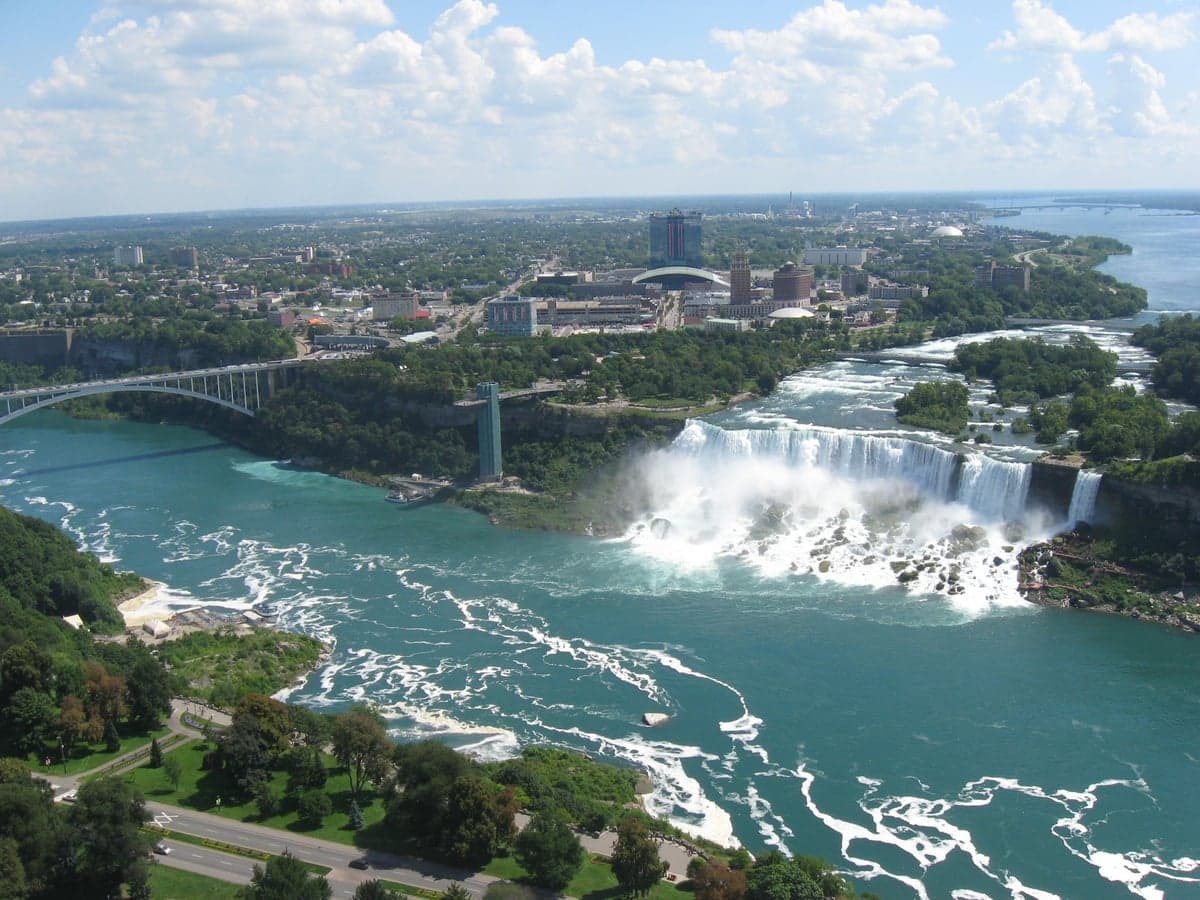
Photo: Wikipedia
Personal Sovereignty in Niagara Falls, NY
Moderate friction. Expect trade-offs in some aspect of personal liberty and independence.
What does Personal Sovereignty tell us?
Personal Sovereignty measures your capacity for self-reliance and independence with minimal government friction. Higher scores mean fewer barriers between you and the way you want to live... but it assumes you have the space you need and good neighbors.
What does this tell us?
Personal Sovereignty measures your capacity for self-reliance and independence with minimal government friction. Higher scores mean fewer barriers between you and the way you want to live... but it assumes you have the space you need and good neighbors.
State Policy
Energy independence: Importer (12% of energy produced in-state)
Personal Liberty
Homesteading

Personal Liberty Analysis
For a survivalist or prepper evaluating personal sovereignty, Niagara Falls, New York presents a challenging environment where state-level overreach significantly constrains individual autonomy. While the city itself offers low property costs that can free up capital for self-reliance investments, the regulatory and tax climate imposed by Albany creates a heavy burden on personal freedom. This analysis examines the specific factors—from tax policy and gun laws to homesteading feasibility and parental rights—that determine whether this area supports or undermines a sovereign lifestyle.
Tax burden and regulatory posture: how much of your income and time is claimed by the state
New York State imposes one of the heaviest tax burdens in the nation, and Niagara Falls residents feel it directly. The state income tax ranges from 4% to 10.9%, with the top rate kicking in at relatively modest income levels. Property taxes in Niagara County are also high, with effective rates often exceeding 2.5% of assessed home value—a significant drag on wealth accumulation for anyone trying to build self-sufficiency. Sales tax in Niagara Falls is 8.75%, which includes county and city surcharges. For a prepper, every dollar taxed is a dollar that cannot go toward supplies, land improvements, or emergency reserves. The regulatory environment is equally dense: New York’s building codes, environmental regulations, and business licensing requirements are among the most stringent in the country. Starting a home-based business or even a small farm requires navigating a maze of permits and inspections, which can discourage the kind of independent enterprise that sovereignty-minded individuals value. The state’s aggressive enforcement of tax compliance—including property tax liens and wage garnishment—means that falling behind can quickly escalate into a loss of assets. Compared to states like Texas or Florida, New York’s posture is one of active management of personal finances, not trust in individual judgment.
Self-defense and gun law specifics: what you can and cannot do to protect your home and family
New York’s gun laws are among the most restrictive in the nation, and Niagara Falls residents must comply with a complex web of statutes that directly impact self-defense capability. The state requires a permit to purchase a handgun, and the process in Niagara County can take months, involving background checks, character references, and a mandatory safety course. The SAFE Act, passed in 2013, bans so-called "assault weapons" and limits magazine capacity to ten rounds. For a prepper, this means that standard defensive rifles like the AR-15 are effectively illegal unless registered under grandfather clauses that are now difficult to navigate. Concealed carry is permitted only with a license, and since the 2022 Supreme Court decision in NYSRPA v. Bruen, the state has attempted to create "sensitive location" restrictions that make carrying in many public places—including parks, churches, and businesses—a felony. Stand-your-ground laws do not exist in New York; instead, the state imposes a "duty to retreat" before using deadly force, except inside one’s home. This legal framework places the burden of proof on the defender, not the aggressor. For those serious about self-reliance, the inability to easily acquire, carry, and use firearms for home defense is a major erosion of personal sovereignty. Ammunition purchases also require a background check and are tracked by the state, adding another layer of surveillance.
Self-reliance and homesteading viability: lot sizes, zoning, and off-grid feasibility
Niagara Falls is an urban environment, and true homesteading within city limits is severely limited. Typical residential lots are small—often under 5,000 square feet—and zoning codes restrict livestock, large gardens, and outbuildings. Raising chickens is permitted in some areas but requires a permit and adherence to setback rules. Keeping goats, pigs, or larger animals is generally prohibited. Off-grid living is effectively illegal: New York requires connection to municipal water and sewer systems in most residential zones, and solar panels must be grid-tied to qualify for net metering. Rainwater collection is allowed but regulated, and composting toilets are not permitted as primary sanitation. For a prepper seeking to reduce dependency on infrastructure, these restrictions are a dealbreaker. However, moving just outside the city—into rural parts of Niagara County or neighboring Orleans County—opens up more possibilities. There, lot sizes of one to five acres are common, and zoning is more permissive. But even then, New York’s building codes require permits for any structure over 200 square feet, and the state’s environmental conservation laws can restrict timber harvesting, pond digging, and land clearing. The cost of land in these areas is relatively low—often under $10,000 per acre—but the regulatory hurdles mean that true self-reliance requires significant legal navigation. For the serious prepper, the best strategy is to buy land in a less restrictive county while maintaining a small city base for income or access to services.
Personal liberties: parental rights, medical autonomy, speech, and property
Parental rights in New York have been under increasing pressure. The state mandates vaccination for school attendance, with only narrow medical exemptions—no religious or philosophical exemptions are recognized. During the COVID-19 pandemic, New York imposed some of the strictest mandates in the country, including vaccine requirements for healthcare workers and school staff, which many parents saw as an infringement on medical choice. The state also has a strong child protective services system that can investigate parental decisions around homeschooling, medical care, and discipline. Homeschooling is legal but requires annual notification, submission of an Individualized Home Instruction Plan (IHIP), and quarterly reports—a level of oversight that many sovereignty-minded families find intrusive. Medical autonomy is similarly constrained: New York does not recognize naturopathic doctors as licensed providers, and access to alternative treatments is limited. The state’s health department has broad authority to mandate treatments during public health emergencies, and there is no explicit right to refuse medical treatment in state law. Free speech is protected under the First Amendment, but New York has enacted laws against "hate speech" and online harassment that some critics argue chill political discourse. Property rights are also limited: the state has a history of using eminent domain for economic development, and the city of Niagara Falls has used it to clear land for casinos and tourism projects. For a prepper, the risk of government seizure—whether through eminent domain, tax foreclosure, or asset forfeiture—is a real concern. The state’s asset forfeiture laws allow law enforcement to seize property without a criminal conviction, placing the burden on the owner to prove the property was not involved in a crime.
Overall, personal sovereignty in Niagara Falls is significantly constrained by state-level policies that prioritize collective mandates over individual choice. The tax burden, restrictive gun laws, limited homesteading options, and erosion of parental and medical autonomy create an environment where self-reliance is difficult to achieve within city limits. For a survivalist or prepper, the area’s low property costs are offset by high regulatory costs. Compared to states like New Hampshire, Idaho, or Montana, New York ranks near the bottom for personal sovereignty. However, for those who are willing to navigate the legal landscape—perhaps by living just outside the city or maintaining a low profile—Niagara Falls can serve as a base of operations. But for anyone serious about maximizing autonomy, the better move is to look westward or southward, where the state’s hand is lighter and the path to self-reliance is clearer.

* Values derived from national, state, county, city and local statistics and may differ in a specific area. Last updated: 2026-04-19T08:28:46.000Z
Narrative content on this page is AI-generated and may contain mistakes. Verify any details that matter before acting on them.
ReloMaps may earn a commission from affiliate links at no extra cost to you.

