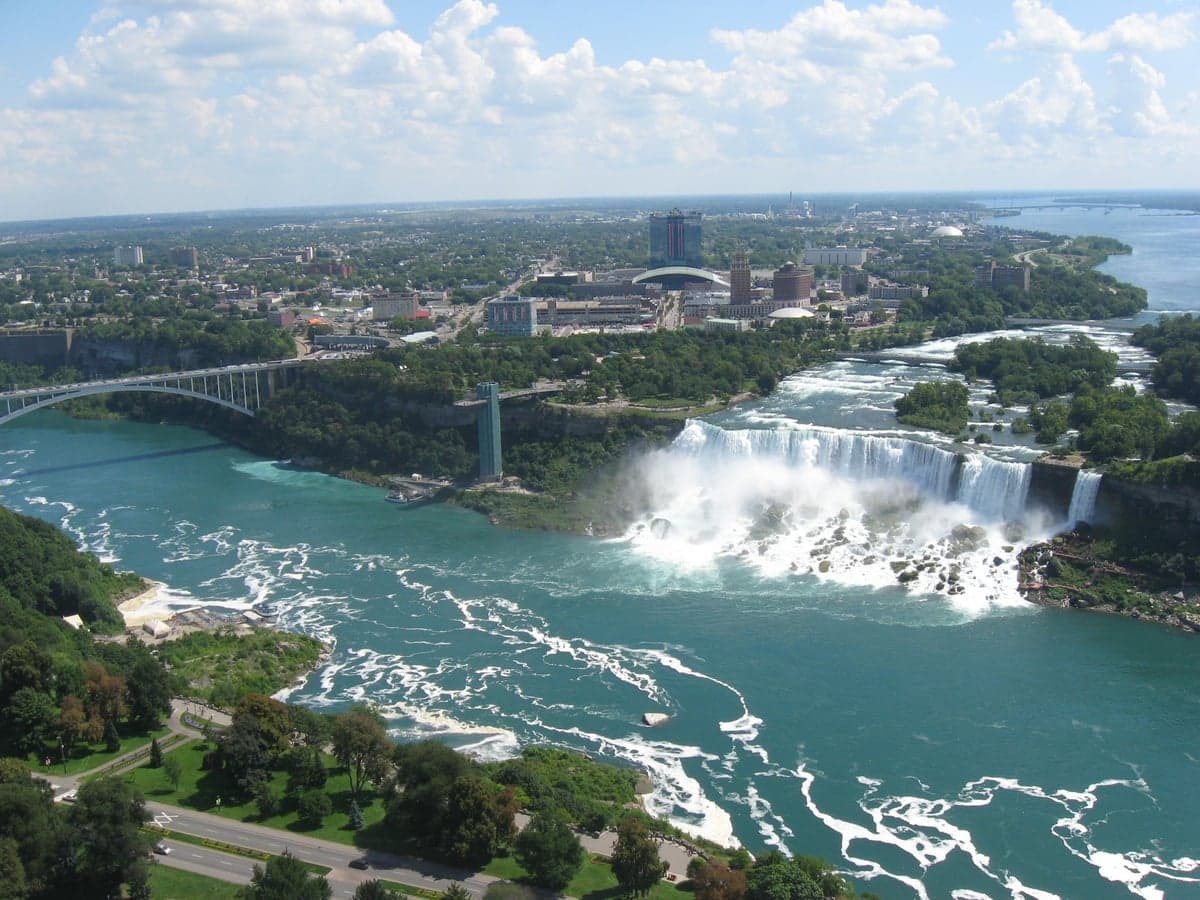
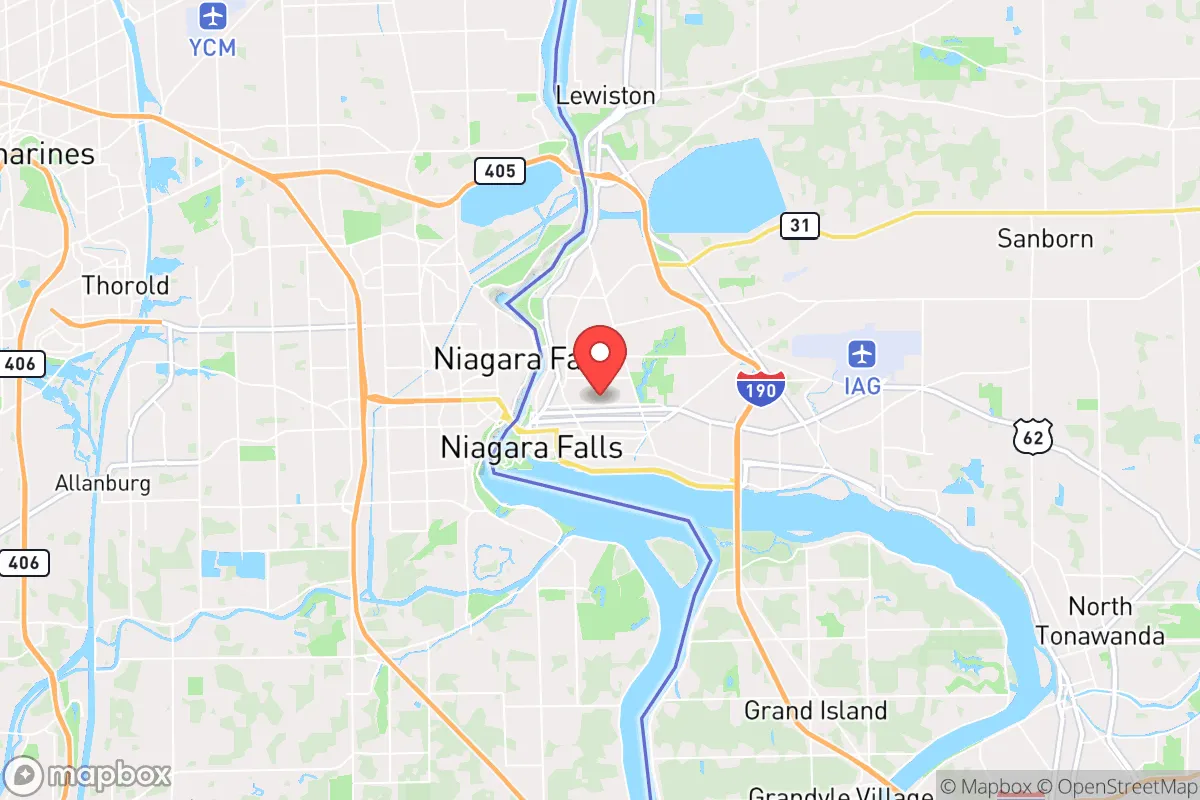
Photo: Wikipedia
Demographics of Niagara Falls, NY
Affluence Level in Niagara Falls, NY
A below-average socioeconomic profile. Incomes, home values, and educational attainment trail the U.S., with higher poverty and unemployment.
People of Niagara Falls, NY
The people of Niagara Falls, New York, today number 48,198, forming a dense, working-class city that is predominantly white (64.1%) but with a significant Black minority (17.1%) and a growing Hispanic population (8.0%). The city’s identity is shaped by its post-industrial decline and a foreign-born share of just 1.9%, making it one of the least immigrant-diverse cities in the Northeast. With only 22.8% of adults holding a college degree, the population is notably less educated than the national average, reflecting a community that once thrived on manufacturing and now struggles to redefine itself.
How the city was settled and grew
Niagara Falls was originally settled by European colonists in the late 18th century, with the first permanent white settlers arriving around 1805. The city’s explosive growth began after the completion of the Erie Canal in 1825 and the harnessing of the Niagara River for hydroelectric power in the 1890s. This industrial boom drew a massive wave of immigrants: Irish and Italian laborers built the power plants and factories, settling in the Hyde Park and LaSalle neighborhoods, which remain working-class Italian and Irish enclaves today. Polish immigrants followed in the early 1900s, clustering in the East Side around the Union Carbide and Carborundum plants, where they established St. Stanislaus Kostka Church as a cultural anchor. By 1950, the city’s population peaked at over 102,000, overwhelmingly white and European-born or first-generation.
Modern era (post-1965)
The post-1965 era brought dramatic demographic change, driven by deindustrialization and the 1965 Immigration Act. As factories closed in the 1970s and 1980s, white families began leaving for the suburbs of Wheatfield and Lewiston, a process that accelerated after the Love Canal disaster in 1978. The white population dropped from over 90% in 1970 to 64.1% today. Black families, who had been a small minority since the Great Migration, grew significantly as they moved into the Downtown and North End neighborhoods, which had been abandoned by fleeing white residents. The Hispanic population, now 8.0%, is largely Puerto Rican and concentrated in the DeVeaux area near the Niagara Gorge. East/Southeast Asian communities (0.9%) and Indian-subcontinent residents (1.4%) are tiny but visible in the College Heights district near Niagara University, where they are often connected to academic or healthcare jobs. The foreign-born share remains low at 1.9%, as the city has not attracted the large-scale immigration seen in Buffalo or Rochester.
The future
The population is projected to continue its slow decline, having fallen from 50,193 in 2010 to 48,198 in 2020. The city is not homogenizing but rather tribalizing into distinct enclaves: the white population is aging and shrinking, concentrated in Hyde Park and LaSalle, while the Black population is stabilizing in the North End and Downtown. The Hispanic share is growing modestly, likely reaching 10-12% by 2035, but remains far below Buffalo’s 20% Hispanic share. The Indian and East/Southeast Asian communities are plateauing, as the city lacks the tech or professional job base to attract new arrivals. The college-educated share (22.8%) is unlikely to rise sharply without a major economic catalyst, such as the planned expansion of the Niagara Falls International Airport or a revival of tourism-related industries. The next 10-20 years will likely see a smaller, poorer, and more racially segregated city, with the white population continuing to age in place and minority groups consolidating in specific neighborhoods.
For someone moving in now, Niagara Falls is becoming a smaller, more racially divided city where the economic base has not recovered from deindustrialization. The low cost of housing in the North End and DeVeaux offers affordability, but the lack of job growth and educational attainment means the population will likely continue to shrink. New residents should expect a community that is proud of its history but struggling to attract the young families and immigrants needed to reverse its demographic decline.

* Values derived from national, state, county, city and local statistics and may differ in a specific area. Last updated: 2026-04-19T08:28:46.000Z
Narrative content on this page is AI-generated and may contain mistakes. Verify any details that matter before acting on them.
ReloMaps may earn a commission from affiliate links at no extra cost to you.

