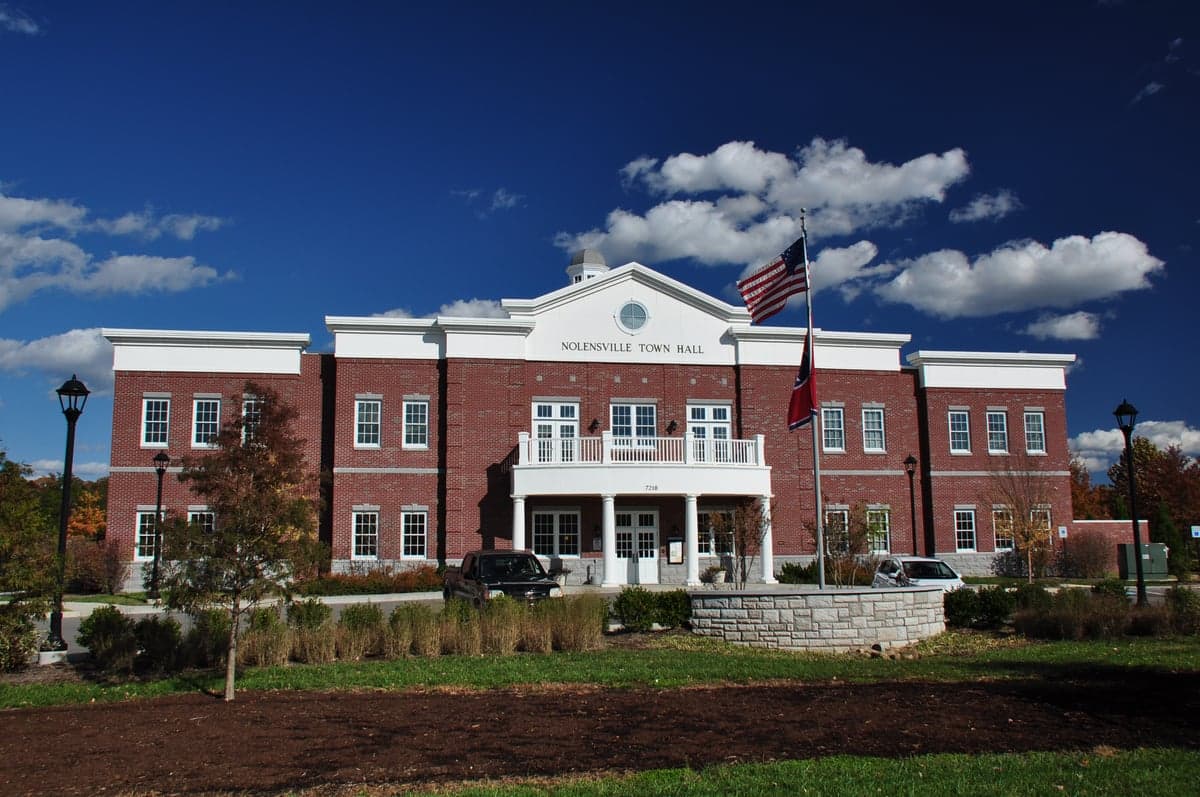
Photo: Wikipedia
Demographics of Nolensville, TN
Affluence Level in Nolensville, TN
A wealthy area with high-earning, well-educated households. Incomes, home values, and educational attainment meaningfully outpace national averages.
People of Nolensville, TN
Today, Nolensville, Tennessee is a rapidly growing suburban community of 14,545 residents, characterized by a predominantly white population (82.5%) with a notably high educational attainment—68.3% hold a college degree. The city’s identity is shaped by its blend of historic rural roots and modern master-planned subdivisions, attracting families and professionals seeking proximity to Nashville without the urban density. Its foreign-born population stands at 4.8%, with Hispanic residents making up 5.5%, Black residents 2.5%, East and Southeast Asian residents 1.7%, and Indian subcontinent residents 1.2%, reflecting a modest but increasing diversity.
How the city was settled and grew
Nolensville’s original population arrived in the late 1790s and early 1800s, drawn by land grants offered to veterans of the American Revolution and the fertile soils of the Mill Creek Valley. The community was named after William Nolen, an early settler who established a gristmill and a general store, anchoring a small farming hamlet. The first wave of settlers were primarily of English, Scots-Irish, and German descent, who built homesteads along what is now Nolensville Road and clustered around the historic Nolensville Village district, where the original log cabins and 19th-century homes still stand. For much of the 19th and early 20th centuries, the population remained small and agrarian, with cotton and livestock as economic mainstays. The arrival of the railroad in the late 1800s briefly spurred growth, but Nolensville remained a quiet crossroads community through the mid-20th century, with fewer than 500 residents as late as 1960.
Modern era (post-1965)
The modern transformation of Nolensville began in earnest after the 1965 Hart-Cellar Act and the subsequent suburban expansion of Nashville in the 1970s and 1980s. The completion of Interstate 840 in the 1990s and the widening of Nolensville Road made the area accessible for commuters, triggering a wave of domestic in-migration from other parts of Tennessee and the broader Sun Belt. Master-planned subdivisions such as Burkitt Place, Ladd Park, and Arbor Springs were developed from the 1990s through the 2010s, attracting middle- and upper-middle-class families, many of whom were white professionals relocating from the Nashville core or from out of state for jobs in healthcare, finance, and technology. The historic Nolensville Village district saw infill development and renovation, while newer neighborhoods like Bent Creek and Enclave at Nolensville absorbed a growing number of Hispanic and Asian families, though these groups remain small relative to the white majority. The Indian subcontinent community, while modest at 1.2%, has concentrated in newer subdivisions near the Nolensville Elementary School zone, reflecting a pattern of professional migration tied to the broader Nashville region’s healthcare and engineering sectors.
The future
Nolensville’s population is projected to continue growing, driven by ongoing residential development and the city’s reputation for high-performing schools and low crime rates. The demographic trajectory suggests a gradual increase in diversity, particularly among Hispanic and East/Southeast Asian residents, as the Nashville metropolitan area attracts more international migrants. However, the city is not homogenizing into a single melting pot; instead, distinct enclaves are emerging. The historic Village remains a preserve of older, established families, while newer subdivisions like Burkitt Place and Ladd Park are becoming more diverse as younger professionals move in. The Indian subcontinent community, while small, is likely to grow as tech and healthcare sectors expand, but it will remain a niche presence. Over the next 10-20 years, Nolensville is expected to become more suburban and less rural, with the population potentially reaching 20,000-25,000, but the white, college-educated majority will likely persist as the dominant demographic force.
For someone moving in now, Nolensville is becoming a well-educated, family-oriented suburb with a strong sense of local identity but increasing diversity in its newer neighborhoods. The city offers a stable, low-crime environment with excellent schools, making it attractive to conservative-leaning families and professionals who value community cohesion and property values. The key trade-off is that the historic small-town character is giving way to suburban expansion, with new subdivisions and commercial development reshaping the landscape.

* Values derived from national, state, county, city and local statistics and may differ in a specific area. Last updated: 2026-05-01T11:22:18.000Z
Narrative content on this page is AI-generated and may contain mistakes. Verify any details that matter before acting on them.
ReloMaps may earn a commission from affiliate links at no extra cost to you.

