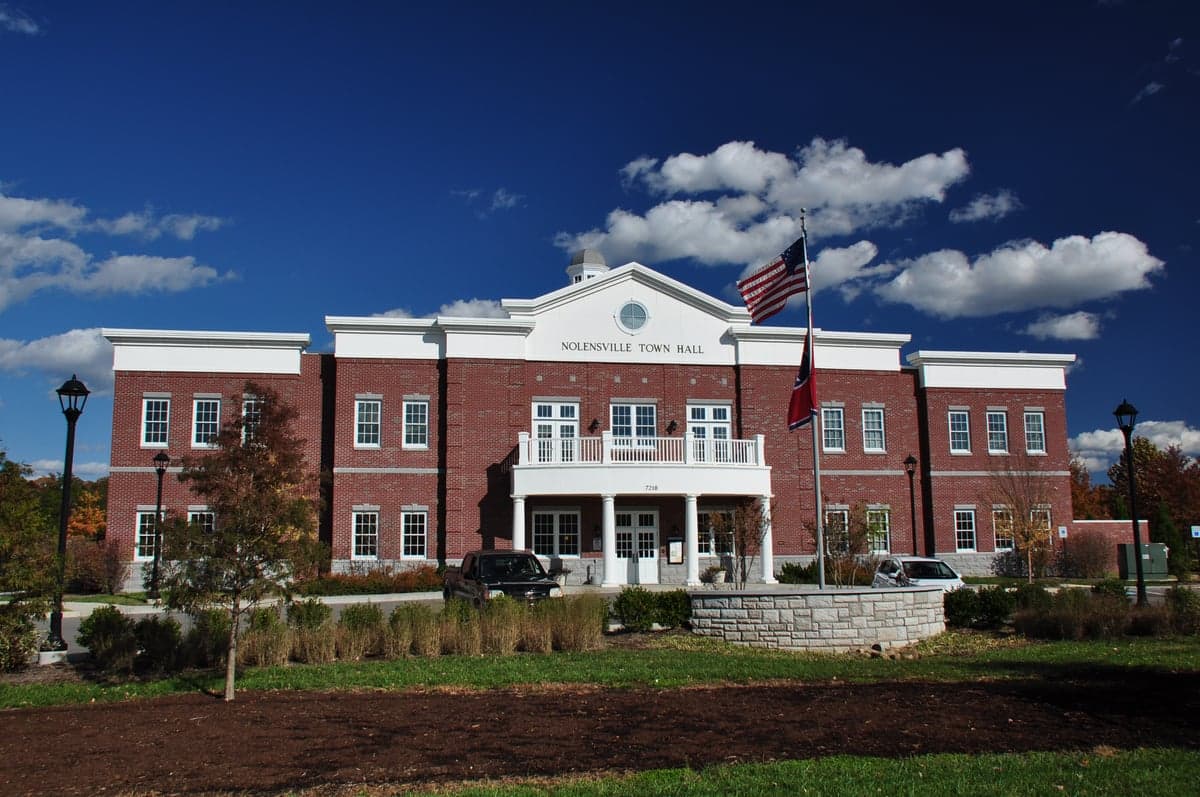
Photo: Wikipedia
Political ClimatePolitical Climate in Nolensville, TN
District shown is the primary district for this city’s centroid. Cities may span multiple districts.
Inherited from parent state — no local data available.
Local Political AnalysisPolitical Analysis of Nolensville, TN
Nolensville, Tennessee, has long been a reliably conservative community, and that hasn't changed much even as the town has grown. The area sits in a solidly Republican district with a Cook PVI of R+8, meaning it votes about eight points more Republican than the national average. If you look at the voting patterns over the last few cycles, you'll see that Nolensville and the surrounding Williamson County consistently back conservative candidates, and that's not likely to shift dramatically anytime soon. The real story here isn't about a political flip—it's about how the town's character is being tested by rapid growth and the subtle pressures that come with it.
How it compares
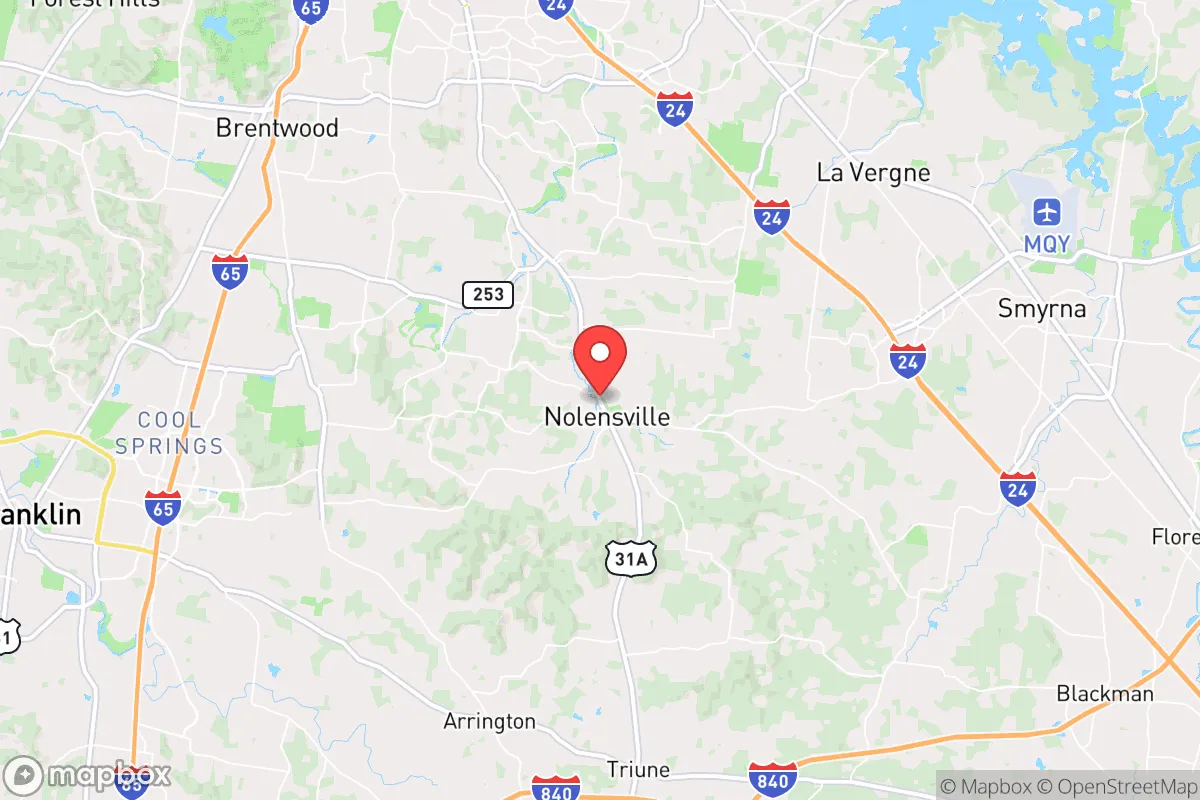
Drive ten minutes north into Nashville proper, and you're in a very different political world—Davidson County leans heavily Democratic, with a Cook PVI of D+20. That contrast is stark and immediate. Meanwhile, head east to Murfreesboro in Rutherford County, and you'll find a more mixed bag, with the city itself trending slightly more moderate while the county overall stays red. Nolensville sits in a sweet spot: close enough to the city for jobs and culture, but far enough to avoid the worst of the progressive policy experiments that have driven up taxes and crime in Nashville. Compared to nearby Franklin, which has seen some of its own growing pains and a slight uptick in progressive-leaning voices, Nolensville has held the line better. The local school board and county commission remain dominated by conservatives who prioritize fiscal restraint and parental rights—two issues that matter a lot to families here.
What this means for residents
For the people who live here, the political climate translates into a few concrete realities. First, property taxes are still relatively low compared to what you'd pay in Nashville or even parts of Franklin, because the local government hasn't gone on a spending spree. Second, the schools—Nolensville Elementary, Mill Creek Middle, and Nolensville High—operate with a focus on academic excellence and local control, not top-down mandates from the state or federal level. You won't find the kind of divisive curriculum battles that have erupted in more progressive districts. Third, the town has resisted the urge to over-regulate. Zoning laws are sensible, not punitive. There's no talk of "missing middle" housing mandates or density-forcing policies that would change the character of the neighborhoods. The biggest concern among long-time residents is that as more people move in from out of state—especially from blue states—they bring different expectations about what government should do. That's the slow creep to watch.
One thing that sets Nolensville apart is its strong sense of local identity. The town has its own police department, its own parks, and a community calendar that revolves around things like the Nolensville Farmers Market and the annual Christmas parade—not political rallies or protests. There's a quiet understanding here that the government's job is to keep the roads paved, the schools safe, and the taxes low, and then get out of the way. That's the kind of conservatism that doesn't need a flag or a bumper sticker to prove itself. If you're looking for a place where you can raise a family without feeling like you're constantly fighting against the local government's agenda, Nolensville still delivers. But keep an eye on the newcomers and the next few election cycles—because the character of a town can change faster than its voting record.

State Political ClimatePolitical Climate in Tennessee
State Political AnalysisPolitical Environment in the State
Tennessee has been a reliably red state for decades, but the political climate here isn't just about voting Republican—it's about a deep-seated cultural commitment to limited government, personal responsibility, and traditional values. Over the last 10-20 years, the state has shifted from a moderate Southern conservative posture to a more aggressively conservative one, driven largely by the exodus of folks from blue states into the Nashville, Knoxville, and Chattanooga metros. While the state legislature has been under GOP supermajority control since 2010, the real story is how the rural and suburban counties have pulled the state further right, even as Davidson County (Nashville) and Shelby County (Memphis) have become increasingly progressive strongholds. The net effect is a state that is now one of the most conservative in the nation, with a policy environment that prioritizes low taxes, gun rights, and parental authority.
Urban vs. rural divide
The political map of Tennessee is a textbook study in the urban-rural split. The three major metros—Nashville, Memphis, and Knoxville—each tell a different story. Nashville (Davidson County) is the state's liberal engine, voting for Joe Biden by a 30-point margin in 2020 and consistently electing progressive city council members who push for things like sanctuary city policies and higher local taxes. Memphis (Shelby County) is even more Democratic, with a heavy African-American population that reliably votes blue, but it's also plagued by crime and corruption that have driven many families to the suburbs. Knoxville (Knox County) is a bit more balanced, but the city itself leans left while the surrounding rural areas are deeply red. The real action is in the suburban and exurban counties that have flipped from purple to solid red over the past decade. Williamson County (south of Nashville) is the poster child—once a moderate Republican area, it's now a hotbed of conservative activism, with voters rejecting school mask mandates and CRT in favor of school choice and parental rights. Rutherford County (Murfreesboro) and Sumner County (Gallatin) have followed suit, while rural counties like Lincoln, Giles, and Marshall remain overwhelmingly conservative. The divide is stark: you can drive 20 minutes from downtown Nashville and go from a city that flies Pride flags and bans plastic bags to a county where the sheriff proudly displays the Gadsden flag and the local school board bans "divisive concepts."
Policy environment
Tennessee's policy environment is a conservative's dream, at least on paper. There is no state income tax on wages—only a flat 1% tax on interest and dividends, which is being phased out entirely by 2029. The sales tax is high (7% state, plus local add-ons up to 9.75%), but the lack of income tax is a huge draw for high-earners fleeing California and New York. The regulatory posture is light: no state-level rent control, no universal background checks for private gun sales, and a right-to-work law that keeps unions weak. Education policy has been a major battleground. In 2021, the legislature passed the "Education Freedom Act," which created a school voucher program for low-income families in Shelby and Davidson counties, and in 2025, it was expanded statewide. The state also banned the teaching of Critical Race Theory in K-12 schools and passed a "Parental Bill of Rights" that gives parents the explicit right to review curriculum and opt their kids out of objectionable material. On healthcare, Tennessee refused to expand Medicaid under Obamacare, leaving a coverage gap for about 300,000 low-income adults, but the state did pass a "Right to Try" law for terminally ill patients and a ban on vaccine mandates for private employers. Election laws are strict: voter ID is required, early voting is limited to 14 days, and the state purges inactive voters regularly. In 2023, the legislature passed a law making it a felony for election officials to send unsolicited absentee ballot applications. For a conservative, this is a state that respects the Tenth Amendment and pushes back hard against federal overreach.
Trajectory & freedom
Tennessee is becoming more free in many respects, but there are warning signs. On the positive side, the state has aggressively expanded gun rights: in 2021, it passed permitless carry (constitutional carry) for anyone 21 and older, and in 2023, it lowered the age to 18. The state also passed a "Second Amendment Sanctuary" law in 2020 that prohibits state and local resources from being used to enforce federal gun bans. On parental rights, the "Parental Bill of Rights" (2022) and the "Tennessee Education Freedom Act" (2025) have given families more control over their kids' education. The state also passed a law in 2023 banning gender transition procedures for minors, which has been a major victory for parents who believe in protecting children from irreversible medical decisions. However, there are concerning trends. The state's COVID response was mixed—Governor Bill Lee resisted lockdowns and mask mandates, but local health departments in Nashville and Memphis imposed strict measures. More troubling is the growth of government surveillance: the Tennessee Bureau of Investigation has expanded its "fusion center" that monitors social media and license plate readers, and the state has passed laws requiring tech companies to hand over data for criminal investigations. Property rights are generally strong, but the state's use of eminent domain for private development projects has raised eyebrows. The biggest freedom concern is the state's prison system—Tennessee has one of the highest incarceration rates in the country, and the "truth in sentencing" laws mean nonviolent offenders often serve 100% of their time. For a conservative, the trajectory is mostly positive, but the creeping expansion of law enforcement powers is something to watch.
Civil unrest & political movements
Tennessee has seen its share of political flashpoints, but they tend to be localized. The most visible was the 2023 Nashville Covenant School shooting, which sparked a massive protest movement led by Moms Demand Action and local progressive groups calling for gun control. The state legislature responded by passing a law to allow armed teachers, which only deepened the divide. In Memphis, the 2023 death of Tyre Nichols at the hands of police led to protests and the disbanding of the SCORPION unit, but the city's crime rate remains a major issue. On the right, the "Tennessee Stands" movement has been active in opposing vaccine mandates and school mask requirements, and the "Tennessee Firearms Association" is a powerful lobbying force. Immigration politics are relatively quiet compared to border states, but in 2024, the legislature passed a law requiring local law enforcement to cooperate with ICE, and several counties have declared themselves "Second Amendment Sanctuaries" and "Constitutional Counties." There is no serious secessionist movement, but there is a strong "nullification" sentiment—in 2023, the legislature passed a resolution asserting the state's right to nullify federal laws it deems unconstitutional. Election integrity controversies have been minimal compared to other states, but in 2020, there were isolated incidents of ballot harvesting allegations in Shelby County. For a new resident, the most noticeable flashpoint will be the culture war over schools—school board meetings in Williamson and Rutherford counties have been packed with parents fighting over library books and curriculum, and it's a sign that the political temperature is high but manageable.
Projection
Over the next 5-10 years, Tennessee is likely to become even more conservative, but with a growing progressive urban core that will create more friction. The in-migration from blue states is accelerating—Nashville alone is adding about 100 new residents per day, many from California, New York, and Illinois. These newcomers tend to be more moderate or even left-leaning, which is already shifting the politics of Davidson County and the inner-ring suburbs. However, the exurbs and rural areas are growing even faster, and they are overwhelmingly conservative. The state's GOP supermajority is not going anywhere—the legislative maps are gerrymandered to protect rural seats, and the state's population growth is happening in red counties like Williamson, Rutherford, and Sumner. The biggest policy fights will be over school choice (already expanding), property taxes (which are low but rising in high-demand areas), and the ongoing battle over local control vs. state preemption. The state has already passed laws stripping Nashville and Memphis of the ability to set their own minimum wage, regulate guns, or impose local income taxes, and this trend will continue. For a conservative moving in now, expect the state to remain a stronghold of traditional values, but be prepared for the culture war to intensify in the suburbs as the blue-state transplants try to change things. The bottom line: Tennessee is a safe bet for a conservative family, but you'll need to pick your county carefully—Williamson or Rutherford for a solid red experience, or the rural counties if you want to avoid the fray entirely.
For a new resident, the practical takeaway is simple: Tennessee offers a low-tax, high-freedom environment that respects your right to live your life as you see fit, as long as you're willing to engage in the local political process to keep it that way. The state is not perfect—the sales tax is regressive, the healthcare system has gaps, and the urban areas are becoming more progressive by the day—but the overall trajectory is one of increasing personal liberty, especially on guns, education, and parental rights. If you're looking for a place where the government stays out of your business and your kids can learn without indoctrination, Tennessee is one of the best bets in the country. Just don't expect it to stay that way without effort—the fight for freedom is never over, and the blue-state refugees are already at the gates.
* Values derived from national, state, county, city and local statistics and may differ in a specific area. Last updated: 2026-05-01T11:22:18.000Z
Narrative content on this page is AI-generated and may contain mistakes. Verify any details that matter before acting on them.
ReloMaps may earn a commission from affiliate links at no extra cost to you.

