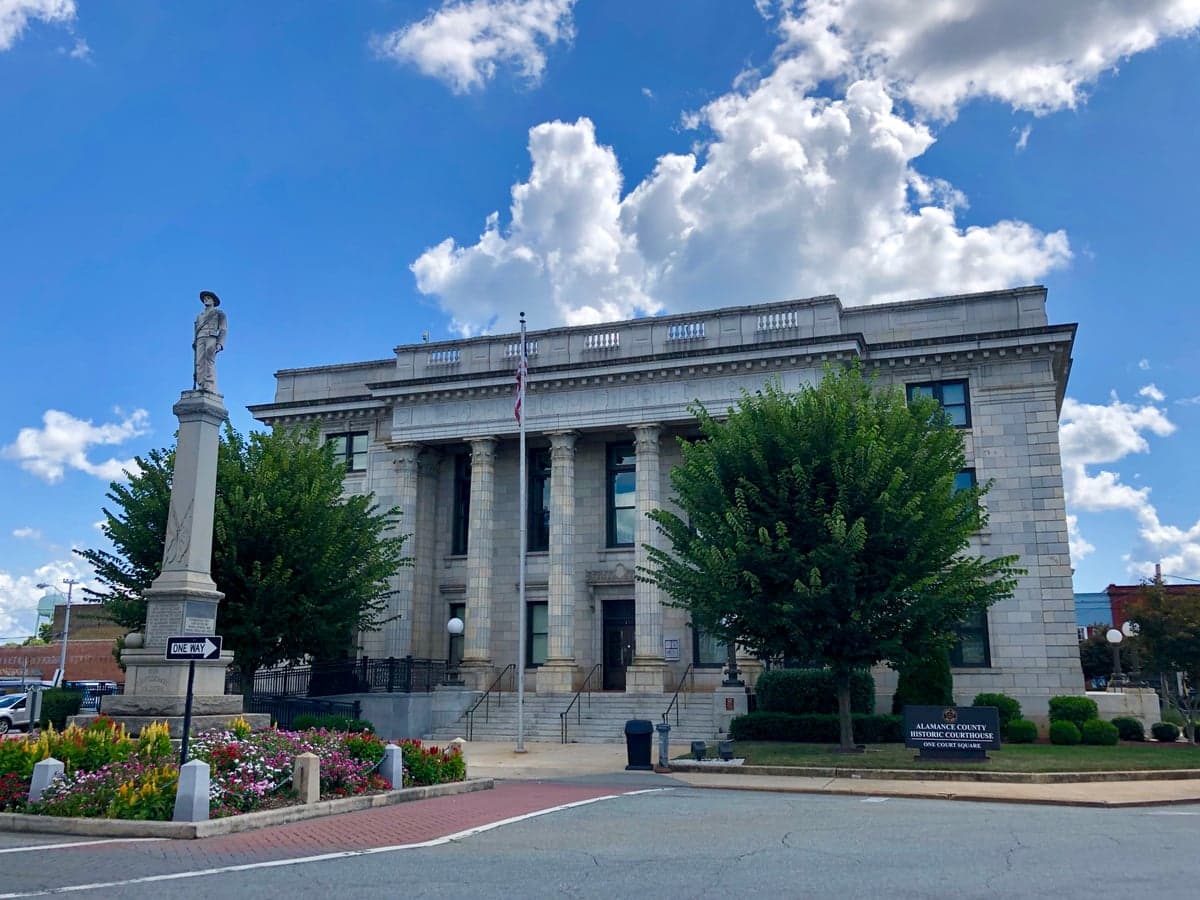
Photo: Wikipedia
Personal Sovereignty in Alamance County
Viable for self-reliance. Generally workable, though some barriers may limit total independence.
What does Personal Sovereignty tell us?
Personal Sovereignty measures your capacity for self-reliance and independence with minimal government friction. Higher scores mean fewer barriers between you and the way you want to live... but it assumes you have the space you need and good neighbors.
What does this tell us?
Personal Sovereignty measures your capacity for self-reliance and independence with minimal government friction. Higher scores mean fewer barriers between you and the way you want to live... but it assumes you have the space you need and good neighbors.
State Policy
Energy independence: Importer (15% of energy produced in-state)
Personal Liberty
Homesteading

Personal Liberty Analysis
Alamance County, North Carolina, offers a notably higher degree of personal sovereignty than many areas of the eastern seaboard, particularly for those who prioritize limited government interference in daily life. While not a libertarian enclave, the county’s political culture—rooted in a mix of rural conservatism and small-town independence—creates an environment where individual autonomy is broadly respected. The county seat, Graham, and the smaller communities of Snow Camp and Saxapahaw exhibit a more hands-off local governance style compared to the more regulated atmosphere of Burlington, the county’s largest city. For a single individual or parent seeking to minimize state overreach while maintaining access to regional infrastructure, Alamance County presents a viable middle ground, though it is not without its compromises, particularly regarding state-level mandates.
Tax burden and regulatory climate for residents and small businesses
North Carolina’s flat income tax rate of 4.75% (as of 2025) and a state sales tax of 4.75% (with local options bringing it to 6.75% in Alamance County) keep the overall tax burden moderate compared to high-tax states like New York or California. Alamance County itself imposes a property tax rate of approximately $0.64 per $100 of assessed value, which is competitive for the Piedmont Triad region. The regulatory posture is generally business-friendly, with no county-level occupational license tax for most trades and a streamlined permitting process for residential construction in unincorporated areas. However, the city of Burlington enforces stricter zoning and building codes, particularly for accessory structures and home-based businesses, while towns like Elon and Gibsonville have their own municipal ordinances that can be more restrictive. For those seeking maximum regulatory freedom, the rural townships of Newlin and Pleasant Grove offer the least restrictive, with minimal county oversight on land use beyond basic health and safety codes. The state’s right-to-work laws and lack of a state income tax on Social Security benefits also favors retirees and those planning for long-term financial independence.
Self-defense rights and gun law specifics in Alamance County
North Carolina is a shall-issue state for concealed carry permits, and Alamance County’s sheriff’s office processes applications efficiently, typically within 45-90 days. The county is home to several gun ranges and training facilities, including the Alamance County Wildlife Club and the Burlington Gun Club, reflecting a strong local firearms culture. Open carry is legal without a permit for anyone who can legally possess a firearm, and the county has no local ordinances restricting the carrying of firearms in public parks or on public property beyond state preemption. Stand-your-ground laws apply, and the state’s Castle Doctrine provides strong legal protection for use of force in defense of home, vehicle, or workplace. The cities of Mebane and Graham have generally pro-Second Amendment city councils, though Burlington has seen occasional debates over discharging firearms within city limits. For preppers and survivalists, the rural areas around Snow Camp and Altamahaw offer the ability to shoot on private property without neighbor complaints, provided the property is at least one acre and shots are not across roads. The state’s firearm purchase permit system for handguns (a relic of pre-2023 law) was effectively repealed, but the county still processes pistol purchase permits for those who prefer them for record-keeping purposes.
Self-reliance and homesteading viability: lot sizes, zoning, and off-grid feasibility
Alamance County’s unincorporated areas offer genuine homesteading potential, particularly in the northern and western townships. Minimum lot sizes in agricultural zoning districts are typically 1-3 acres, though many parcels in the Snow Camp and Eli Whitney areas are available in 5-20 acre tracts suitable for small-scale farming. The county does not require building permits for agricultural structures under 600 square feet, and there are no county-level restrictions on rainwater collection, composting toilets, or solar panel installation. Off-grid living is legally feasible in unincorporated areas, provided the property meets state septic and well requirements. The towns of Ossipee and Swepsonville have more relaxed enforcement of nuisance ordinances, allowing for backyard chickens, beekeeping, and even small livestock on parcels as small as one acre. However, Burlington’s extraterritorial jurisdiction (ETJ) extends zoning authority up to one mile beyond city limits, which can restrict homesteading activities on properties near the city. The county’s soil quality is generally good for gardening, with the Haw River and Cane Creek watersheds providing reliable water sources. For those seeking true self-reliance, the area around Saxapahaw—with its working farms, grist mill, and community—offers a network of like-minded individuals while maintaining privacy.
Personal liberties: parental rights, medical autonomy, speech, and property
North Carolina’s Parents’ Bill of Rights (enacted 2023) gives parents explicit authority over their children’s education, medical decisions, and Alamance County’s school board has been generally supportive of parental involvement, with no controversial curriculum mandates that have sparked protests in other districts. Medical autonomy is more constrained at the state level, with vaccine mandates for school attendance (though religious exemptions are available) and prescription requirements for most medications. The county has no local health ordinances that exceed state requirements, and the rural areas see less enforcement of state health mandates. Free speech protections are robust, with the county’s public comment periods at commission meetings allowing for unfiltered citizen input. Property rights are strongly protected under state law, with no county-level rent control or landlord licensing schemes. The towns of Green Level and Haw River have minimal zoning enforcement, allowing for creative property uses like home-based metal fabrication or automotive repair without the bureaucratic hurdles found in more regulated jurisdictions. However, the state’s ability to seize property through civil asset forfeiture remains a concern, though Alamance County’s sheriff’s office has a relatively low rate of forfeiture cases compared to urban counties.
Overall, Alamance County ranks favorably for personal sovereignty when compared to the heavily regulated environments of the Northeast or West Coast, and even against more restrictive North Carolina counties like Wake or Mecklenburg. The county’s combination of low taxes, strong gun rights, viable homesteading options, and respect for parental authority makes it a strategic relocation choice for those prioritizing individual freedom. The primary trade-offs are the state-level constraints on medical autonomy and the occasional municipal overreach in Burlington. For the survivalist or prepper, the rural townships of Snow Camp, Eli Whitney, and Newlin offer the highest degree of autonomy, while Graham and Mebane provide a balance of services and freedom. Alamance County is not a libertarian paradise, but it is a place where a determined individual can live largely on their own terms, with the state and county governments acting more as a backdrop than a daily presence in personal affairs.

* Values derived from national, state, county, city and local statistics and may differ in a specific area. Last updated: 2026-05-19T11:16:07.000Z
Narrative content on this page is AI-generated and may contain mistakes. Verify any details that matter before acting on them.
ReloMaps may earn a commission from affiliate links at no extra cost to you.

