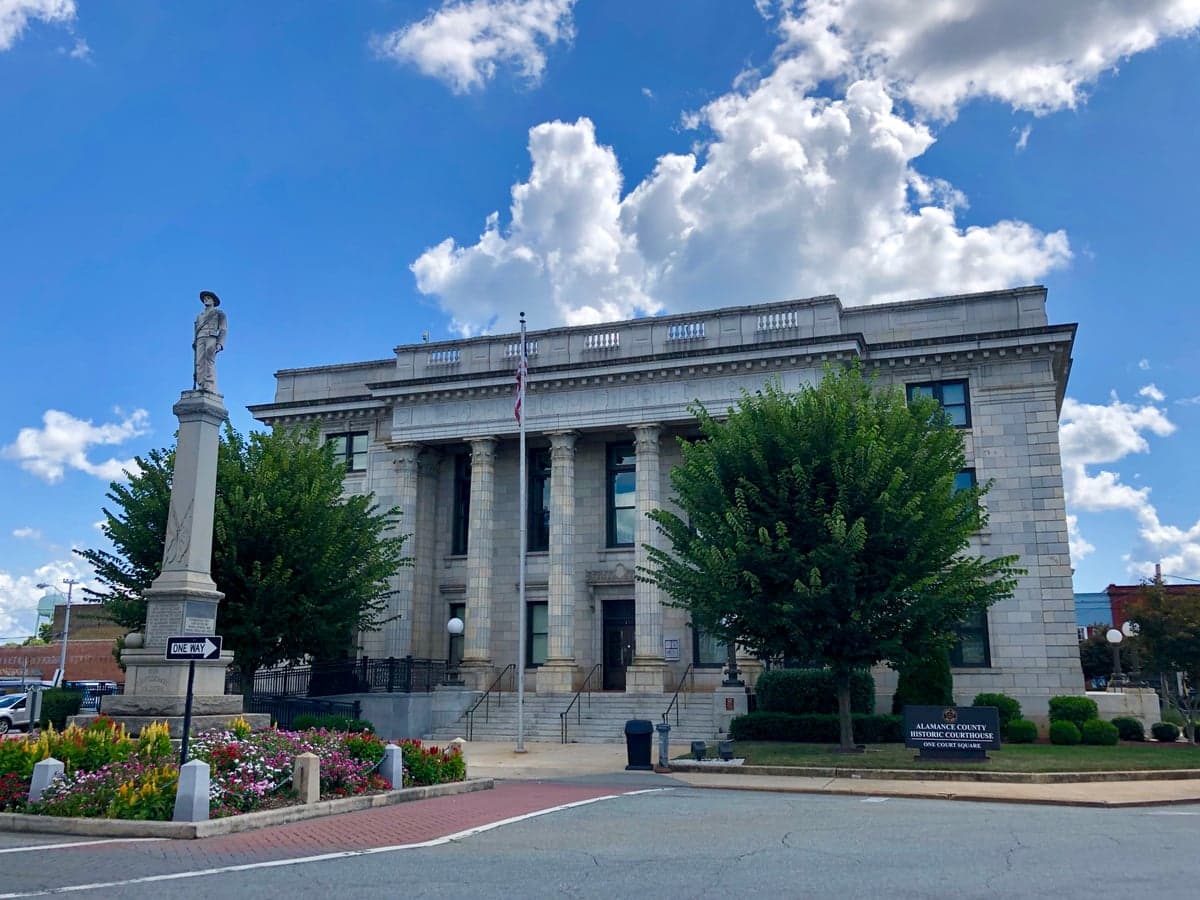
Photo: Wikipedia
Demographics of Alamance County
Affluence Level in Alamance County
A middle-class area roughly in line with national averages across income, home values, education, and employment.
People of Alamance County
Today, Alamance County, North Carolina, is home to 174,286 residents, a population shaped by a layered history of early American settlement, industrial migration, and modern diversification. The county’s character is rooted in its Piedmont geography—a mix of small cities, mill towns, and rural farmland—with a population that is 59.5% white, 19.6% Black, 14.8% Hispanic, and 1.1% East/Southeast Asian, alongside a small Indian subcontinent community at 0.5%. Its identity remains distinctly Southern and working-class, anchored by the manufacturing legacy of Burlington and Graham, while recent growth is slowly shifting its cultural and political landscape.
Settlement & growth (pre-1960)
Before European settlement, the area now known as Alamance County was part of the homeland of the Sissipahaw people, a Siouan-speaking tribe, and later a hunting ground for the Catawba and Cherokee nations. The first European incursion came via the Great Wagon Road in the mid-1700s, a migration route that brought Scots-Irish and German settlers from Pennsylvania down the Shenandoah Valley. These groups were drawn by cheap land grants and the promise of fertile soil in the Piedmont. The Scots-Irish, in particular, established farms and small communities around what is now Snow Camp and Graham, while German settlers concentrated near Alamance Creek, where the county’s name originates from a local Native word.
The county’s defining economic event was the founding of the textile industry in the 1830s, centered on the Haw River. By the late 19th century,
century, cotton mills sprang up in Burlington, Graham, and Mebane, pulling in the county’s northern and eastern sections. These mills attracted waves of rural white farmers from the surrounding countryside, as well as Black families moving out of sharecropping after the Civil War. The 1880s through the 1920s saw the construction of mill villages—and the construction of—mill villages around—mills like the Alamance Cotton Mill in Burlington and the Glencoe Mill in the Haw River area. These mill villages created tight-knit, often segregated communities, with white workers in the mills and Black workers in service roles or on farms.
The Great Migration (1910–1970) brought a significant number of Black families from the Deep South into Alamance County, seeking industrial jobs in Burlington’s expanding textile plants. By 1950, the Black population had grown to roughly 20% of the county-wide, concentrated in neighborhoods like West End in Burlington and Pleasant Grove near Graham. Meanwhile, the county’s white population remained predominantly of Scots-Irish and German descent, with a small number of Italian and Polish immigrants arriving in the early 1900s to work in the mills, though they never formed large enclaves. The post-World War II era saw suburbanization begin, with white families moving to new developments on the outskirts of Burlington and Elon, where Elon College (now Elon University) was expanding.
Modern era (post-1965)
The 1965 Hart-Cellar Act had a modest but noticeable effect on Alamance County, unlike the major coastal cities. The first significant post-1965 immigrant group was Hispanic, primarily from Mexico and Central America, arriving in the 1990s and 2000s to fill labor shortages in the declining textile mills and the growing poultry processing plants. Today, the Hispanic population stands at 14.8% of the county—is concentrated in Burlington’s eastern neighborhoods and in the town of Mebane, where a large poultry plant operates. A smaller but growing East/Southeast Asian community (1.1%) has formed around Elon University and the medical sector in Burlington, with Vietnamese and Filipino families arriving since the 2000s, often in professional roles. The Indian subcontinent community (0.5%) is tiny but visible in Burlington’s tech and healthcare sectors.
Domestic migration has been more transformative. Since the 1990s, Alamance County has experienced steady in-migration from the Rust Belt—especially Ohio, Michigan, and New York—as retirees and younger families seek lower costs and milder winters. This has accelerated since 2020, with coastal flight from California and the Northeast pushing up housing demand in Graham and Elon. Suburbanization has spread outward from Burlington, with new subdivisions filling developments in Snow Camp and Swepsonville, transforming former farmland into commuter suburbs for workers in Greensboro and Durham. The white population has declined from 70% in 2000 to 59.5% today, while the Hispanic share has doubled, and the Black share has remained stable. The county’s foreign-born population stands at 5.6%, below the national average but rising.
The future
Alamance County’s population is heading toward greater diversity, but the pace is slow compared to the state’s urban centers. The Hispanic community is the fastest-growing group, projected to reach 18–20% by 2035, driven by both immigration and higher birth rates. This growth is concentrated in Burlington and Mebane, where Hispanic-owned businesses and churches are forming visible enclaves. The East/Southeast Asian and Indian communities are likely to grow modestly, tied to Elon University’s expansion and the healthcare sector, but they will remain small. The white population, while still the majority, is aging and declining in share, with younger white families often moving to exurban areas like Snow Camp or Altamahaw.
The county is not homogenizing; instead, it is tribalizing along geographic and cultural lines. The rural western towns (Snow Camp, Ossipee) remain overwhelmingly white and conservative, while Burlington’s eastern side is becoming a Hispanic-majority corridor. Black communities in Graham and western Burlington are stable but not growing. In-migration from the Rust Belt and coastal states is bringing more politically moderate and secular residents, which is slowly shifting the county’s cultural identity away from its traditional Southern evangelical Southern norms. However, this change is being absorbed rather than overwhelming—newcomers often adapt to the county’s slower pace and local traditions, rather than transforming them. The next 10–20 years will likely see Alamance County become a patchwork of distinct enclaves: a Hispanic-majority urban core in Burlington, a white exurban fringe, and a stable Black belt in Graham, with Elon University acting as a liberalizing influence.
For someone moving in now, Alamance County offers a middle ground: it is diversifying but not chaotic, growing but not sprawling, and still deeply rooted in its mill-town past. The population is becoming more varied, but the county’s identity—working-class, Southern, and community-oriented—remains intact, making it a place where change is gradual and often negotiated rather than imposed.

* Values derived from national, state, county, city and local statistics and may differ in a specific area. Last updated: 2026-05-19T11:16:07.000Z
Narrative content on this page is AI-generated and may contain mistakes. Verify any details that matter before acting on them.
ReloMaps may earn a commission from affiliate links at no extra cost to you.

