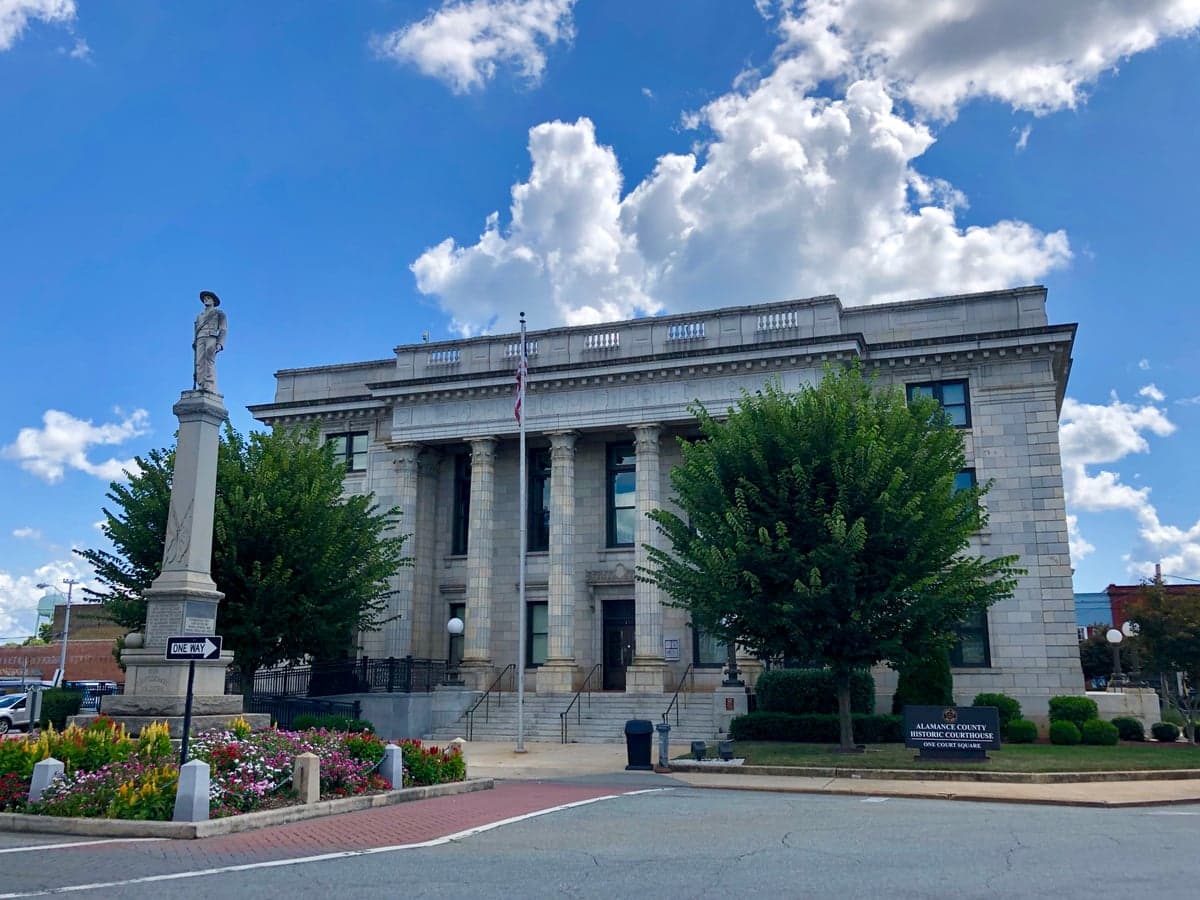
Photo: Wikipedia
Quality of Life in Alamance County
A livable area that tracks near national norms for affordability, walkability, and neighborhood health.
What does Quality of Life tell us?
Quality of Life measures an area by evaluating factors like cost of living, nearby amenities, country club access, airport proximity, socioeconomic signals and neighborhood character. For large states, this is a general average — quality of life can vary dramatically between metro areas, suburbs, and rural communities within the same state.
What does this tell us?
Quality of Life measures an area by evaluating factors like cost of living, nearby amenities, country club access, airport proximity, socioeconomic signals and neighborhood character. For large states, this is a general average — quality of life can vary dramatically between metro areas, suburbs, and rural communities within the same state.
Cost of Living
17% below national average
102%
The Real Cost of Living in Alamance County for 2026
| Tier | Individual | Family (4) |
|---|---|---|
| Survival | $16k | $30k |
| Comfortable | $43k | $63k |
| Luxury | $106k+ | $164k+ |
| Elite (Top 5%) | $125k+ | $194k+ |
Quality-of-Life Analysis
Alamance County offers a broad spectrum of living environments, from the urbanized core of Burlington and Graham to quiet crossroads communities like Snow Camp and Eli Whitney. The county attracts a mix of manufacturing workers commuting to the Triad, University of North Carolina at Greensboro and Elon University affiliates, and long-time residents of its historic mill villages. With a cost of living index of 83 (23% below the national average), the county provides notably affordable entry points into both suburban and rural lifestyles, though the character and pace of life shift dramatically between its eastern and western halves.
Largest town(s) & population centers
Burlington, the county seat and largest city (pop. ~60,000), functions as the primary commercial and industrial hub. Daily life here centers around the I-40/I-85 corridor, with major employers including LabCorp, Honda Aircraft Company, and Alamance Regional Medical Center. The city offers a mix of historic mill housing near downtown, newer subdivisions along the Church Street corridor, and apartment complexes near the Alamance Crossing shopping center. Graham (pop. ~15,000), the other incorporated city, has a more compact historic downtown with a courthouse square, independent restaurants, and a growing craft beer scene. Graham's residential areas are generally quieter and more established than Burlington's newer developments, with many homes dating from the early to mid-20th century. Elon (pop. ~12,000), dominated by Elon University, provides a college-town atmosphere with walkable streets, coffee shops, and a calendar of campus events that draws residents from across the county. Commute times average 25.6 minutes, slightly below the national average, with most traffic congestion concentrated along the I-40/I-85 corridor between exits 140 and 148.
Smaller towns & rural pockets
South of Burlington, Snow Camp is a historic Quaker settlement that remains deeply rural, with working farms, antique shops, and the Snow Camp Outdoor Theatre. The area has no commercial strip development and few rental properties, attracting those seeking acreage and privacy. Glen Raven, once a textile mill village, has evolved into a bedroom community with a mix of older brick mill houses and newer single-family homes on larger lots. Swepsonville, along the Haw River, offers a small-town feel with river access and a historic mill district, though it lacks its own grocery store or pharmacy. Altamahaw and Ossipee in the northern part of the county are unincorporated communities where residents rely on Burlington or Graham for most services. These areas feature older farmhouses, mobile homes on private land, and a slower pace of life that appeals to retirees and remote workers. The Haw River corridor itself, running through the county's center, provides a natural buffer between developed areas and contains several public access points and the Haw River Trail.
Cost & lifestyle range
The cost of living index of 83 masks significant internal variation. At the lower end, older neighborhoods in eastern Burlington and parts of Graham offer median home values well below the county's $221,200 median, with some three-bedroom homes available under $150,000. Median rent of $1,007 is achievable in older apartment complexes along Maple Avenue in Burlington or in duplexes in Swepsonville. At the higher end, the Lake Mackintosh area and Quaker Creek subdivisions in western Alamance County feature homes from $350,000 to $600,000, with larger lots and access to private lakes. The Elon area commands a premium due to university proximity, with smaller homes often listing above $300,000. Property taxes in Alamance County are moderate, and the absence of a city income tax keeps overall costs low compared to Wake or Mecklenburg counties. For renters, newer apartment complexes near I-40 in Burlington charge $1,200–$1,500 for one-bedroom units, while older units in Graham or rural areas can be found for $750–$900.
Alamance County best suits those who want proximity to the Triad's job market and amenities without paying Guilford County prices. Families seeking good schools shouldered homes in subdivisions with good schools will gravitate to western Burlington or Elon, while those wanting acreage, privacy, or a historic small town will find value in Snow Camp, Swepsonville, or the Haw River valley. The county's mix of manufacturing, healthcare, and education employment provides stability, though residents should expect to drive for major shopping, entertainment, or specialized medical care outside of Burlington's offerings.

Crime in Alamance County
Crime rates similar to the national median for U.S. locations.
Violent CrimeViolent Crime Analysis
Property CrimeProperty Crime Analysis
Crime Analysis
Alamance County, North Carolina, presents a mixed safety picture where crime rates generally align with or slightly exceed state averages, though significant variation exists between its urban and rural communities. The county recorded a violent crime rate of 309.4 per 100,000 residents and a property crime rate of 1,689.6 per 100,000 in the most recent reporting period. These figures place Alamance County in a moderate risk category, with property crime being a more pressing concern for most residents than violent offenses.
Crime in context
Alamance County’s violent crime rate of 309.4 per 100,000 is roughly on par with the North Carolina state average of approximately 340 per 100,000, but notably lower than the national average of about 380 per 100,000. Property crime in the county, at 1,689.6 per 100,000, sits slightly above the state average of roughly 1,600 per 100,000 and below the national figure of about 1,950 per 100,000. The county’s largest city, Burlington, drives a disproportionate share of these numbers, with its violent crime rate exceeding 400 per 100,000 and property crime rates well above the county average. In contrast, smaller towns like Graham and Mebane report lower crime rates, though Mebane’s proximity to the Interstate 85/40 corridor has led to a rise in property crimes, particularly vehicle break-ins and theft from retail establishments.
What residents experience
Residents of Alamance County most frequently encounter property crimes such as larceny, burglary, and motor vehicle theft. Burlington accounts for the majority of these incidents, with retail theft and residential burglaries concentrated in areas near the Alamance Crossing shopping center and older neighborhoods east of Church Street. Violent crime, while less common, is not evenly distributed: Burlington and the unincorporated community of Swepsonville report higher rates of aggravated assault and robbery, often linked to domestic disputes or drug-related activity. The county’s judicial district, part of the 15th Prosecutorial District, has seen a shift toward more progressive policies under recent district attorney leadership, which has raised concerns among residents about repeat offenders cycling through the system. Critics argue that a focus on diversion programs and reduced sentencing for non-violent property crimes has led to a perception that criminals face few consequences, potentially emboldening theft and burglary rings that operate across the county. This ideological approach, while well-intentioned, can result in more offenders remaining on the streets, directly impacting public safety and victim satisfaction.
Neighborhood-level variation
Safety in Alamance County varies sharply by location. Elon, home to Elon University, benefits from a strong campus police presence and consistently reports the lowest crime rates in the county, with violent crime near zero and property crime well below 1,000 per 100,000. Mebane’s newer subdivisions and Tanger Outlets area see occasional property crime but remain generally safe, though residents should secure vehicles and packages. Graham offers a quieter, lower-crime alternative to Burlington, with most incidents concentrated along Main Street and near the courthouse. In contrast, Burlington’s downtown and the neighborhoods surrounding the former Burlington Industries mill sites experience higher crime, particularly after dark. For those considering relocation, the safest bets are the western parts of the county near Elon and Mebane, while buyers should exercise caution in Burlington’s older urban core and areas near the interstate exits in Swepsonville.
* Values derived from national, state, county, city and local statistics and may differ in a specific area. Last updated: 2026-05-19T11:16:07.000Z
Narrative content on this page is AI-generated and may contain mistakes. Verify any details that matter before acting on them.
ReloMaps may earn a commission from affiliate links at no extra cost to you.

