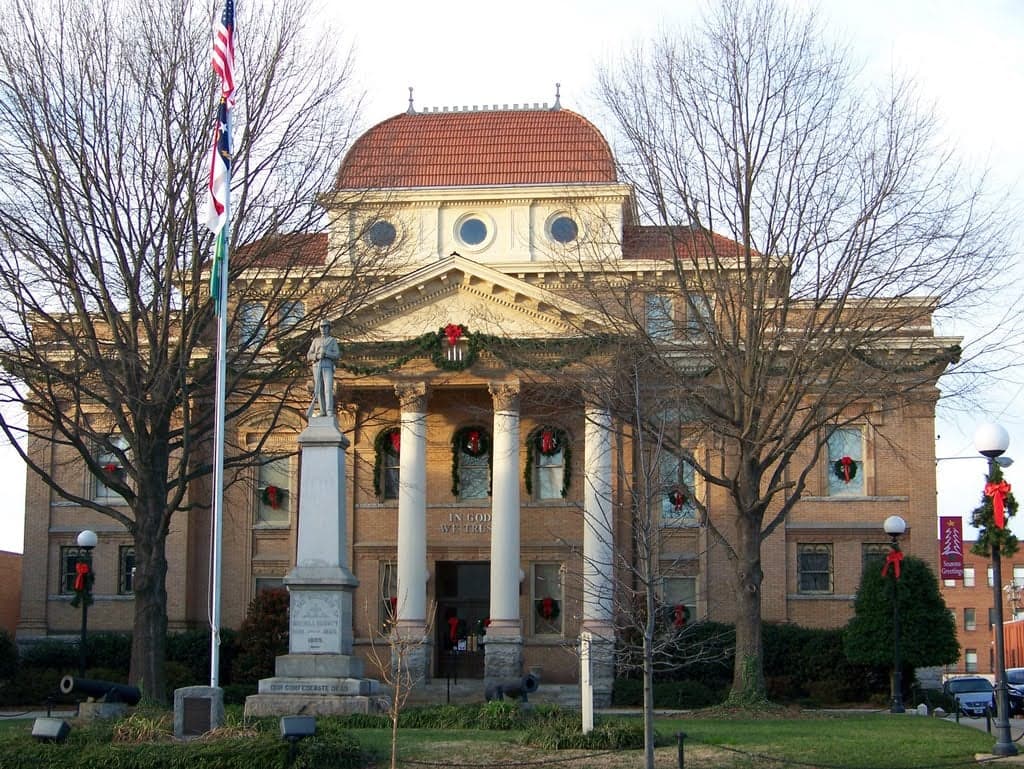
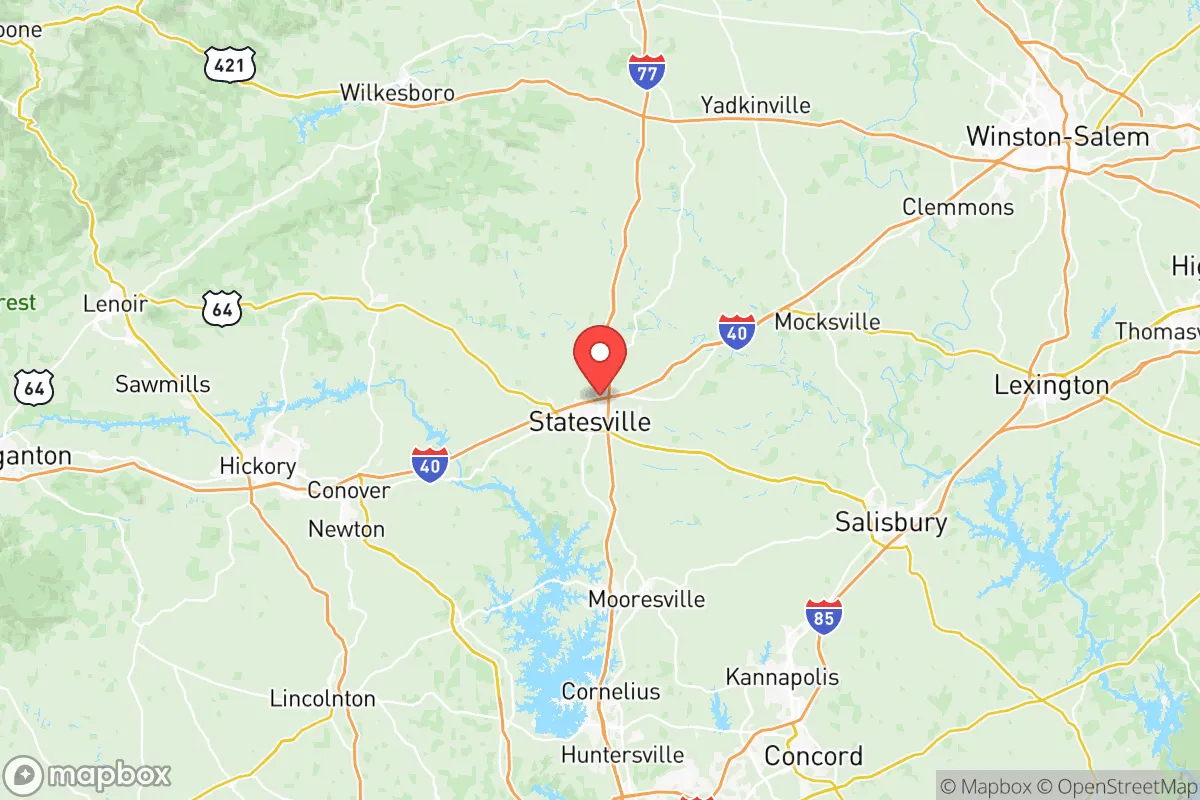
Photo: Wikipedia
Demographics of Iredell County
Affluence Level in Iredell County
A middle-class area roughly in line with national averages across income, home values, education, and employment.
People of Iredell County
Iredell County, North Carolina, is home to roughly 191,800 residents whose character reflects a layered history of Scotch-Irish frontier settlement, post–Civil War agricultural persistence, and recent Sun Belt migration. The county is 73.5% white, 11.3% Black, 8.9% Hispanic, 1.5% East/Southeast Asian, and 1.1% Indian-subcontinent, with a foreign-born population of just 4.0% — well below the national average. Residents describe the county as family-oriented, politically conservative, and rooted in evangelical Protestant traditions, with a growing professional class drawn to the Charlotte metro’s northern edge. Iredell’s identity today is a blend of small-town habits, NASCAR heritage, and suburban ambition.
Settlement & growth (pre-1960)
Before European contact, the land that became Iredell County was part of the hunting and trading territory of the Catawba people, whose villages clustered along the Catawba River to the west. The Cherokee also ranged into the northern hills. The Catawba were largely displaced or reduced by smallpox in the 1700s, opening the interior for European settlement.
The first permanent European settlers were Scots-Irish Presbyterians and German Lutherans who arrived from Pennsylvania and Virginia via the Great Wagon Road between the 1740s and 1770s. They pushed into the fertile valleys around Statesville, Harmony, and Turnersburg, drawn by cheap land grants and the promise of religious freedom outside the established Anglican parishes of the coastal plain. Iredell County was officially formed in 1788 from a portion of Rowan County, named after North Carolina’s Federalist governor James Iredell. By 1790, the population was roughly 5,000, overwhelmingly white and of British or German descent, with a small number of enslaved African Americans working on family farms and gristmills.
The early 19th century brought a second wave: English, Welsh, and additional German families who settled along the South Yadkin River near what is now Union Grove and Stony Point. These communities were almost entirely agricultural, growing wheat, corn, and tobacco. The arrival of the railroad in the 1850s transformed Statesville into a regional trading hub and, briefly, a Confederate supply depot during the Civil War.
After Reconstruction, the county’s Black population grew to roughly one-third of residents by 1900, concentrated around Mooresville and Love Valley, where sharecropping and tenant farming replaced the plantation system. The early 1900s saw a small but steady influx of Scots-Irish and English families from the Deep South seeking work in the region’s expanding textile mills and furniture factories in Troutman and Harmony. The Great Migration drew many Black families to Northern cities, reducing the county’s Black share from about 33% in 1910 to under 20% by 1950. The post–World War II period brought a modest trickle of Rust Belt retirees and military veterans who sought the quiet climate of Lake Norman’s early resort communities.
Modern era (post-1965)
The 1965 Hart-Cellar Act had a muted direct effect on Iredell County. Unlike Charlotte or Raleigh, the county did not experience large-scale chain migration from Asia or Latin America until the 1990s. The foreign-born share remains low at 4.0%, but the composition has shifted noticeably since 2000. The dominant modern migration pattern has been domestic: a steady flow of families and professionals from the Rust Belt — especially Ohio, Michigan, and New York — and from the coastal Northeast (New Jersey, Connecticut, Massachusetts) seeking lower taxes, lower crime, and better schools in the Charlotte suburbs.
Suburbanization reshaped the southern half of the county dramatically. Mooresville, once a lumber and cotton town, became a major bedroom community for Charlotte by the 1980s, its population swelling from fewer than 9,000 in 1980 to over 50,000 by 2020. This influx brought a contingent of NASCAR teams and racing families, earning Mooresville the nickname “Race City USA.” The lakefront areas around Lake Norman developed as enclaves for wealthier Charlotte commuters, with large custom homes and golf-course communities. Troutman and Statesville absorbed moderate suburban growth, though Statesville has retained a more independent, small-city feel.
Hispanic and East/Southeast Asian populations began growing in the 1990s and 2000s, primarily drawn by construction and service jobs tied to the suburban boom. Hispanic residents now make up 8.9% of the county, with the largest concentrations in Mooresville and Statesville, where new immigrant-serving businesses have opened on the main commercial corridors. The East/Southeast Asian community (1.5%) is smaller but visible in Mooresville’s medical and engineering sectors, particularly among Chinese and Vietnamese families who arrived for skilled positions at Lowe’s corporate campus and Lake Norman’s hospital system. The Indian-subcontinent community (1.1%) is similarly concentrated among tech and medical professionals in the southern part of the county, especially around Mooresville and Davidson. These groups tend to be relatively affluent and integrated into suburban life, with less distinct enclave formation than in larger metros.
The future
Iredell County is projected to reach roughly 225,000–240,000 residents by 2040, driven by continued domestic in-migration from the Northeast and Midwest. The county remains overwhelmingly white (73.5%) but is becoming modestly more diverse, with the Hispanic share likely to reach 12–14% and the East/Southeast Asian share 2–3% by 2040. The Indian-subcontinent population is expected to grow slowly as Charlotte’s tech sector expands northward. The foreign-born percentage, though still low, should rise toward 6–7% as second-generation families and new arrivals settle along the I-77 corridor.
Politically and culturally, the county is likely to remain solidly conservative, but with a subtle suburban moderation around Mooresville and Lake Norman, where white-collar professionals from out of state tend to be slightly less conservative than the native small-town population. The challenge for the county will be managing growth pressures — school crowding, water supply on Lake Norman, and the loss of agricultural land — without losing the low-tax, family-friendly character that attracts new residents. Enclave formation is minimal: newer immigrant communities are dispersing rather than clustering, and second-generation Hispanic and Asian children are integrating into the county’s public schools and churches.
Iredell County is becoming more diverse and more connected to Charlotte while retaining its conservative cultural foundations. A newcomer moving in now will find a rapidly growing but still

* Values derived from national, state, county, city and local statistics and may differ in a specific area. Last updated: 2026-05-18T18:50:57.000Z
Narrative content on this page is AI-generated and may contain mistakes. Verify any details that matter before acting on them.
ReloMaps may earn a commission from affiliate links at no extra cost to you.

