Photo: Wikipedia
Demographics of Lee County
Affluence Level in Lee County
A middle-class area roughly in line with national averages across income, home values, education, and employment.
People of Lee County
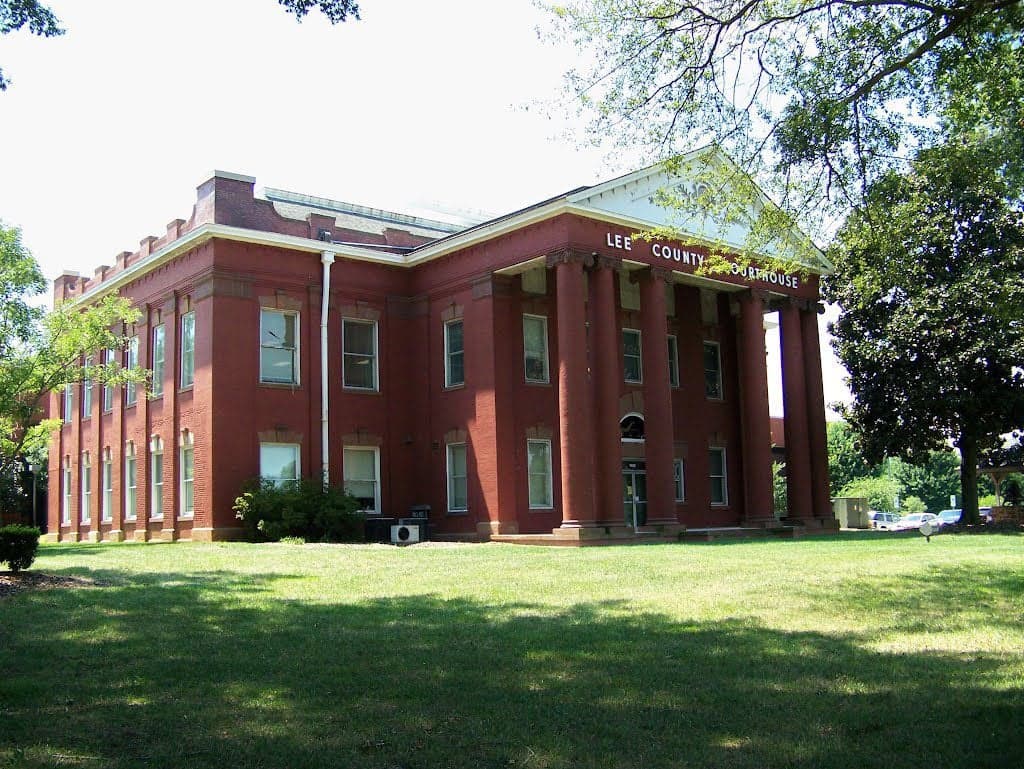
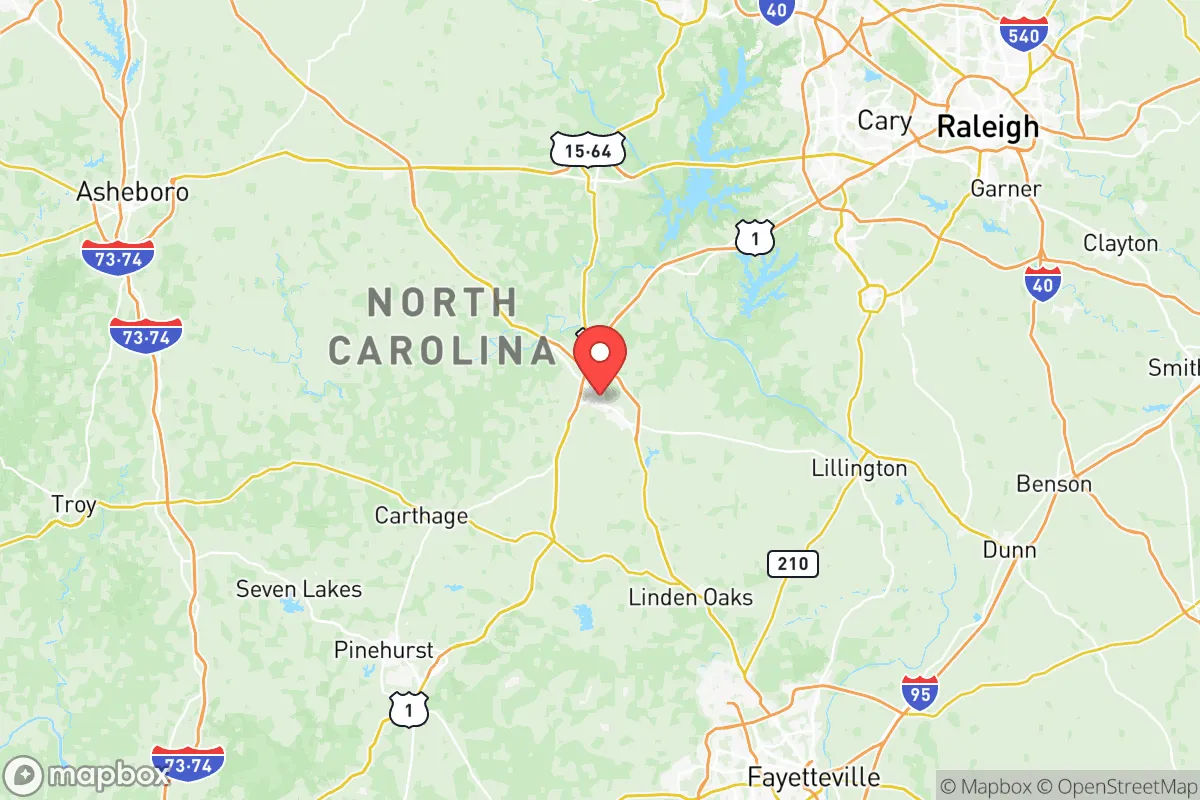
Lee County, North Carolina, is a community of roughly 64,565 residents defined by its small-town manufacturing roots and a rapidly diversifying population. The county seat, Sanford, anchors a region where a white majority (56.4%) coexists with a substantial Hispanic (21.0%) and Black (17.5%) population, creating a cultural landscape that blends Southern tradition with new immigrant energy. With a foreign-born share of 7.4% and a college attainment rate of 21.6%, the county is more working-class and less educated than the state average, giving it a distinct, grounded character that appeals to families seeking affordable housing and steady employment in the Piedmont.
Settlement & growth (pre-1960)
Long before European settlers arrived, the area now known as Lee County was part of the homeland of the Sissipahaw people, a Siouan-speaking tribe who lived along the Deep River. By the mid-1700s, the Sissipahaw had been largely displaced by disease and conflict, and the land became a frontier for Scots-Irish and English settlers moving south from Virginia and Pennsylvania. These early families, drawn by the promise of fertile soil and abundant timber, established small farms and crossroads communities like Jonesboro and Haw Branch, which later became part of Sanford.
The county itself was not formed until 1907, carved from Chatham and Moore counties specifically to create a new economic hub around the emerging railroad and brick-making industries. The arrival of the Raleigh and Augusta Air Line Railroad in the 1880s transformed the sleepy hamlet of Sanford into a boomtown. The region's rich clay deposits sparked a brick-manufacturing industry that would become the county's economic backbone. By the 1920s, Sanford was known as the "Brick Capital of the World," and the industry drew a wave of white laborers from the surrounding countryside and Black workers from the Deep South, who settled in neighborhoods like West Sanford and East Sanford. The brick plants, along with textile mills in Brickhaven and Moncure, created a stable, blue-collar economy that persisted through the Great Depression and World War II.
The post-war period saw modest growth as returning veterans took jobs in the brick and textile sectors. The county's population remained overwhelmingly white and Black, with little foreign-born presence. The construction of U.S. Highway 421 and the expansion of the Sanford Municipal Airport in the 1950s began to connect Lee County more tightly to the Research Triangle region to the north, setting the stage for later suburbanization.
Modern era (post-1965)
The 1965 Hart-Cellar Act had a delayed but significant impact on Lee County. Unlike the Research Triangle cities of Raleigh, Durham, and Chapel Hill, which saw a surge of Asian and Indian professionals in the 1970s and 1980s, Lee County's manufacturing economy attracted a different wave of immigrants. Beginning in the 1990s, a steady stream of Mexican and Central American migrants arrived to fill labor shortages in the brick plants, poultry processing facilities, and construction trades. This Hispanic population concentrated in Sanford's Downtown and West Sanford neighborhoods, as well as in the unincorporated community of Carbonton, where affordable housing and proximity to industrial jobs created natural enclaves. By 2020, the Hispanic share of the county's population had reached 21.0%, making it the largest minority group.
Domestic migration also reshaped the county. The 2000s and 2010s saw a slow but steady outflow of white residents from the county's rural areas to newer subdivisions in Sanford's southern and western fringes, while Black residents, many of whom had lived in the county for generations, remained concentrated in East Sanford and the historic Haw Branch area. The Asian population remains very small at 0.9%, consisting primarily of a few Vietnamese and Filipino families who moved to the area for work at Caterpillar's Sanford plant or at Central Carolina Hospital. The Indian-subcontinent population is negligible at 0.2%, reflecting the county's lack of the high-tech jobs that draw Indian professionals to the Triangle.
Suburbanization accelerated after 2010, as rising housing costs in Wake and Orange counties pushed families southward. New subdivisions like Greenwood and Woodland Hills sprouted along the U.S. 1 corridor, attracting a mix of white and Black middle-class families. However, the county's college attainment rate of 21.6% remains well below the state average of 33%, indicating that many new residents are working-class families seeking lower costs rather than highly educated professionals.
The future
Lee County is becoming more diverse, but the pace of change is slower than in the nearby Research Triangle. The Hispanic population is projected to grow to roughly 25-28% by 2040, driven by both continued immigration and higher birth rates. This growth is likely to remain concentrated in Sanford's western neighborhoods and in the Brickhaven area, where existing social networks and affordable housing provide a foothold. The white population share will continue to decline, but not as sharply as in urban counties, as the county remains a destination for white families priced out of Raleigh and Cary.
The Black population share is expected to remain stable at around 17-18%, as outmigration to larger cities is balanced by new arrivals from the Sandhills and eastern North Carolina. The East and Southeast Asian population may grow slightly as the county attracts more manufacturing and logistics jobs, but it will likely remain below 2%. The county's cultural identity is evolving from a historically biracial Southern community to a tri-ethnic one, with Spanish increasingly visible in local businesses, churches, and schools. The next 10-20 years will likely see continued suburban sprawl along the U.S. 1 and N.C. 87 corridors, with new subdivisions and shopping centers drawing a more diverse, but still predominantly working-class, population.
For someone moving in now, Lee County offers a slower-paced, more affordable alternative to the Triangle, with a growing Hispanic influence that is reshaping local cuisine, festivals, and community life. The county remains a place where brick and manufacturing roots run deep, but the future is being built by a broader mix of people seeking stability and opportunity in the Piedmont.

* Values derived from national, state, county, city and local statistics and may differ in a specific area. Last updated: 2026-08-19T22:12:20.000Z
Narrative content on this page is AI-generated and may contain mistakes. Verify any details that matter before acting on them.
ReloMaps may earn a commission from affiliate links at no extra cost to you.

