Photo: Wikipedia
Demographics of Northglenn, CO
Affluence Level in Northglenn, CO
A middle-class area roughly in line with national averages across income, home values, education, and employment.
People of Northglenn, CO
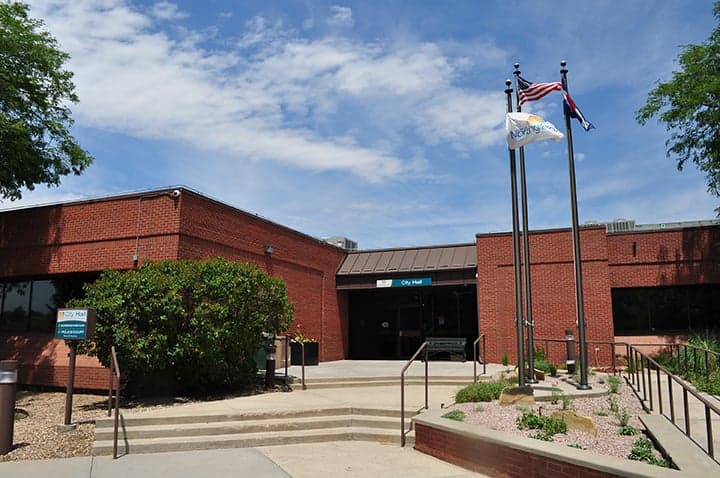
Today, Northglenn, Colorado is a mature, middle-ring suburb of Denver with a population of 37,953 that is nearly evenly split between White (50.5%) and Hispanic (37.0%) residents, creating a distinctly bicultural character uncommon among Front Range suburbs of its vintage. The city is denser than many of its peers, with a tight grid of post-war ranch homes and townhouses that give it a working-to-middle-class feel rather than the sprawling acreage of newer exurbs. Its identity is rooted in the post-World War II building boom, and its people reflect the layered waves of Anglo homesteaders, defense-industry migrants, and later Hispanic families who reshaped the city block by block.
How the city was settled and grew
Northglenn did not exist as a settlement before 1959. The land was part of the larger Adams County farming plain, originally homesteaded by Anglo-American families of German and Scandinavian descent in the late 19th century. These early farm families—names like Malley, Irondale, and the original homesteaders along what is now Washington Street—worked dryland wheat and sugar-beet fields. The first real population wave came not from pioneers but from the post-World War II housing shortage. In 1959, the Perl-Mack Company began constructing Northglenn as a planned suburban community, marketing it directly to young white families leaving Denver proper. The original neighborhoods—Malley Estates and Hunters Glen—were built as affordable starter-home tracts, and by 1965 the city had swelled to roughly 15,000 residents, almost entirely non-Hispanic white. These early subdivisions were filled by veterans using GI Bill mortgages, workers at the nearby Rocky Mountain Arsenal, and employees of the growing federal government presence in Denver. The city incorporated in 1969, and its character was set: a blue-collar, white, family-oriented suburb with a strong sense of civic boosterism.
Modern era (post-1965)
The 1965 Hart-Cellar Act began to shift immigration patterns nationally, but Northglenn’s demographic transformation did not accelerate until the 1980s and 1990s. As Denver’s Hispanic population grew and housing prices rose in the city core, working-class Hispanic families began moving north along the Interstate 25 corridor. Northglenn’s aging post-war housing stock—particularly in the East Hill and Northglenn Estates neighborhoods—became affordable entry points for first-time homebuyers and renters. By 2000, the Hispanic share of the population had climbed past 20%, and by 2020 it reached 37.0%. The White share dropped from over 90% in 1970 to 50.5% today. This shift was not a rapid replacement but a gradual, block-by-block transition as older Anglo residents aged in place or moved to newer exurbs like Firestone and Frederick. The East/Southeast Asian population (3.5%) is small but concentrated in the Fox Run area near 120th Avenue, drawn by proximity to Asian grocery and service corridors in neighboring Westminster. The Black population (3.0%) is dispersed but slightly more present in the rental complexes near the Northglenn Marketplace corridor. The Indian-subcontinent population (0.1%) is negligible. The foreign-born share (6.4%) is modest compared to Denver or Aurora, indicating that most Hispanic growth is from U.S.-born families rather than recent immigrants.
The future
Northglenn’s population is likely to continue its gradual diversification, but the pace may slow. The city is nearly built out—there is little vacant land for new subdivisions—so future demographic change will come through redevelopment and turnover of existing housing. The Hispanic share is expected to rise toward 45-50% over the next two decades as older Anglo homeowners sell to younger Hispanic families, a pattern seen in similar Denver suburbs like Thornton and Commerce City. The East/Southeast Asian and Black shares are likely to remain stable or grow only slightly, as these groups tend to concentrate in newer suburbs farther south and east. The city is not tribalizing into distinct ethnic enclaves; rather, neighborhoods like Malley Estates and Hunters Glen are becoming more mixed block by block. The college-educated share (24.2%) is low by metro Denver standards, and without a major new employer or transit-oriented development, Northglenn will likely retain its blue-collar, family-oriented character. The next 10-20 years will see a city that is more Hispanic, slightly older in housing stock, and still affordable relative to the rest of the Front Range.
For someone moving in now, Northglenn offers a stable, middle-income suburb where the bicultural character is a lived reality, not a marketing slogan. It is not a place of rapid gentrification or ethnic tension, but of gradual, organic demographic change. The city’s identity is being rewritten block by block, and the new Northglenn is a place where a 1960s ranch house on a quiet street might be owned by a third-generation Hispanic family whose grandparents worked the same beet fields the original homesteaders plowed.

* Values derived from national, state, county, city and local statistics and may differ in a specific area. Last updated: 2026-04-19T08:31:41.000Z
Narrative content on this page is AI-generated and may contain mistakes. Verify any details that matter before acting on them.
ReloMaps may earn a commission from affiliate links at no extra cost to you.

