Photo: Wikipedia
Demographics of Oak Park, IL
Affluence Level in Oak Park, IL
An upper-middle-class area. Household wealth, education levels, and homeownership run ahead of national benchmarks.
People of Oak Park, IL
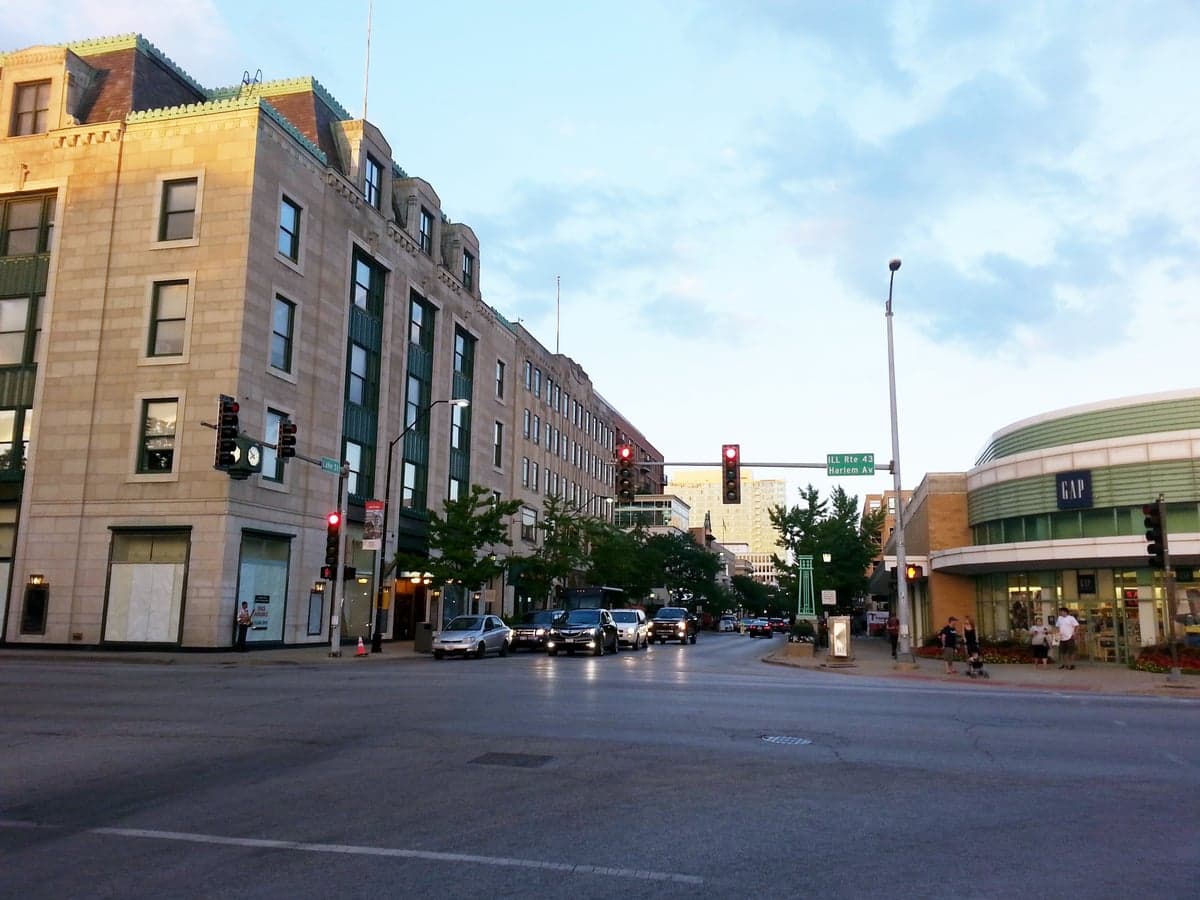
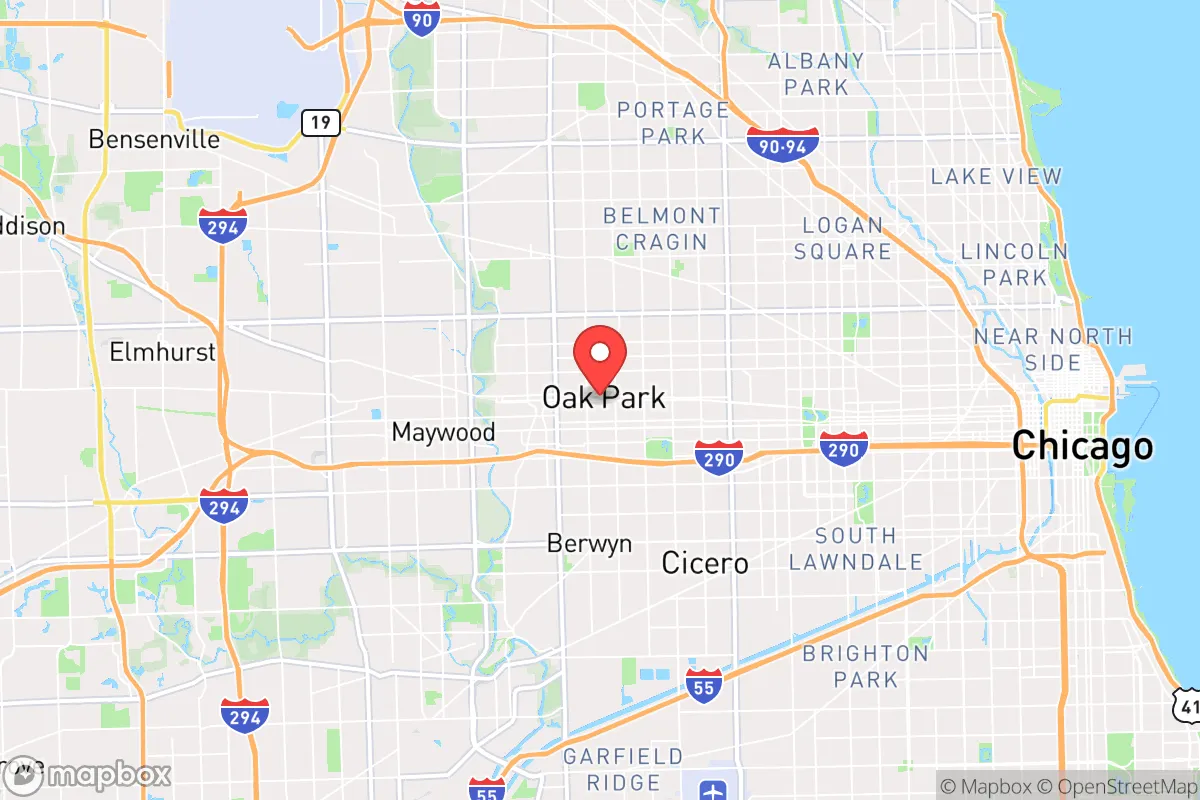
Oak Park, Illinois, is a densely built, historically progressive inner-ring suburb of 53,315 residents, known for its Frank Lloyd Wright architecture, strong public schools, and a population that is notably more diverse and highly educated than the surrounding region. With 72.5% of adults holding a bachelor’s degree or higher, the city attracts professionals and families who value walkable urbanism and racial integration, though its foreign-born share sits at just 3.0% — well below the national average. The city’s identity is shaped by a long-standing commitment to open housing and a demographic mix that is 61.1% white, 19.3% Black, 8.5% Hispanic, 3.7% East/Southeast Asian, and 1.6% Indian.
How the city was settled and grew
Oak Park’s original population was drawn by the Galena & Chicago Union Railroad in the 1850s, which turned a farming hamlet into a commuter suburb for Chicago’s growing merchant and professional classes. The first wave of settlers were largely Yankee and German Protestants who built substantial homes in what is now the Frank Lloyd Wright Historic District, a neighborhood of Prairie-style houses that remains the city’s architectural and social anchor. By the 1880s, Irish and Swedish immigrants arrived to work on the railroad and in local brickyards, settling in the South Oak Park area near the rail lines, where modest worker cottages still stand. The city incorporated in 1902 and grew rapidly through the 1920s, with the Ridgeland and Mills Park neighborhoods filling with second-generation European immigrants — Italians, Poles, and Czechs — who found jobs in Chicago’s factories and took the elevated train (the “L”) to work. Oak Park’s population peaked at roughly 66,000 in 1950, making it one of the most densely populated suburbs in the country.
Modern era (post-1965)
The post-1965 period brought the city’s most consequential demographic shift: the deliberate integration of Black families into a previously all-white suburb. Oak Park’s village government, led by a coalition of liberal activists and clergy, enacted aggressive fair-housing policies in the 1970s — including a municipal housing authority that bought and managed rental properties to prevent block-by-block resegregation. Black families moved primarily into the East Oak Park and South Oak Park neighborhoods, where older, more affordable housing stock offered entry points. By 1980, the Black share of the population had risen to roughly 12%; today it stands at 19.3%, with Black residents concentrated in the eastern third of the village. The Hispanic population, now 8.5%, began growing in the 1990s, driven by Mexican and Puerto Rican families settling in the South Oak Park corridor near the Eisenhower Expressway. East/Southeast Asian residents (3.7%) and Indian residents (1.6%) are more recent arrivals, drawn by Oak Park’s reputation for excellent schools and proximity to Chicago’s professional job market; they tend to cluster in the North Oak Park and Mills Park neighborhoods, where larger single-family homes are common. The city’s foreign-born share, however, remains low at 3.0% — a reflection of Oak Park’s high housing costs and its historical role as a destination for domestic, not international, migration.
The future
Oak Park’s population is stable but aging, with the median age rising to 37.8 as young families are priced out by rising home values — the median home price now exceeds $450,000. The white share has declined from 70% in 2000 to 61.1% today, while the Hispanic and Asian shares continue to grow slowly. The Black population has plateaued near 19%, suggesting that the city’s integration policies have reached a stable equilibrium rather than a tipping point. The Indian and East/Southeast Asian communities are the fastest-growing segments, though from a small base, and are likely to increase as Oak Park’s schools draw professional-class families from Chicago and the suburbs. The city is not homogenizing; rather, it is becoming more finely layered, with distinct enclaves — East Oak Park remains predominantly Black, South Oak Park is the most Hispanic and working-class, and North Oak Park and the Frank Lloyd Wright Historic District are overwhelmingly white and affluent. Over the next 10–20 years, Oak Park will likely see continued slow diversification, with the white share dropping toward 55% and the Hispanic and Asian shares rising, while the Black share holds steady.
For someone moving in now, Oak Park offers a rare combination of urban density, racial integration, and top-tier schools — but at a price that increasingly limits who can afford to join that experiment. The city is becoming more, not less, stratified by income, even as its racial diversity broadens. A new resident should expect a community that values its progressive history but is grappling with the economic pressures that come with being a desirable, expensive suburb.

* Values derived from national, state, county, city and local statistics and may differ in a specific area. Last updated: 2026-04-29T19:33:16.000Z
Narrative content on this page is AI-generated and may contain mistakes. Verify any details that matter before acting on them.
ReloMaps may earn a commission from affiliate links at no extra cost to you.

